Lithuania Wine Glass Market Size (2020-2030)
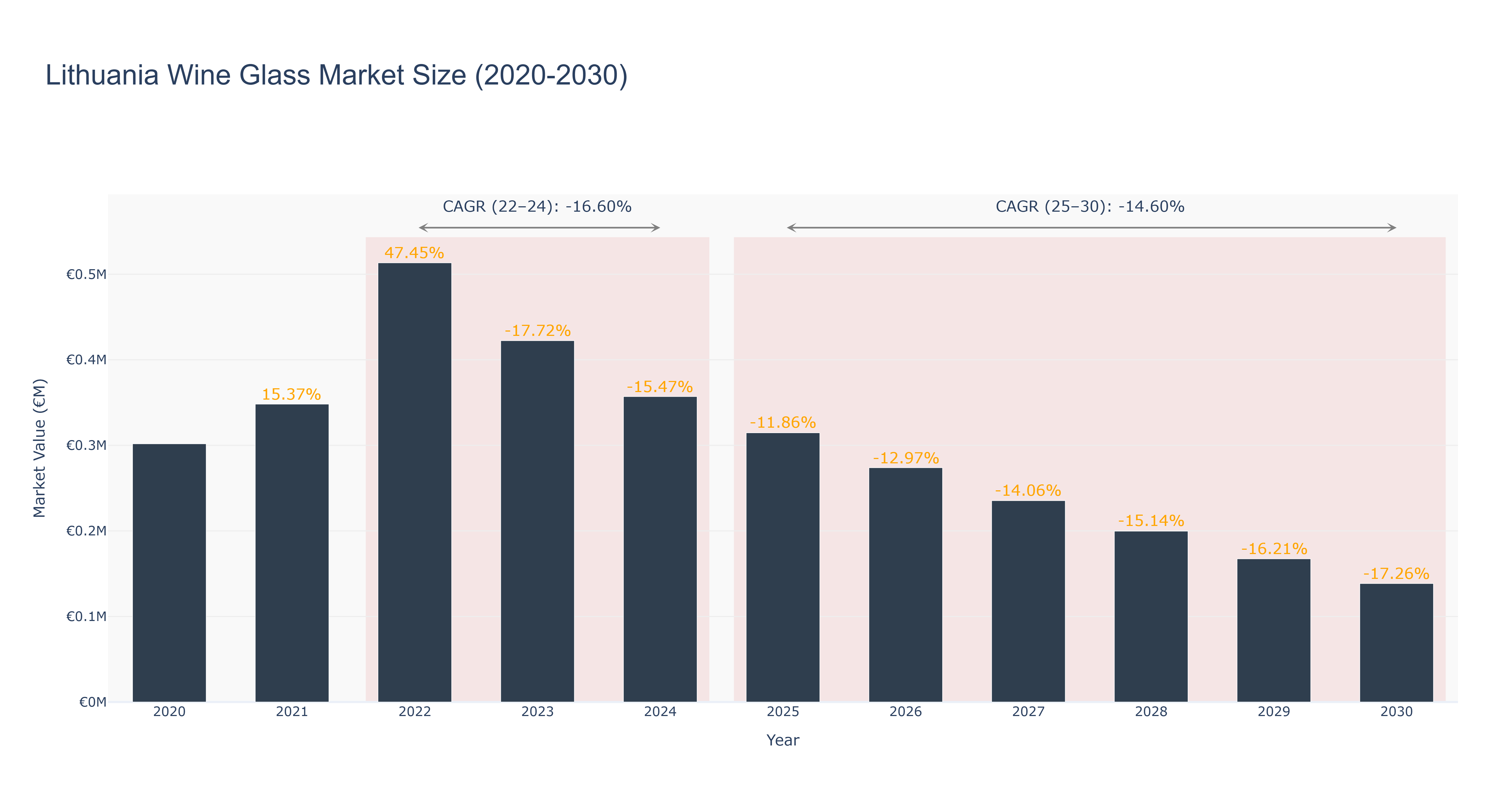
The Lithuania Wine Glass Market experienced significant fluctuations between 2020 and 2024, peaking at €513.35 thousand in 2022, which represented a remarkable growth of 47.45% from the previous year. However, this growth trend was short-lived, as the market contracted sharply in 2023 and 2024, with sizes of €422.38 thousand and €357.04 thousand, respectively, leading to a CAGR of -16.60% for the actual period. Looking ahead to the forecasted period from 2025 to 2030, the market is expected to continue its decline, with projected sizes decreasing to €138.48 thousand by 2030, reflecting a CAGR of -14.60%. This downturn may be attributed to changing consumer preferences, economic uncertainty, and increased competition from alternative drinkware. While there are no specific upcoming projects identified in the market, macroeconomic factors and shifts in consumer behavior will remain critical drivers in shaping the future of the Lithuania Wine Glass Market.
Lithuania Wine Glass Market: Production & Trade Performance (2019-2025)
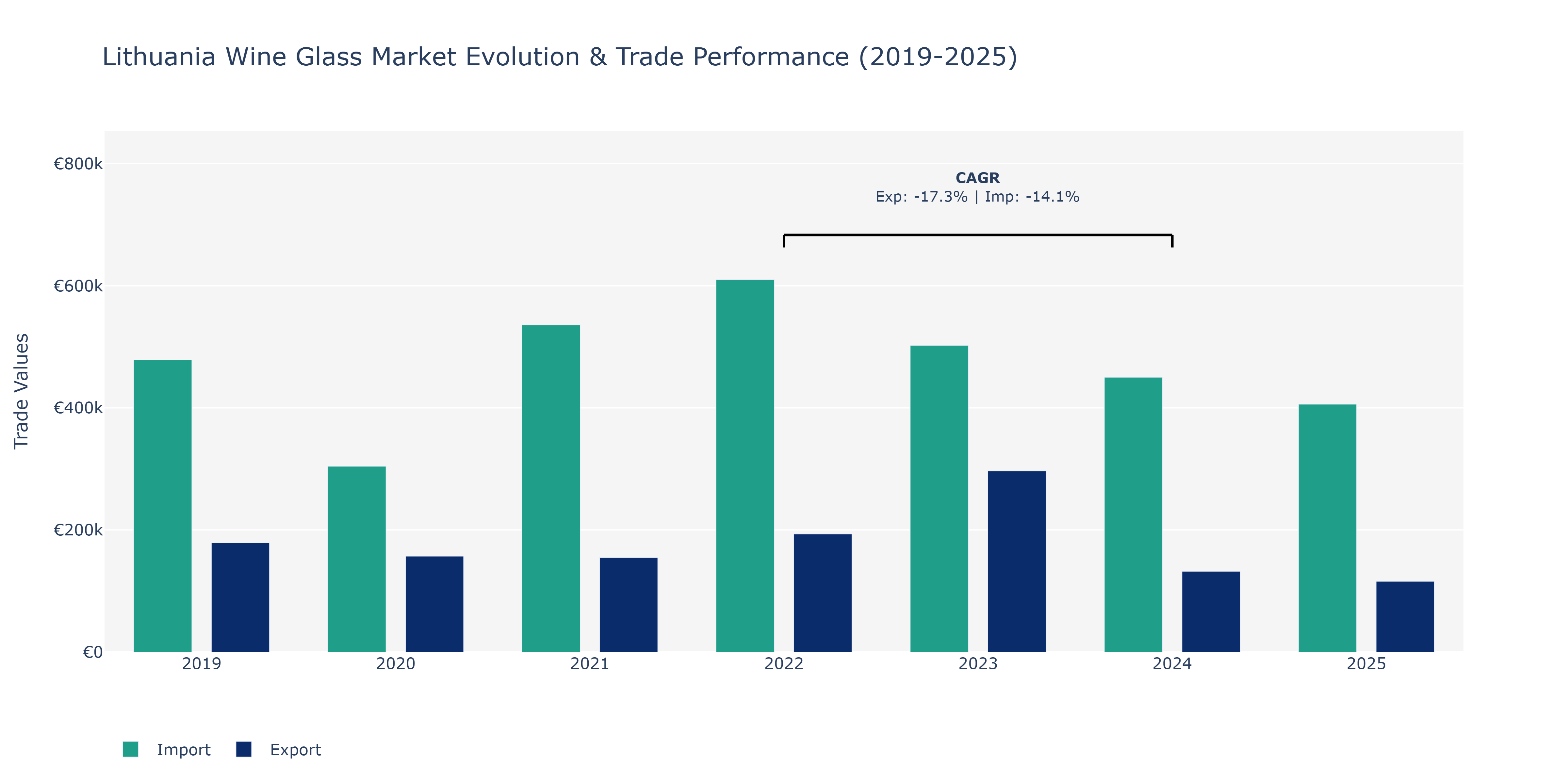
Between 2019 and 2025, Lithuania's Wine Glass Market witnessed varying trends in both Exports and Imports. The Exports of wine glasses from Lithuania displayed fluctuations, starting at €178.78 thousand in 2019, decreasing to €115.84 thousand in 2025. In contrast, Imports followed a different trajectory, starting at €478.47 thousand in 2019, reaching a peak at €610.05 thousand in 2022, then dropping to €406.03 thousand in 2025. The market experienced a significant increase in Exports from 2019 to 2022, followed by a sharp decline. A potential reason for this could be shifts in global demand for wine glass products or changes in trade agreements affecting export volumes. On the other hand, the fluctuations in Imports could be influenced by changes in consumer preferences or domestic production capacity developments impacting the need for imports. These trends highlight the market's sensitivity to international dynamics and underline the importance of agility in response to changing demands.
Key Highlights of the Report:
- Lithuania Wine Glass Market Outlook
- Market Size of Lithuania Wine Glass Market, 2025
- Forecast of Lithuania Wine Glass Market, 2032
- Historical Data and Forecast of Lithuania Wine Glass Revenues & Volume for the Period 2022 - 2032
- Lithuania Wine Glass Market Trend Evolution
- Lithuania Wine Glass Market Drivers and Challenges
- Lithuania Wine Glass Price Trends
- Lithuania Wine Glass Porter's Five Forces
- Lithuania Wine Glass Industry Life Cycle
- Historical Data and Forecast of Lithuania Wine Glass Market Revenues & Volume By Type for the Period 2022 - 2032
- Historical Data and Forecast of Lithuania Wine Glass Market Revenues & Volume By Glass for the Period 2022 - 2032
- Historical Data and Forecast of Lithuania Wine Glass Market Revenues & Volume By Crystal for the Period 2022 - 2032
- Historical Data and Forecast of Lithuania Wine Glass Market Revenues & Volume By Others for the Period 2022 - 2032
- Historical Data and Forecast of Lithuania Wine Glass Market Revenues & Volume By Application for the Period 2022 - 2032
- Historical Data and Forecast of Lithuania Wine Glass Market Revenues & Volume By Personal Consumption for the Period 2022 - 2032
- Historical Data and Forecast of Lithuania Wine Glass Market Revenues & Volume By Commercial Consumption for the Period 2022 - 2032
- Lithuania Wine Glass Import Export Trade Statistics
- Market Opportunity Assessment By Type
- Market Opportunity Assessment By Application
- Lithuania Wine Glass Top Companies Market Share
- Lithuania Wine Glass Competitive Benchmarking By Technical and Operational Parameters
- Lithuania Wine Glass Company Profiles
- Lithuania Wine Glass Key Strategic Recommendations






































