Slovakia Wine Glass Market Size (2020-2030)
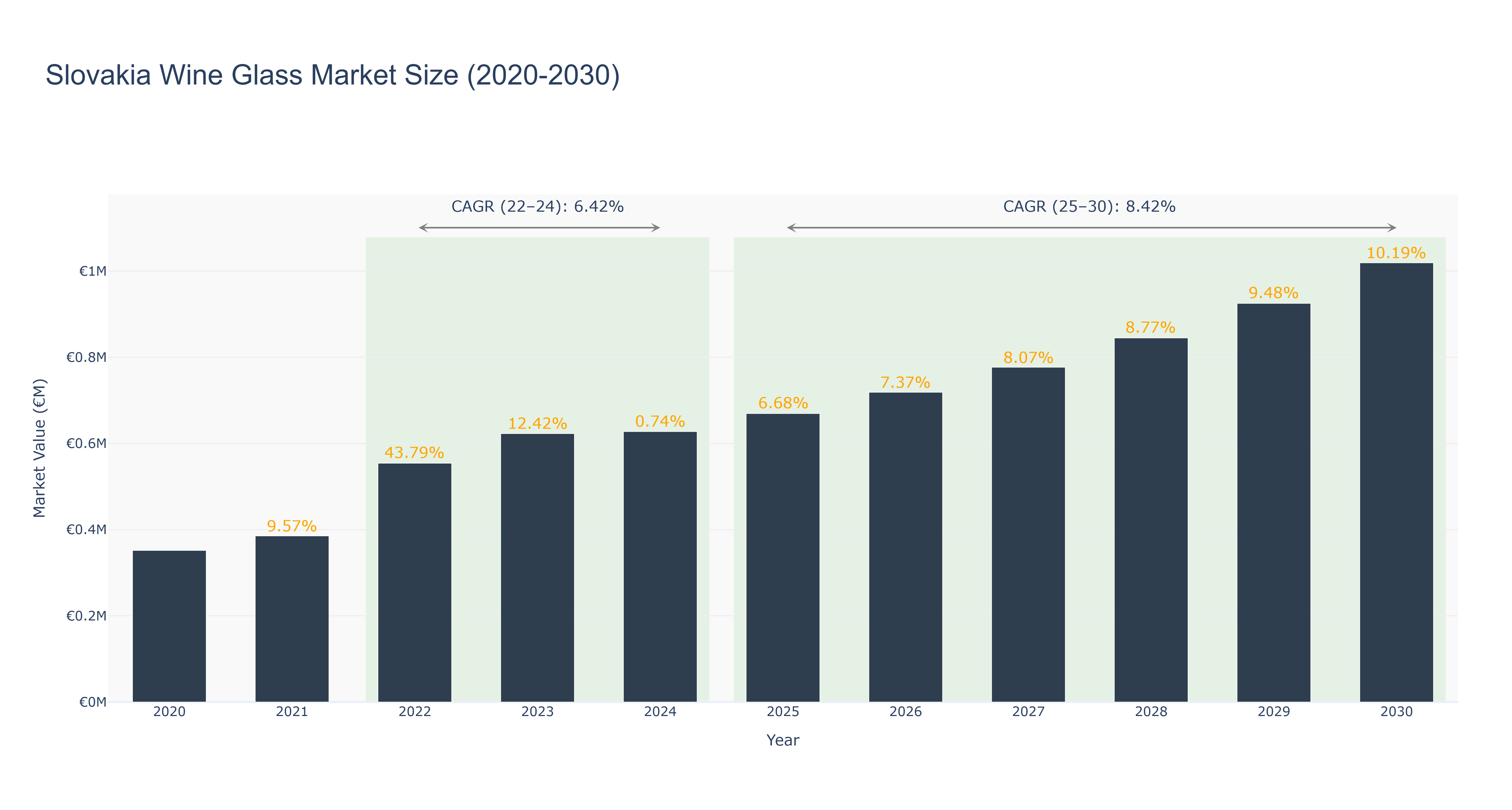
Slovakia Wine Glass Market has shown a steady growth trajectory over the years. The market size peaked at €1.02 million in 2030, with a consistent annual growth rate (CAGR) of 10.19% since 2020. The actual market size increased from €0.35 million in 2020 to €0.63 million in 2024, and is forecasted to reach €1.02 million by 2030. The CAGR for the period 2022-24 was 6.42%, while for the period 2025-30 it is projected to be 8.42%. This growth can be attributed to increasing disposable income, changing consumer preferences towards premium glassware, and a growing wine culture in Slovakia. Looking ahead, recent developments in sustainable glass production techniques and upcoming collaborations with local wineries are expected to drive further market expansion in the near future.
Slovakia Wine Glass Market: Production & Trade Performance (2019-2025)
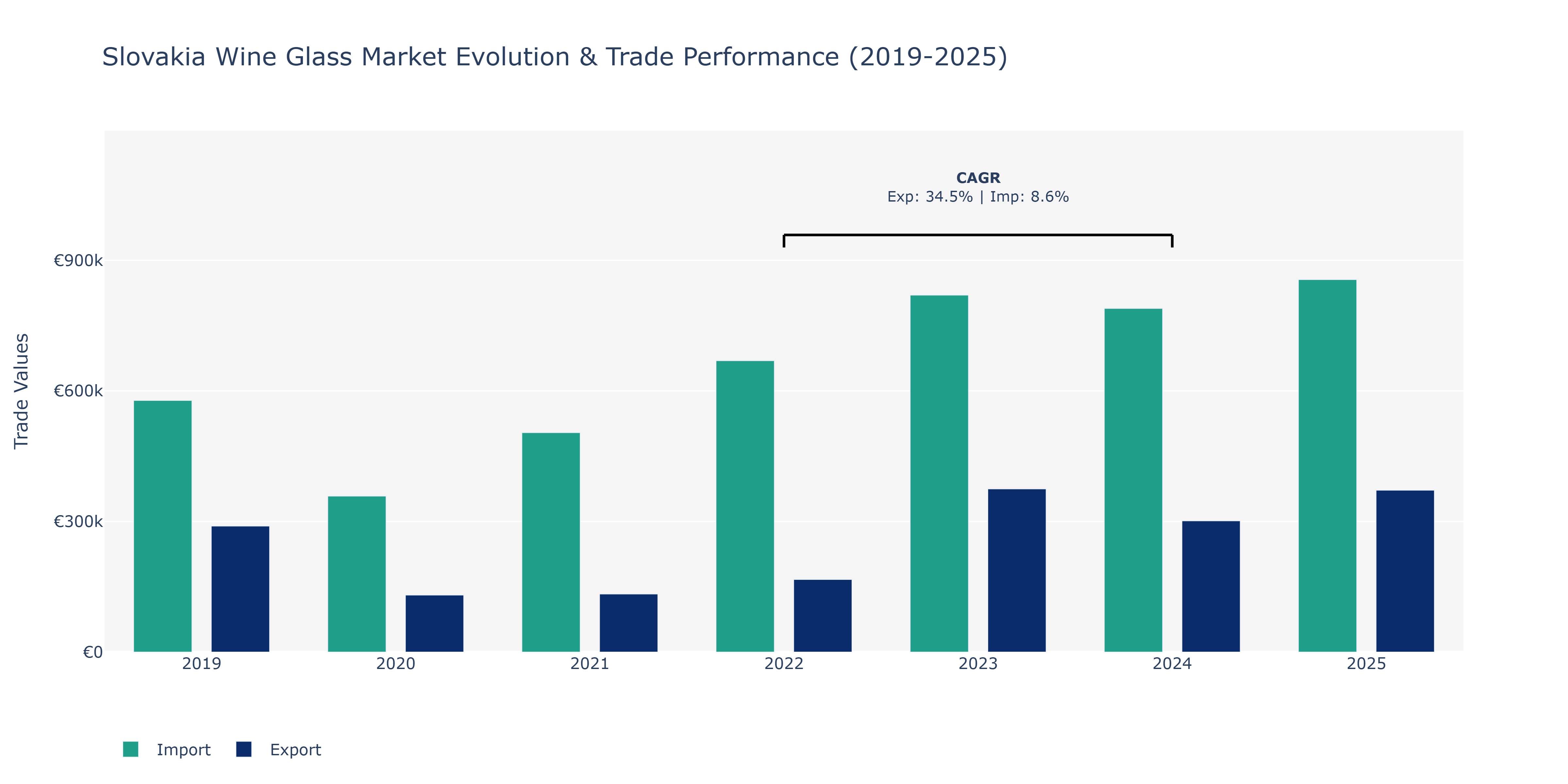
Between 2019 and 2025, Slovakia's Wine Glass Market experienced notable fluctuations in both exports and imports. In 2019, exports stood at €289.22 thousand, dipping substantially to €130.74 thousand in 2020 before gradually recovering over the next few years. Imports followed a similar trajectory, starting at €577.93 thousand in 2019, decreasing to €358.21 thousand in 2020, and then steadily rising. The peak export value of €374.64 thousand was observed in 2023, while the highest import value of €855.53 thousand occurred in 2025. These fluctuations can be attributed to various factors, including changes in consumer preferences, economic conditions impacting disposable income, and global trade dynamics affecting demand for wine-related products. The upward trend in both exports and imports indicates a potential growing market for wine glasses in Slovakia, showcasing opportunities for market expansion and increased competitiveness in the wine glass industry.
Key Highlights of the Report:
- Slovakia Wine Glass Market Outlook
- Market Size of Slovakia Wine Glass Market, 2025
- Forecast of Slovakia Wine Glass Market, 2032
- Historical Data and Forecast of Slovakia Wine Glass Revenues & Volume for the Period 2022 - 2032
- Slovakia Wine Glass Market Trend Evolution
- Slovakia Wine Glass Market Drivers and Challenges
- Slovakia Wine Glass Price Trends
- Slovakia Wine Glass Porter's Five Forces
- Slovakia Wine Glass Industry Life Cycle
- Historical Data and Forecast of Slovakia Wine Glass Market Revenues & Volume By Type for the Period 2022 - 2032
- Historical Data and Forecast of Slovakia Wine Glass Market Revenues & Volume By Glass for the Period 2022 - 2032
- Historical Data and Forecast of Slovakia Wine Glass Market Revenues & Volume By Crystal for the Period 2022 - 2032
- Historical Data and Forecast of Slovakia Wine Glass Market Revenues & Volume By Others for the Period 2022 - 2032
- Historical Data and Forecast of Slovakia Wine Glass Market Revenues & Volume By Application for the Period 2022 - 2032
- Historical Data and Forecast of Slovakia Wine Glass Market Revenues & Volume By Personal Consumption for the Period 2022 - 2032
- Historical Data and Forecast of Slovakia Wine Glass Market Revenues & Volume By Commercial Consumption for the Period 2022 - 2032
- Slovakia Wine Glass Import Export Trade Statistics
- Market Opportunity Assessment By Type
- Market Opportunity Assessment By Application
- Slovakia Wine Glass Top Companies Market Share
- Slovakia Wine Glass Competitive Benchmarking By Technical and Operational Parameters
- Slovakia Wine Glass Company Profiles
- Slovakia Wine Glass Key Strategic Recommendations






































