Luxembourg Brandy Market Size (2020-2030)
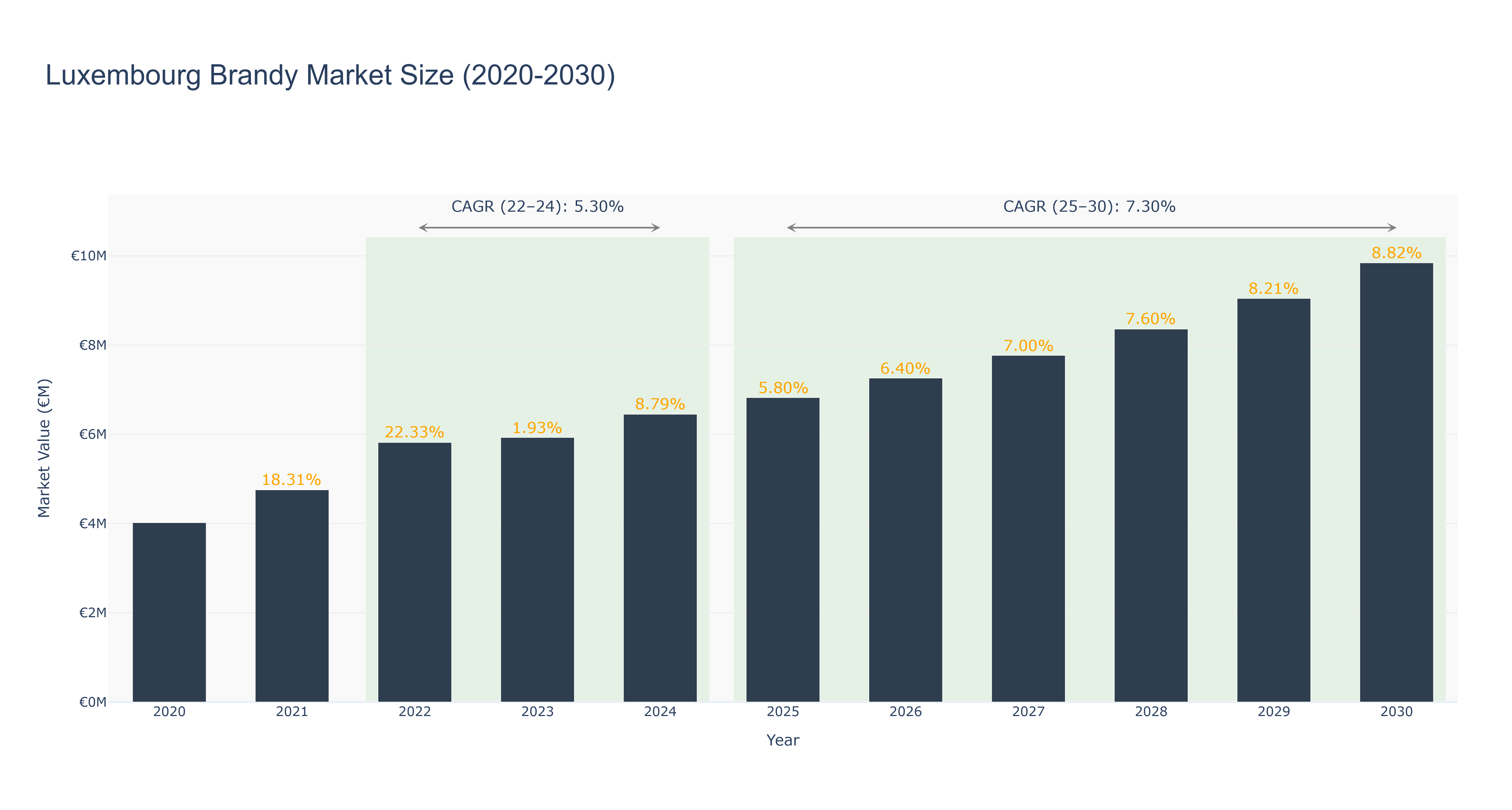
Luxembourg Brandy Market has shown a steady growth trajectory over the years. The peak market size of €9.84 million is forecasted for 2030, with an impressive CAGR of 7.30% from 2025 to 2030. The market size has seen consistent growth from €4.02 million in 2020 to €6.45 million in 2024, driven by increasing consumer demand and strategic marketing efforts. The recent CAGR from 2022 to 2024 was 5.30%, indicating a slightly slower growth phase. Looking ahead, the market is poised for further expansion, fueled by innovative product launches and expanding distribution channels. In line with this growth trajectory, upcoming projects in the region include collaborations with local vineyards to enhance product quality and sustainability practices, ensuring a competitive edge in the global market.
Luxembourg Brandy Market: Production & Trade Performance (2019-2025)
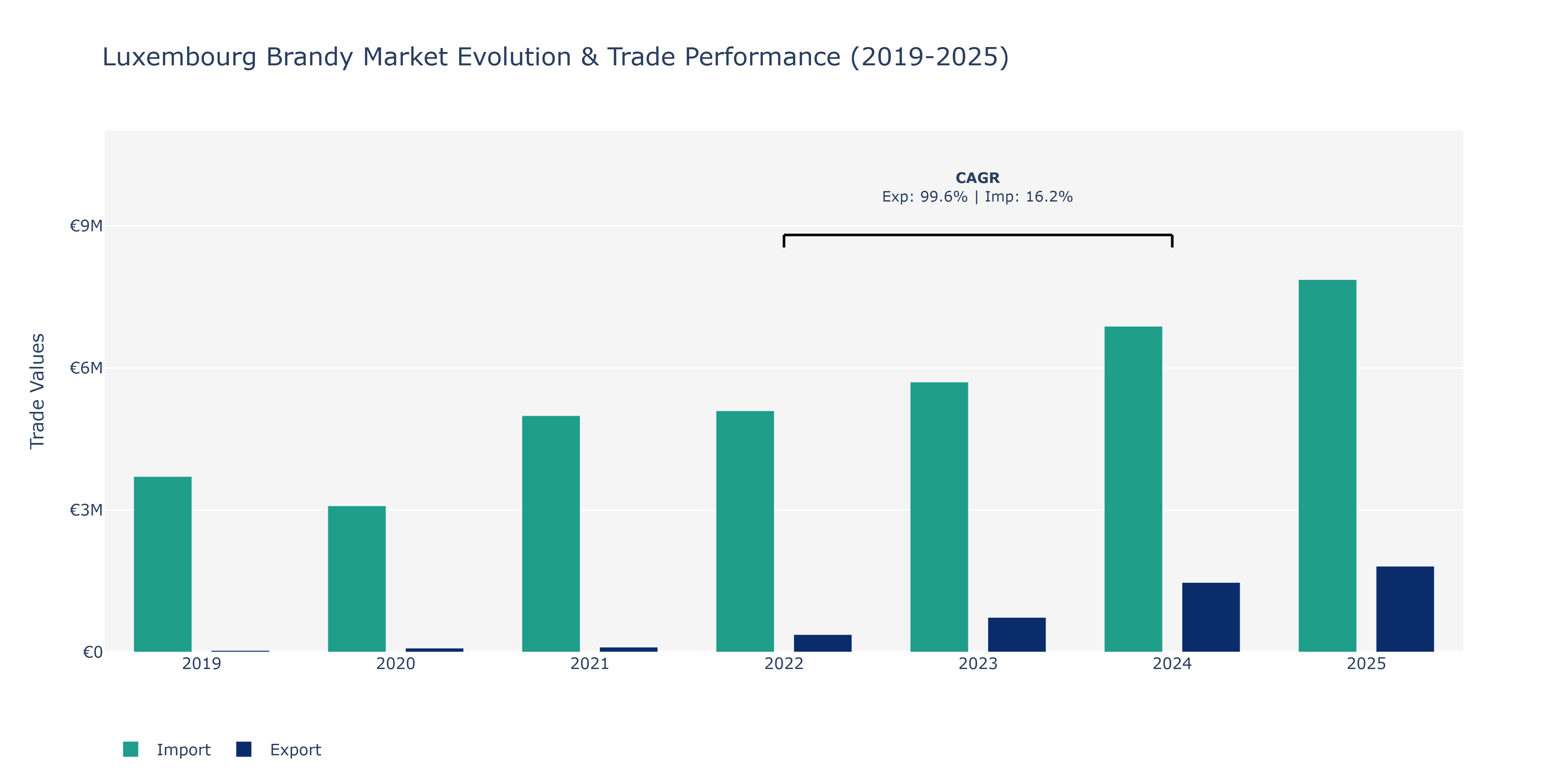
Between 2019 and 2025, Luxembourg's Brandy Market showcased substantial growth in both exports and imports. The exports saw a significant surge from €32.88 thousand in 2019 to €1.81 million by 2025, indicating a consistent upward trajectory each year. Meanwhile, imports also experienced a notable increase, rising from €3.71 million in 2019 to €7.87 million in 2025. Notably, there was a remarkable spike in both exports and imports from 2022 onwards, with exports demonstrating a remarkable 99.61% CAGR between 2022 and 2024. The surge in exports can be attributed to the growing global demand for Luxembourg's high-quality brandy, coupled with strategic marketing initiatives and favorable trade agreements. On the other hand, the increase in imports reflects the rising consumer preference for a diverse range of brandy products in the local market, driven by changing consumer tastes and increasing disposable incomes. The continuous growth in both exports and imports signifies Luxembourg's Brandy Market's strong position in the global market, supported by a reputation for excellence and quality craftsmanship.
Key Highlights of the Report:
- Luxembourg Brandy Market Outlook
- Market Size of Luxembourg Brandy Market, 2025
- Forecast of Luxembourg Brandy Market, 2032
- Historical Data and Forecast of Luxembourg Brandy Revenues & Volume for the Period 2022-2032F
- Luxembourg Brandy Market Trend Evolution
- Luxembourg Brandy Market Drivers and Challenges
- Luxembourg Brandy Price Trends
- Luxembourg Brandy Porter`s Five Forces
- Luxembourg Brandy Industry Life Cycle
- Historical Data and Forecast of Luxembourg Brandy Market Revenues & Volume By Type for the Period 2022-2032F
- Historical Data and Forecast of Luxembourg Brandy Market Revenues & Volume By V.S. ("very special") for the Period 2022-2032F
- Historical Data and Forecast of Luxembourg Brandy Market Revenues & Volume By V.S.O.P. ("very superior old pale") for the Period 2022-2032F
- Historical Data and Forecast of Luxembourg Brandy Market Revenues & Volume By XO ("extra old") for the Period 2022-2032F
- Historical Data and Forecast of Luxembourg Brandy Market Revenues & Volume By Hors d`age ("beyond age") for the Period 2022-2032F
- Historical Data and Forecast of Luxembourg Brandy Market Revenues & Volume By Applications for the Period 2022-2032F
- Historical Data and Forecast of Luxembourg Brandy Market Revenues & Volume By Shop & Supermarket for the Period 2022-2032F
- Historical Data and Forecast of Luxembourg Brandy Market Revenues & Volume By Restaurant & Bar & Club for the Period 2022-2032F
- Historical Data and Forecast of Luxembourg Brandy Market Revenues & Volume By Exclusive Store for the Period 2022-2032F
- Historical Data and Forecast of Luxembourg Brandy Market Revenues & Volume By Others for the Period 2022-2032F
- Luxembourg Brandy Import Export Trade Statistics
- Market Opportunity Assessment By Type
- Market Opportunity Assessment By Applications
- Luxembourg Brandy Top Companies Market Share
- Luxembourg Brandy Competitive Benchmarking By Technical and Operational Parameters
- Luxembourg Brandy Company Profiles
- Luxembourg Brandy Key Strategic Recommendations






































