Malaysia Ammonium Fluoride Market Size, Share & Growth Rate
The Malaysia Ammonium Fluoride Market was estimated at USD 166 Million in 2025 and is projected to reach USD 215 Million by 2032, growing at a CAGR of 3.8% from 2026 to 2032. This growth trajectory is primarily driven by increasing industrialization and the burgeoning demand for ammonium fluoride across various sectors. Its critical applications in electronics manufacturing, ceramics, and glass production are expected to further fuel market expansion in the region.
Malaysia Ammonium Fluoride Market Year-wise Growth Rate and Key Drivers
This graph highlights how the Malaysia Ammonium Fluoride Market has steadily grown over the years, supported by major growth factors.
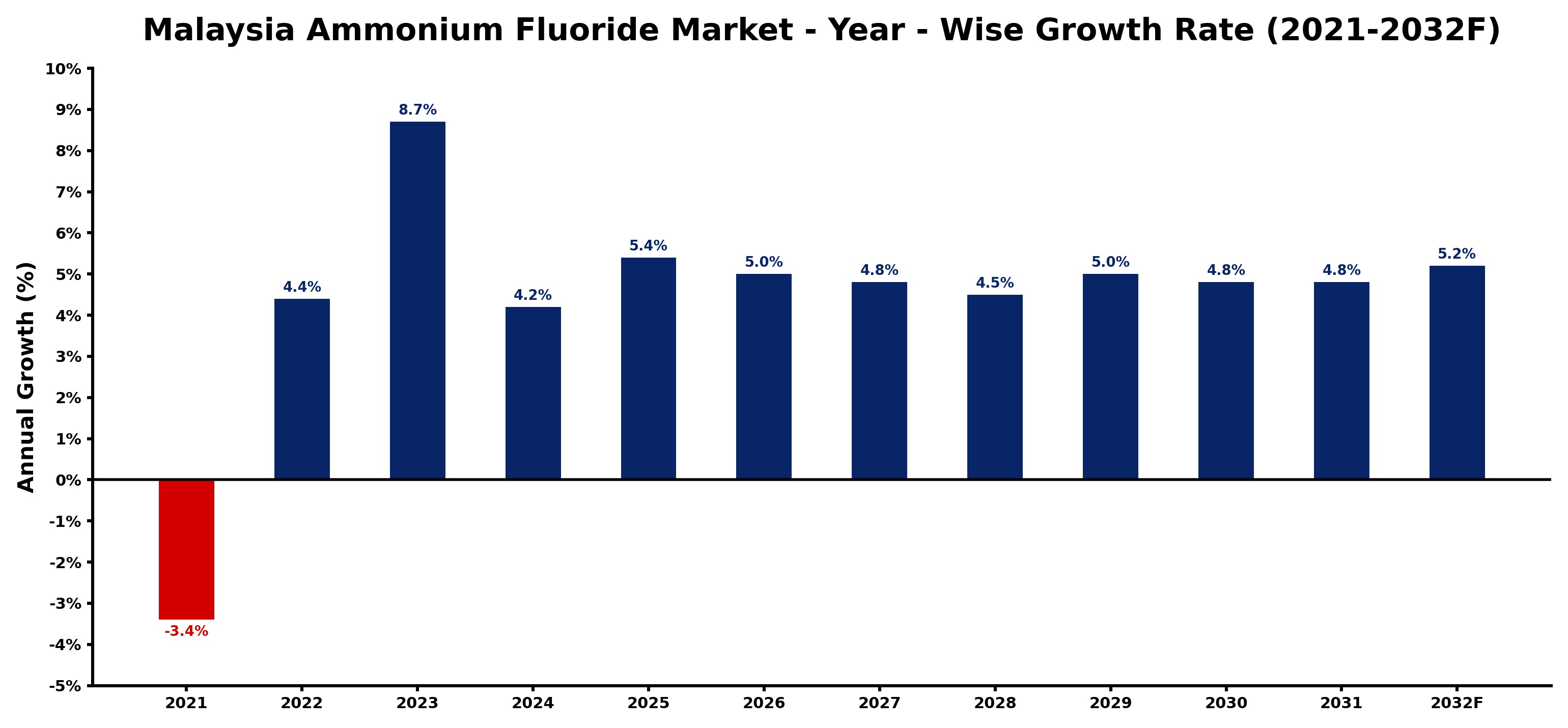
The table below presents the year‑wise growth rates along with the key drivers influencing the market
| Year | Growth Rate | Major Drivers |
| 2021 | -3.4% | Supply chain disruptions affected production |
| 2022 | 4.4% | Industrial applications expanded significantly |
| 2023 | 8.7% | Technological advancements enhanced efficiency |
| 2024 | 4.2% | Increased demand from electronics sector |
| 2025 | 5.4% | Emerging markets drove consumption growth |
| 2026 | 5.0% | Sustainability initiatives encouraged usage |
| 2027 | 4.8% | R&D investments fostered innovation |
| 2028 | 4.5% | Regulatory support enhanced market stability |
| 2029 | 5.0% | Partnerships expanded distribution networks |
| 2030 | 4.8% | Consumer awareness improved product adoption |
| 2031 | 4.8% | Market diversification opened new opportunities |
| 2032 | 5.2% | Global demand for fluorides increased |
Note - Market size estimations and growth projections presented in this report are based on 6Wresearch’s advanced forecasting approach, validated with industry datasets as of June 2026.
Malaysia Ammonium Fluoride Market Synopsis
The Malaysia ammonium fluoride market has shown recent resilience amidst fluctuating demand driven by global economic conditions. As we look ahead, the market is set to capitalize on rising industrial activities and advancements in manufacturing technologies, creating a favorable outlook for growth.
Key drivers, such as the increasing use of ammonium fluoride in water treatment and its essential role in semiconductor and glass production, underpin this momentum. As diverse end-user sectors like automotive and packaging expand, the demand for ammonium fluoride is likely to see a corresponding increase.
Malaysia Ammonium Fluoride Market Key Takeaways
- The market is projected to experience steady growth, with a CAGR of 3.8% from 2026 to 2032.
- Expanding industrialization across the Asia Pacific region is a significant growth driver.
- Applications in electronics and glass production remain crucial for market dynamics.
- Ongoing advancements in manufacturing processes are expected to enhance product demand.
- Market players are increasingly focused on improving sustainability and product safety.
Evaluation of Restraints in Malaysia Ammonium Fluoride Market
Despite the positive growth trajectory, the Malaysia ammonium fluoride market faces notable restraints. Changes in consumer preferences, particularly in the electronics and glass sectors, create volatility in demand. Furthermore, regulatory frameworks regarding chemical safety and environmental impact require constant adaptation by manufacturers. Fluctuations in raw material availability can also introduce uncertainties in pricing and supply, challenging market participants to maintain stability and compliance.
Malaysia Ammonium Fluoride Market Trends
The market is witnessing several trends that are shaping its future. A notable movement towards sustainability is prompting manufacturers to explore eco-friendly production methods. Additionally, innovations in etching techniques for semiconductor applications are enhancing the efficiency and effectiveness of ammonium fluoride use. The rise of smart technology in electronics is also creating new avenues for application, potentially expanding the market's reach significantly.
Malaysia Ammonium Fluoride Market Opportunities
There are abundant opportunities for growth in the Malaysia ammonium fluoride market, particularly within the realm of specialty chemicals. With ongoing industrialization, sectors such as agriculture and food processing are likely to require more water treatment solutions, providing avenues for increased ammonium fluoride sales. Additionally, as the construction and automotive industries continue to evolve, the need for high-quality chemical compounds will drive investment in ammonium fluoride applications.
Government Initiatives in the Malaysia Ammonium Fluoride Market
The Malaysian government has taken proactive measures to stimulate industrial growth through various initiatives aimed at enhancing manufacturing capabilities. Policies promoting research and development in chemical processes and environmental sustainability create a conducive environment for ammonium fluoride production. Public spending on infrastructure development also supports the construction sector, indirectly benefiting the ammonium fluoride market by increasing demand across associated industries.
Future Insights of the Malaysia Ammonium Fluoride Market
Looking forward to the period from 2026 to 2032, the Malaysia ammonium fluoride market is poised for steady growth driven by technological advancements and increased industrial activity. The shift towards more sustainable production methods, coupled with the demand for high-purity chemicals in electronics and ceramics, will be pivotal. As sectors continue to innovate and expand, the ammonium fluoride market is likely to adapt and thrive in this evolving landscape.
Malaysia Ammonium Fluoride Market Latest Developments (May 2025 - June 2026)
Recent developments within the Malaysia ammonium fluoride market suggest a focus on enhancing production efficiency and addressing environmental concerns. Companies are exploring new manufacturing technologies that reduce waste and improve the quality of the end product. Furthermore, strategic partnerships are being formed to bolster research capabilities and drive innovation in applications that utilize ammonium fluoride.
Malaysia Ammonium Fluoride Market - Key Attractiveness of the Report
- 10 Years of Market Numbers
- Historical Data Starting from 2022 to 2025
- Base Year: 2025
- Forecast Data until 2032
- Key Performance Indicators Impacting the Market
- Major Upcoming Developments and Projects
Key Highlights of the Report:
- Malaysia Ammonium Fluoride Market Outlook
- Market Size of Malaysia Ammonium Fluoride Market, 2025
- Forecast of Malaysia Ammonium Fluoride Market, 2032
- Historical Data and Forecast of Malaysia Ammonium Fluoride Revenues & Volume for the Period 2022-2032F
- Malaysia Ammonium Fluoride Market Trend Evolution
- Malaysia Ammonium Fluoride Market Drivers and Challenges
- Malaysia Ammonium Fluoride Price Trends
- Malaysia Ammonium Fluoride Porter's Five Forces
- Malaysia Ammonium Fluoride Industry Life Cycle
- Historical Data and Forecast of Malaysia Ammonium Fluoride Market Revenues & Volume By Product Type for the Period 2022-2032F
- Historical Data and Forecast of Malaysia Ammonium Fluoride Market Revenues & Volume By Industrial grade ammonium fluoride for the Period 2022-2032F
- Historical Data and Forecast of Malaysia Ammonium Fluoride Market Revenues & Volume By Electronic Grade ammonium fluoride for the Period 2022-2032F
- Historical Data and Forecast of Malaysia Ammonium Fluoride Market Revenues & Volume By Application for the Period 2022-2032F
- Historical Data and Forecast of Malaysia Ammonium Fluoride Market Revenues & Volume By Glass Etching Agent for the Period 2022-2032F
- Historical Data and Forecast of Malaysia Ammonium Fluoride Market Revenues & Volume By Electrical Components Processing for the Period 2022-2032F
- Historical Data and Forecast of Malaysia Ammonium Fluoride Market Revenues & Volume By Other for the Period 2022-2032F
- Malaysia Ammonium Fluoride Import Export Trade Statistics
- Market Opportunity Assessment By Product Type
- Market Opportunity Assessment By Application
- Malaysia Ammonium Fluoride Top Companies Market Share
- Malaysia Ammonium Fluoride Competitive Benchmarking By Technical and Operational Parameters
- Malaysia Ammonium Fluoride Company Profiles
- Malaysia Ammonium Fluoride Key Strategic Recommendations






































