Malaysia Aquaculture & Marine Products Market Size, Share & Growth Rate
The Malaysia Aquaculture & Marine Products Market was estimated at USD 414 Million in 2025 and is projected to reach USD 540 Million by 2032, growing at a CAGR of 3.9% from 2026 to 2032. This growth trajectory is primarily fueled by the increasing demand for seafood, both locally and globally, along with strategic government initiatives aimed at enhancing sustainable aquaculture practices. As consumer preferences shift toward healthy and responsibly sourced food options, Malaysia's rich aquatic biodiversity and advanced farming techniques further bolster its competitive edge in the global market.
Malaysia Aquaculture & Marine Products Market Year-wise Growth Rate and Key Drivers
This graph highlights how the Malaysia Aquaculture & Marine Products Market has steadily grown over the years, supported by major growth factors.
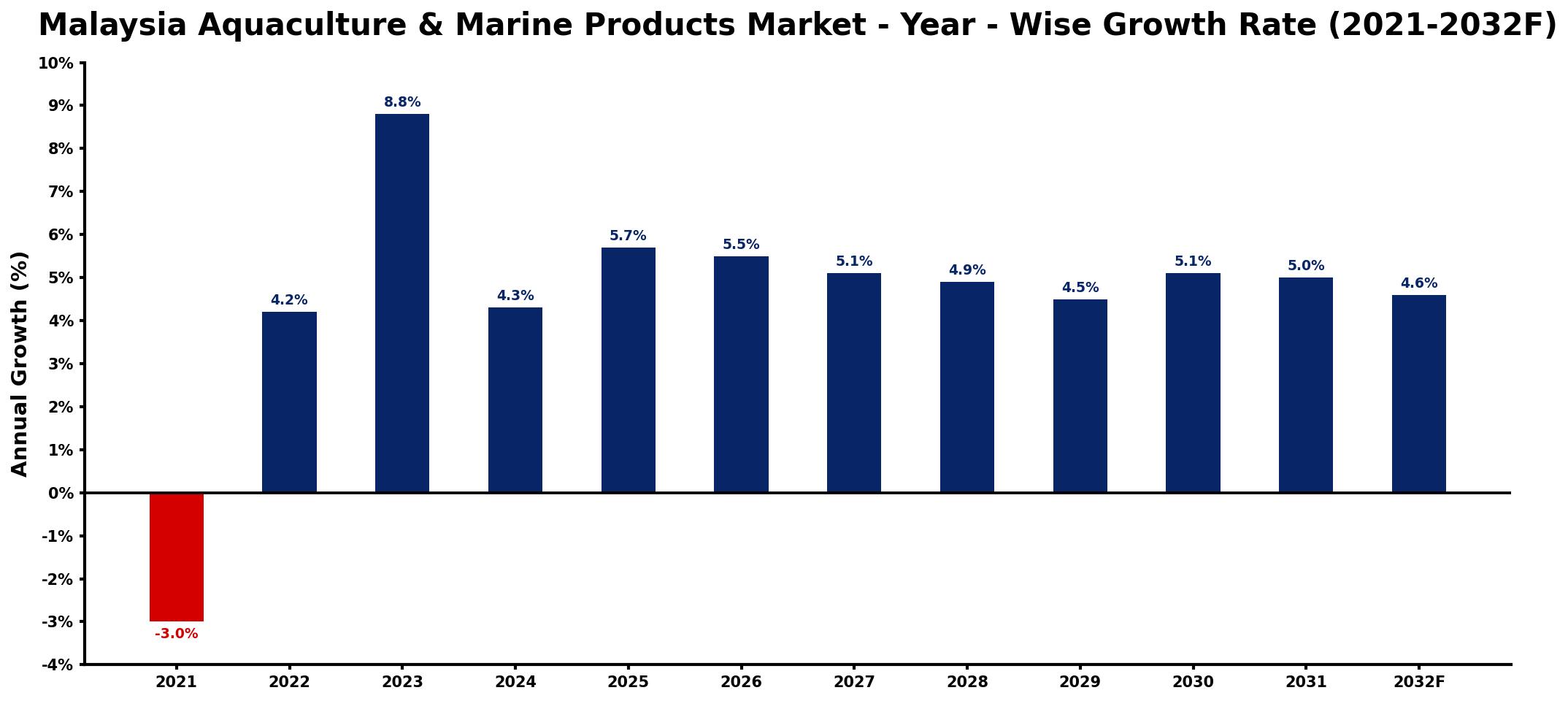
The table below presents the year‑wise growth rates along with the key drivers influencing the market
| Year | Growth Rate | Major Drivers |
| 2021 | -3.0% | Decreased consumer spending on seafood |
| 2022 | 4.2% | Rising health consciousness among consumers |
| 2023 | 8.8% | Increased investment in sustainable practices |
| 2024 | 4.3% | Expansion of export markets availability |
| 2025 | 5.7% | Growing demand for organic alternatives |
| 2026 | 5.5% | Technological advancements in farming techniques |
| 2027 | 5.1% | Increased focus on food security |
| 2028 | 4.9% | Enhanced distribution channel efficiency |
| 2029 | 4.5% | Growing popularity of local cuisines |
| 2030 | 5.1% | growing commercial sector adoption |
| 2031 | 5.0% | Rising interest in eco-friendly sourcing |
| 2032 | 4.6% | Increased collaboration among industry stakeholders |
Note: Market size estimations and growth projections presented in this report are based on 6Wresearch's proprietary forecasting methodology, utilizing the latest available industry data, government publications, and primary research inputs.
Malaysia Aquaculture & Marine Products Market Synopsis
The aquaculture sector in Malaysia has become a vital contributor to the nation's economy, providing a plethora of fish and shellfish species that cater to varying culinary preferences. A unique blend of traditional aquaculture methods and modern technology enables the country to maintain high production standards, thereby meeting both local consumption and export demands effectively.
Sustainability remains at the forefront of Malaysia's aquaculture practices, with numerous initiatives launched to ensure environmental conservation and compliance with international quality standards. As a result, Malaysian marine products are increasingly recognized for their high quality, paving the way for enhanced export opportunities in international markets.
- The market is anticipated to experience steady growth, driven by increasing global seafood demand.
- Sustainable production methods are being prioritized to address environmental concerns.
- Technological innovations in aquaculture practices are enhancing productivity and efficiency.
- Government initiatives play a crucial role in supporting the sector's growth and export potential.
- The market's resilience has been tested by recent global disruptions but shows signs of recovery and adaptation.
Despite the market's promising outlook, several restraints continue to challenge its full potential. Environmental sustainability issues, particularly concerning the impacts of overfishing and habitat degradation, pose significant risks. Additionally, managing diseases in aquaculture operations requires ongoing attention and resources. Theres also heightened competition from imported seafood products, which could affect local producers. The market must address these challenges with innovative solutions and strategic policies to maintain growth momentum.
Several trends are shaping the future of the Malaysian aquaculture and marine products market. A notable trend is the increasing consumer preference for organic and sustainably sourced seafood, prompting aquaculture producers to adopt eco-friendly practices. Furthermore, advancements in aquaculture technology, such as automation and IoT applications, are revolutionizing farming techniques, improving yield quality and efficiency. Moreover, there is a rising interest in aquaculture diversification, with farmers exploring new species and aquaponic systems to meet changing consumer demands.
Growth opportunities within the Malaysian aquaculture sector are abundant, particularly in enhancing export capabilities and tapping into niche markets. As global seafood consumption continues to rise, Malaysian producers can leverage their geographic advantages and rich marine resources to position themselves in lucrative international markets. Additionally, investments in research and development can lead to innovative practices that improve sustainability and productivity, providing a competitive edge in the global arena.
The Malaysian government has launched several initiatives to bolster the aquaculture sector, including funding programs for sustainable farming practices and public-private partnerships aimed at technological advancements. These initiatives are designed to ensure compliance with international standards, promote research and innovation, and support local farmers in expanding their market reach. By prioritizing aquaculture in national policies, the government seeks to enhance food security and economic resilience.
Looking ahead to 2026-2032, the Malaysian aquaculture and marine products market is poised for substantial growth. As consumer awareness about sustainability and health continues to increase, the demand for responsibly sourced seafood will likely drive innovation in farming practices. Additionally, ongoing government support and the adoption of cutting-edge technologies will facilitate the sector's adaptability in facing environmental challenges. All these factors suggest a vibrant future for Malaysia in the global aquaculture landscape.
Recent developments in the Malaysian aquaculture sector indicate a shift towards more sustainable practices, with many farms adopting new technologies to enhance production efficiency. There is also a growing emphasis on meeting international quality standards to facilitate exports. Collaborative efforts between government agencies and private sector stakeholders are increasingly focused on improving disease management and resource allocation, reflecting a collective commitment to strengthening the industry.
- 10 Years of Market Numbers
- Historical Data Starting from 2022 to 2025
- Base Year: 2025
- Forecast Data until 2032
- Key Performance Indicators Impacting the Market
- Major Upcoming Developments and Projects
Key Highlights of the Report:
- Malaysia Aquaculture & Marine Products Market Outlook
- Market Size of Malaysia Aquaculture & Marine Products Market, 2025
- Forecast of Malaysia Aquaculture & Marine Products Market, 2032
- Historical Data and Forecast of Malaysia Aquaculture & Marine Products Revenues & Volume for the Period 2022-2032F
- Malaysia Aquaculture & Marine Products Market Trend Evolution
- Malaysia Aquaculture & Marine Products Market Drivers and Challenges
- Malaysia Aquaculture & Marine Products Price Trends
- Malaysia Aquaculture & Marine Products Porter's Five Forces
- Malaysia Aquaculture & Marine Products Industry Life Cycle
- Historical Data and Forecast of Malaysia Aquaculture & Marine Products Market Revenues & Volume By Rearing Product Type for the Period 2022-2032F
- Historical Data and Forecast of Malaysia Aquaculture & Marine Products Market Revenues & Volume By Equipment for the Period 2022-2032F
- Historical Data and Forecast of Malaysia Aquaculture & Marine Products Market Revenues & Volume By Chemicals for the Period 2022-2032F
- Historical Data and Forecast of Malaysia Aquaculture & Marine Products Market Revenues & Volume By Pharmaceuticals for the Period 2022-2032F
- Historical Data and Forecast of Malaysia Aquaculture & Marine Products Market Revenues & Volume By Fertilizers for the Period 2022-2032F
- Historical Data and Forecast of Malaysia Aquaculture & Marine Products Market Revenues & Volume By Others for the Period 2022-2032F
- Historical Data and Forecast of Malaysia Aquaculture & Marine Products Market Revenues & Volume By Type for the Period 2022-2032F
- Historical Data and Forecast of Malaysia Aquaculture & Marine Products Market Revenues & Volume By Fisheries for the Period 2022-2032F
- Historical Data and Forecast of Malaysia Aquaculture & Marine Products Market Revenues & Volume By Seaweeds for the Period 2022-2032F
- Historical Data and Forecast of Malaysia Aquaculture & Marine Products Market Revenues & Volume By Microalgae for the Period 2022-2032F
- Historical Data and Forecast of Malaysia Aquaculture & Marine Products Market Revenues & Volume By Crustaceans for the Period 2022-2032F
- Historical Data and Forecast of Malaysia Aquaculture & Marine Products Market Revenues & Volume By Molluscs for the Period 2022-2032F
- Historical Data and Forecast of Malaysia Aquaculture & Marine Products Market Revenues & Volume By Others for the Period 2022-2032F
- Historical Data and Forecast of Malaysia Aquaculture & Marine Products Market Revenues & Volume By Production Type for the Period 2022-2032F
- Historical Data and Forecast of Malaysia Aquaculture & Marine Products Market Revenues & Volume By Small-Scale for the Period 2022-2032F
- Historical Data and Forecast of Malaysia Aquaculture & Marine Products Market Revenues & Volume By Medium & Large Scale for the Period 2022-2032F
- Historical Data and Forecast of Malaysia Aquaculture & Marine Products Market Revenues & Volume By Culture for the Period 2022-2032F
- Historical Data and Forecast of Malaysia Aquaculture & Marine Products Market Revenues & Volume By Freshwater for the Period 2022-2032F
- Historical Data and Forecast of Malaysia Aquaculture & Marine Products Market Revenues & Volume By Brackish Water for the Period 2022-2032F
- Historical Data and Forecast of Malaysia Aquaculture & Marine Products Market Revenues & Volume By Marine for the Period 2022-2032F
- Malaysia Aquaculture & Marine Products Import Export Trade Statistics
- Market Opportunity Assessment By Rearing Product Type
- Market Opportunity Assessment By Type
- Market Opportunity Assessment By Production Type
- Market Opportunity Assessment By Culture
- Malaysia Aquaculture & Marine Products Top Companies Market Share
- Malaysia Aquaculture & Marine Products Competitive Benchmarking By Technical and Operational Parameters
- Malaysia Aquaculture & Marine Products Company Profiles
- Malaysia Aquaculture & Marine Products Key Strategic Recommendations






































