Malaysia Aromatic Compounds Market Size, Share & Growth Rate
The Malaysia Aromatic Compounds Market was estimated at USD 271 Million in 2025 and is projected to reach USD 351 Million by 2032, growing at a CAGR of 3.8% from 2026 to 2032. This growth trajectory is largely attributed to the increasing demand for aromatic compounds across various sectors such as pharmaceuticals and petrochemicals. Moreover, the market's expansion is further bolstered by rising disposable incomes and an overall increase in industrial activities throughout the region.
Malaysia Aromatic Compounds Market Year-wise Growth Rate and Key Drivers
This graph highlights how the Malaysia Aromatic Compounds Market has steadily grown over the years, supported by major growth factors.
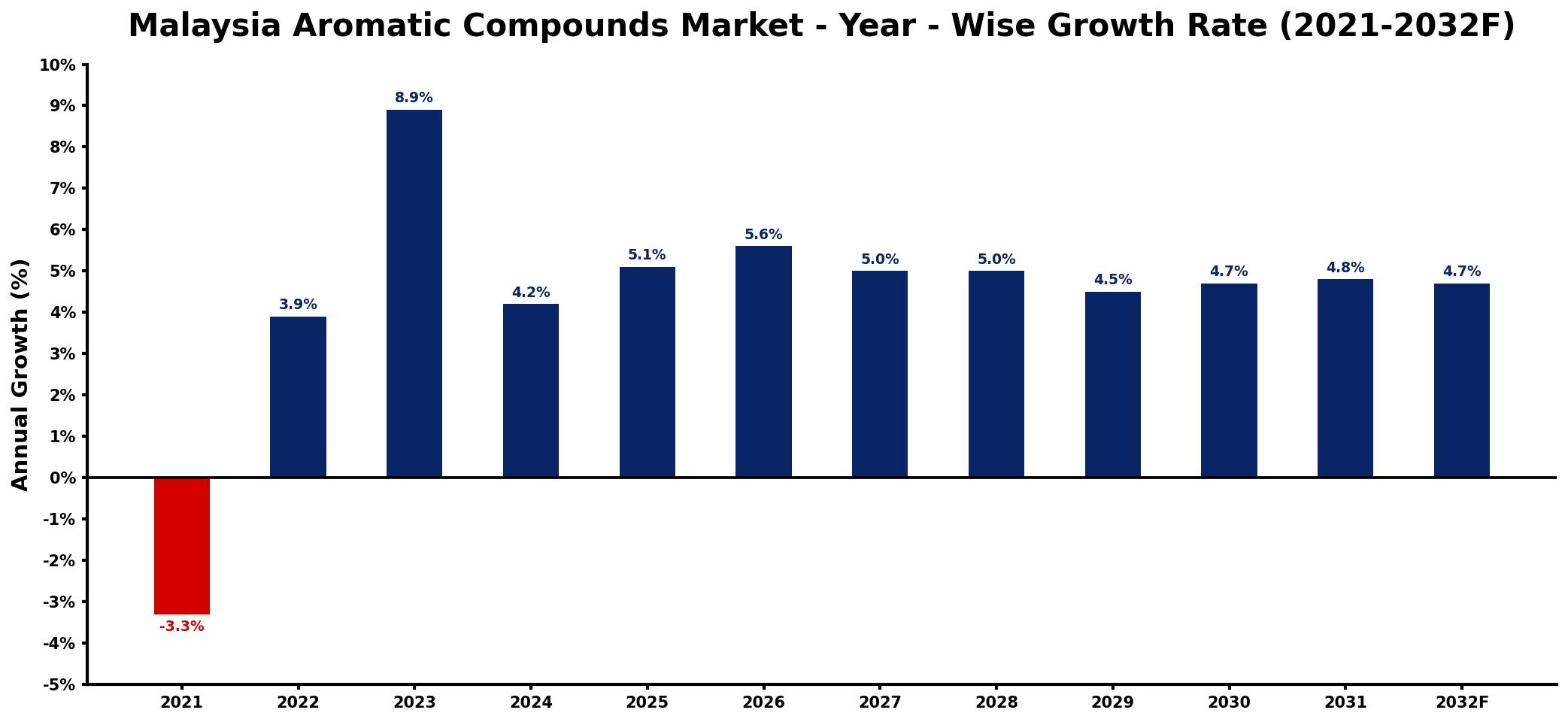
The table below presents the year‑wise growth rates along with the key drivers influencing the market
| Year | Growth Rate | Major Drivers |
| 2021 | -3.3% | decreased consumer interest in fragrances |
| 2022 | 3.9% | rising popularity of natural ingredients |
| 2023 | 8.9% | expansion of personal care market |
| 2024 | 4.2% | increased demand for eco-friendly products |
| 2025 | 5.1% | growing investment in research initiatives |
| 2026 | 5.6% | increased utilization in food industry |
| 2027 | 5.0% | increased capital investment inflows |
| 2028 | 5.0% | rising demand from cosmetic sector |
| 2029 | 4.5% | growth in home fragrance segment |
| 2030 | 4.7% | increased exports to international markets |
| 2031 | 4.8% | emerging trends in wellness products |
| 2032 | 4.7% | expanding manufacturing base activity |
Note: Market size estimations and growth projections presented in this report are based on 6Wresearch's proprietary forecasting methodology, utilizing the latest available industry data, government publications, and primary research inputs.
Malaysia Aromatic Compounds Market Synopsis
The aromatic compounds market in Malaysia has seen a dynamic evolution, with recent years showcasing robust growth driven by diverse applications in key industries. However, as the market moves forward, it is poised for a transformation fueled by technological innovations and sustainable practices. Such changes are anticipated to enhance the efficiency and environmental impact of production processes.
Current trends indicate a shift towards greener methodologies and increased regulatory focus, aligning with global sustainability goals. The interplay between rising industrial demands and evolving consumer preferences will significantly influence the market landscape, presenting new challenges and opportunities alike.
Malaysia Aromatic Compounds Market Key Takeaways
- Strong growth anticipated in the pharmaceutical and petrochemical sectors, driving demand.
- Increasing investment in sustainable production methods is reshaping the market landscape.
- Technological advancements are enhancing the efficiency of aromatic compound production.
- Rising disposable incomes and population growth are expected to boost market consumption.
- Market dynamics are heavily influenced by regional economic conditions and global supply chains.
Evaluation of Restraints in Malaysia Aromatic Compounds Market
Despite the favorable growth outlook, the Malaysian aromatic compounds market faces certain constraints that may limit its potential. Key among these is the availability of feedstock, which can fluctuate based on global supply and geopolitical factors. Environmental regulations are increasingly stringent, pressuring companies to adopt eco-friendly practices. Moreover, competitive pressures from other regional markets could affect pricing strategies and market share, posing additional challenges for local producers.
Malaysia Aromatic Compounds Market Trends
Several emerging trends are shaping the Malaysian aromatic compounds market. Notably, there is a significant shift towards eco-friendly production practices, driven by consumer preferences for sustainable products. Advances in technology are leading to more efficient extraction and processing methods, which enhance product quality. Additionally, the integration of digital solutions in manufacturing processes is optimizing supply chains and inventory management, ultimately improving profitability.
Malaysia Aromatic Compounds Market Opportunities
Growth and investment opportunities abound in the Malaysian aromatic compounds market. The continuous expansion of the pharmaceutical sector presents lucrative avenues for aromatic compounds, particularly in drug formulation and synthesis. Furthermore, the rising trend of green chemistry opens doors for innovation in sustainable sourcing and production methods. As the regional population grows and urbanizes, there is an increasing demand for products derived from aromatic compounds, from everyday household items to advanced industrial applications.
Government Initiatives in the Malaysia Aromatic Compounds Market
The Malaysian government has recognized the importance of the aromatic compounds market and is implementing various initiatives to support its growth. Policies aimed at promoting sustainable industrial practices are being prioritized, along with incentives for companies adopting green technologies. Public spending in research and development is also encouraged to foster innovation in this sector, helping to drive competitiveness on a global scale.
Future Insights of the Malaysia Aromatic Compounds Market
Looking towards 2026-2032, the Malaysian aromatic compounds market is expected to continue on its growth path, underpinned by strong demand from multiple industries. The increasing emphasis on sustainability will likely necessitate further investment in cleaner technologies and practices. Additionally, as Malaysia strengthens its position as a key player in the Southeast Asian region, opportunities for export and collaboration will grow, positioning the market for a robust future.
Malaysia Aromatic Compounds Market Latest Developments (2025 - 2026)
In the recent months, the Malaysian aromatic compounds market has witnessed notable developments characterized by increased investment in capacity expansion and technological upgrades. Companies are focusing on enhancing production efficiencies and implementing environmentally-friendly practices. Additionally, strategic collaborations are being formed to bolster innovation and share best practices, setting the stage for future growth.
Malaysia Aromatic Compounds Market - Key Attractiveness of the Report
- 10 Years of Market Numbers
- Historical Data Starting from 2022 to 2025
- Base Year: 2025
- Forecast Data until 2032
- Key Performance Indicators Impacting the Market
- Major Upcoming Developments and Projects
Key Highlights of the Report:
- Malaysia Aromatic Compounds Market Outlook
- Market Size of Malaysia Aromatic Compounds Market, 2025
- Forecast of Malaysia Aromatic Compounds Market, 2032
- Historical Data and Forecast of Malaysia Aromatic Compounds Revenues & Volume for the Period 2022-2032F
- Malaysia Aromatic Compounds Market Trend Evolution
- Malaysia Aromatic Compounds Market Drivers and Challenges
- Malaysia Aromatic Compounds Price Trends
- Malaysia Aromatic Compounds Porter's Five Forces
- Malaysia Aromatic Compounds Industry Life Cycle
- Historical Data and Forecast of Malaysia Aromatic Compounds Market Revenues & Volume By Type for the Period 2022-2032F
- Historical Data and Forecast of Malaysia Aromatic Compounds Market Revenues & Volume By Benzene for the Period 2022-2032F
- Historical Data and Forecast of Malaysia Aromatic Compounds Market Revenues & Volume By Xylene for the Period 2022-2032F
- Historical Data and Forecast of Malaysia Aromatic Compounds Market Revenues & Volume By Toluene for the Period 2022-2032F
- Historical Data and Forecast of Malaysia Aromatic Compounds Market Revenues & Volume By Application for the Period 2022-2032F
- Historical Data and Forecast of Malaysia Aromatic Compounds Market Revenues & Volume By Solvent for the Period 2022-2032F
- Historical Data and Forecast of Malaysia Aromatic Compounds Market Revenues & Volume By Additive for the Period 2022-2032F
- Historical Data and Forecast of Malaysia Aromatic Compounds Market Revenues & Volume By End-use for the Period 2022-2032F
- Historical Data and Forecast of Malaysia Aromatic Compounds Market Revenues & Volume By Packaging for the Period 2022-2032F
- Historical Data and Forecast of Malaysia Aromatic Compounds Market Revenues & Volume By Detergent And Dyes for the Period 2022-2032F
- Historical Data and Forecast of Malaysia Aromatic Compounds Market Revenues & Volume By Automobile for the Period 2022-2032F
- Historical Data and Forecast of Malaysia Aromatic Compounds Market Revenues & Volume By Electronic Devices for the Period 2022-2032F
- Historical Data and Forecast of Malaysia Aromatic Compounds Market Revenues & Volume By Medical Devices for the Period 2022-2032F
- Historical Data and Forecast of Malaysia Aromatic Compounds Market Revenues & Volume By Pharmaceuticals for the Period 2022-2032F
- Historical Data and Forecast of Malaysia Aromatic Compounds Market Revenues & Volume By Gasoline for the Period 2022-2032F
- Historical Data and Forecast of Malaysia Aromatic Compounds Market Revenues & Volume By Tire for the Period 2022-2032F
- Malaysia Aromatic Compounds Import Export Trade Statistics
- Market Opportunity Assessment By Type
- Market Opportunity Assessment By Application
- Market Opportunity Assessment By End-use
- Malaysia Aromatic Compounds Top Companies Market Share
- Malaysia Aromatic Compounds Competitive Benchmarking By Technical and Operational Parameters
- Malaysia Aromatic Compounds Company Profiles
- Malaysia Aromatic Compounds Key Strategic Recommendations






































