Malaysia Automotive Chassis Market Size, Share & Growth Rate
The Malaysia Automotive Chassis Market was estimated at USD 429 Million in 2025 and is projected to reach USD 557 Million by 2032, growing at a CAGR of 3.8% from 2026 to 2032. This upward trajectory is propelled by increasing consumer demand for vehicles emphasizing performance and safety, coupled with ongoing advancements in automotive technology. As regulatory standards become more stringent, automakers are increasingly investing in high-quality chassis components to meet both market and compliance expectations.
Malaysia Automotive Chassis Market Growth Rate Analysis (2021-2032)
The Malaysian automotive chassis market has witnessed notable fluctuations in growth over the past few years. Following a decline of 3.3% in 2021, the industry rebounded with impressive growth of 4.1% in 2022 and surged further by 8.4% in 2023, driven primarily by increased consumer demand and significant investments in local manufacturing. This upward trend is expected to continue, with projected growth rates of 4.0% in 2024 and around 5% annually through 2030. Factors such as advancements in technology, supportive government policies, and a shift towards sustainable energy solutions have bolstered this growth. However, the market must remain agile to adapt to evolving consumer preferences and global automotive trends.
Malaysia Automotive Chassis Market Year-wise Growth Rate and Key Drivers
This graph highlights how the Malaysia Automotive Chassis Market has steadily grown over the past five years, supported by major growth factors.
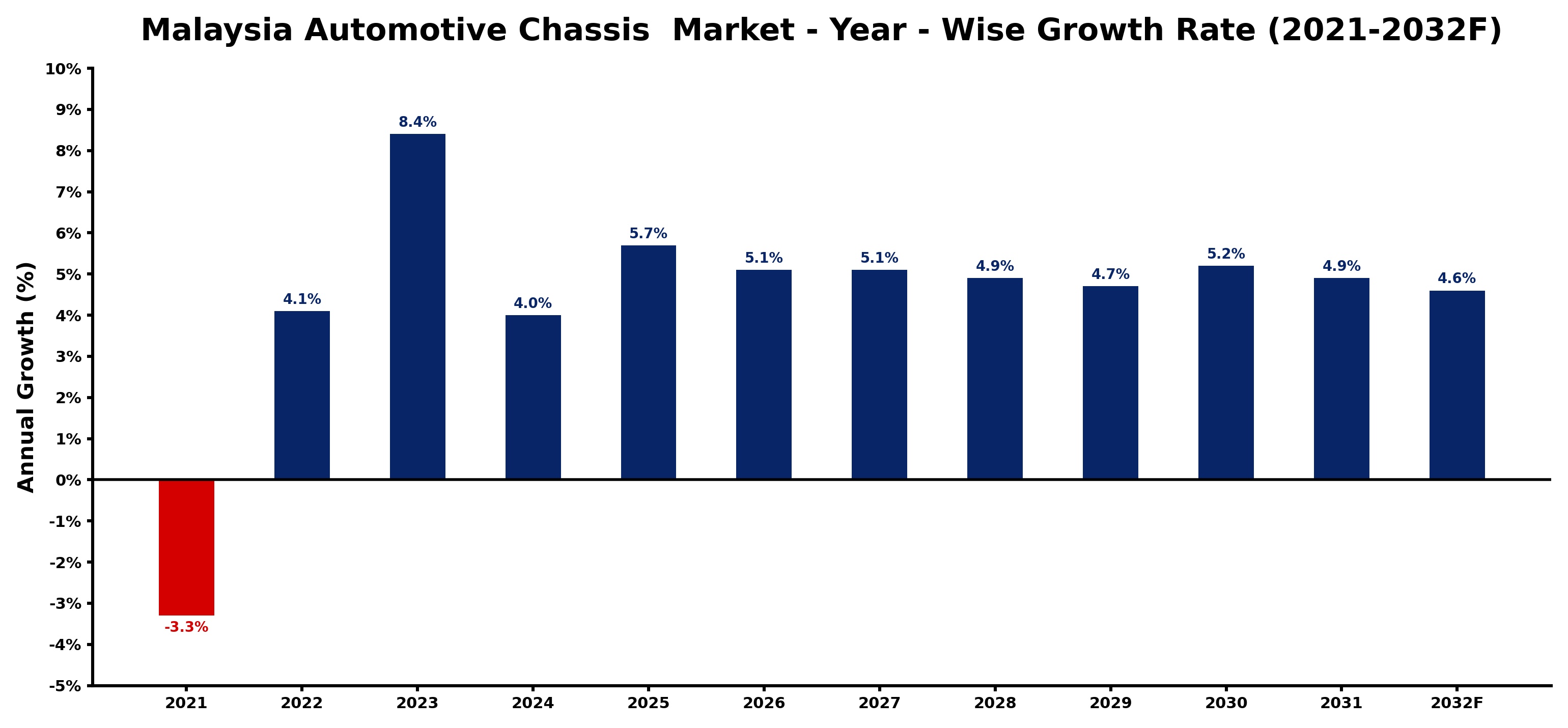
The table below presents the year‑wise growth rates along with the key drivers influencing the market
| Year | Growth Rate | Major Drivers |
| 2021 | -3.3% | Supply chain disruptions affected production |
| 2022 | 4.1% | Electric vehicle adoption accelerated growth |
| 2023 | 8.4% | Technological advancements enhanced efficiency |
| 2024 | 4.0% | Sustainability initiatives drove market expansion |
| 2025 | 5.7% | Increased consumer demand for innovation |
| 2026 | 5.1% | Government incentives promoted investment |
| 2027 | 5.1% | Rising automotive exports boosted revenue |
| 2028 | 4.9% | Industrial activity supported growth |
| 2029 | 4.7% | Growing urbanization increased vehicle demand |
| 2030 | 5.2% | Enhanced manufacturing processes improved output |
| 2031 | 4.9% | R&D investments fostered product development |
| 2032 | 4.6% | Market diversification opened new opportunities |
Note - Market size estimations and growth projections presented in this report are based on 6Wresearch's advanced forecasting approach, validated with industry datasets as of June 2026.
Malaysia Automotive Chassis Market Synopsis
In Malaysia, the automotive chassis market is witnessing a unique surge in demand driven by the country's push towards modernizing its automotive sector. This is not just about manufacturing; it's also about developing a supply chain that can support advanced chassis design and integration, particularly as electrification becomes a prevalent trend.
Additionally, a growing emphasis on vehicle safety and performance has catalyzed interest in innovative chassis solutions. Manufacturers are now prioritizing the integration of advanced materials and techniques to enhance durability and safety, paving the way for a more robust automotive ecosystem.
Malaysia Automotive Chassis Market Key Takeaways
- The market is poised for steady growth, driven by technological advancements and consumer preferences for enhanced safety features.
- Investment in high-quality chassis components is increasing as regulations around vehicle safety continue to tighten.
- Challenges in adapting chassis designs for electrification and autonomous vehicles highlight the need for advanced engineering solutions.
- Key players are focusing on innovative manufacturing techniques to improve chassis dynamics and vehicle performance.
- Government initiatives are expected to further fuel market growth by incentivizing research and development in the automotive sector.
Evaluation of Restraints in Malaysia Automotive Chassis Market
Despite the promising growth trajectory of the Malaysia automotive chassis market, certain restraints are impacting its pace. The rapid evolution of vehicle technologies, particularly in electrification and autonomous driving, presents significant engineering challenges. Manufacturers must continually adapt chassis designs to accommodate new technologies while ensuring that traditional safety and performance standards are not compromised. Furthermore, the pandemic has exposed vulnerabilities in supply chains, causing disruptions that hinder optimal production efficiency.
Malaysia Automotive Chassis Market Trends
Current trends in the Malaysia automotive chassis market are heavily influenced by the shift towards sustainability and technological innovation. The rise of electric vehicles (EVs) necessitates a redesign of chassis structures to accommodate battery systems and associated technologies. Additionally, manufacturers are increasingly exploring the use of lightweight materials, which not only improve fuel efficiency but also enhance performance. This trend towards sustainability aligns with global automotive goals, marking a significant shift in manufacturing practices.
Malaysia Automotive Chassis Market Opportunities
The landscape of the Malaysia automotive chassis market is ripe with opportunities, particularly in research and development. Companies can capitalize on the growing demand for electric and hybrid vehicles by investing in innovative chassis solutions that support these technologies. Additionally, the rise in consumer preference for SUVs and crossovers presents a chance for manufacturers to refine their offerings in chassis design tailored to these segments. Establishing partnerships with technology firms could also foster advancements in autonomous driving capabilities.
Government Initiatives in the Malaysia Automotive Chassis Market
The Malaysian government has launched several initiatives aimed at boosting the automotive industry, with a particular focus on sustainability and technological advancement. Policies encouraging electric vehicle production and investment in R&D are vital to the growth of the automotive chassis market. Incentives for local manufacturers and programs supporting industry collaboration are also significant, fostering an environment where innovation can thrive.
Future Insights of the Malaysia Automotive Chassis Market
Looking ahead to 2026-2032, the Malaysia automotive chassis market is expected to evolve significantly. The push for enhanced safety standards and eco-friendly technologies will drive continuous innovation in chassis design. Companies that adapt swiftly to these changing dynamics will likely gain a competitive edge. As more automakers pivot towards electric and autonomous vehicles, the demand for advanced chassis solutions that meet the unique requirements of these models will escalate, opening new avenues for growth.
Malaysia Automotive Chassis Market Latest Developments (May 2025 - June 2026)
Recent developments in the Malaysian automotive chassis market indicate a marked focus on integrating advanced materials and technologies. Collaborations between local manufacturers and international technology firms are becoming more common as the industry seeks to enhance production capabilities. The adoption of automated manufacturing processes is also on the rise, streamlining operations and improving overall efficiency. As businesses strive to recover from pandemic-induced disruptions, innovative practices are paving the way for a resilient future.
Malaysia Automotive Chassis Market - Key Attractiveness of the Report
- 10 Years of Market Numbers
- Historical Data Starting from 2022 to 2025
- Base Year: 2025
- Forecast Data until 2032
- Key Performance Indicators Impacting the Market
- Major Upcoming Developments and Projects
Key Highlights of the Report:
- Malaysia Automotive Chassis Market Outlook
- Market Size of Malaysia Automotive Chassis Market, 2025
- Forecast of Malaysia Automotive Chassis Market, 2032F
- Historical Data and Forecast of Malaysia Automotive Chassis Revenues & Volume for the Period 2022-2032F
- Malaysia Automotive Chassis Market Trend Evolution
- Malaysia Automotive Chassis Market Drivers and Challenges
- Malaysia Automotive Chassis Price Trends
- Malaysia Automotive Chassis Porter's Five Forces
- Malaysia Automotive Chassis Industry Life Cycle
- Historical Data and Forecast of Malaysia Automotive Chassis Market Revenues & Volume By Chassis Type for the Period 2022-2032F
- Historical Data and Forecast of Malaysia Automotive Chassis Market Revenues & Volume By Backbone for the Period 2022-2032F
- Historical Data and Forecast of Malaysia Automotive Chassis Market Revenues & Volume By Ladder for the Period 2022-2032F
- Historical Data and Forecast of Malaysia Automotive Chassis Market Revenues & Volume By Monocoque for the Period 2022-2032F
- Historical Data and Forecast of Malaysia Automotive Chassis Market Revenues & Volume By Modular for the Period 2022-2032F
- Historical Data and Forecast of Malaysia Automotive Chassis Market Revenues & Volume By Material for the Period 2022-2032F
- Historical Data and Forecast of Malaysia Automotive Chassis Market Revenues & Volume By Steel for the Period 2022-2032F
- Historical Data and Forecast of Malaysia Automotive Chassis Market Revenues & Volume By Aluminum Alloy for the Period 2022-2032F
- Historical Data and Forecast of Malaysia Automotive Chassis Market Revenues & Volume By Carbon Fiber Composite for the Period 2022-2032F
- Historical Data and Forecast of Malaysia Automotive Chassis Market Revenues & Volume By Electric Vehicle for the Period 2022-2032F
- Historical Data and Forecast of Malaysia Automotive Chassis Market Revenues & Volume By BEV for the Period 2022-2032F
- Historical Data and Forecast of Malaysia Automotive Chassis Market Revenues & Volume By PHEV for the Period 2022-2032F
- Historical Data and Forecast of Malaysia Automotive Chassis Market Revenues & Volume By HEV for the Period 2022-2032F
- Historical Data and Forecast of Malaysia Automotive Chassis Market Revenues & Volume By Vehicle Type for the Period 2022-2032F
- Historical Data and Forecast of Malaysia Automotive Chassis Market Revenues & Volume By PC for the Period 2022-2032F
- Historical Data and Forecast of Malaysia Automotive Chassis Market Revenues & Volume By CV for the Period 2022-2032F
- Malaysia Automotive Chassis Import Export Trade Statistics
- Market Opportunity Assessment By Chassis Type
- Market Opportunity Assessment By Material
- Market Opportunity Assessment By Electric Vehicle
- Market Opportunity Assessment By Vehicle Type
- Malaysia Automotive Chassis Top Companies Market Share
- Malaysia Automotive Chassis Competitive Benchmarking By Technical and Operational Parameters
- Malaysia Automotive Chassis Company Profiles
- Malaysia Automotive Chassis Key Strategic Recommendations






































