Malaysia Aviation Market Size, Share & Growth Rate
The Malaysia Aviation Market was estimated at USD 399 Million in 2025 and is projected to reach USD 521 Million by 2032, growing at a CAGR of 3.9% from 2026 to 2032. This trajectory is driven primarily by the rebound in passenger traffic as tourism recovers and a burgeoning middle class increasingly opts for air travel. The commitment to infrastructure enhancement and regulatory reform further supports this positive outlook, positioning Malaysia as a significant player in the regional aviation landscape.
Malaysia Aviation Market Year-wise Growth Rate and Key Drivers
This graph highlights how the Malaysia Aviation Market has steadily grown over the years, supported by major growth factors.
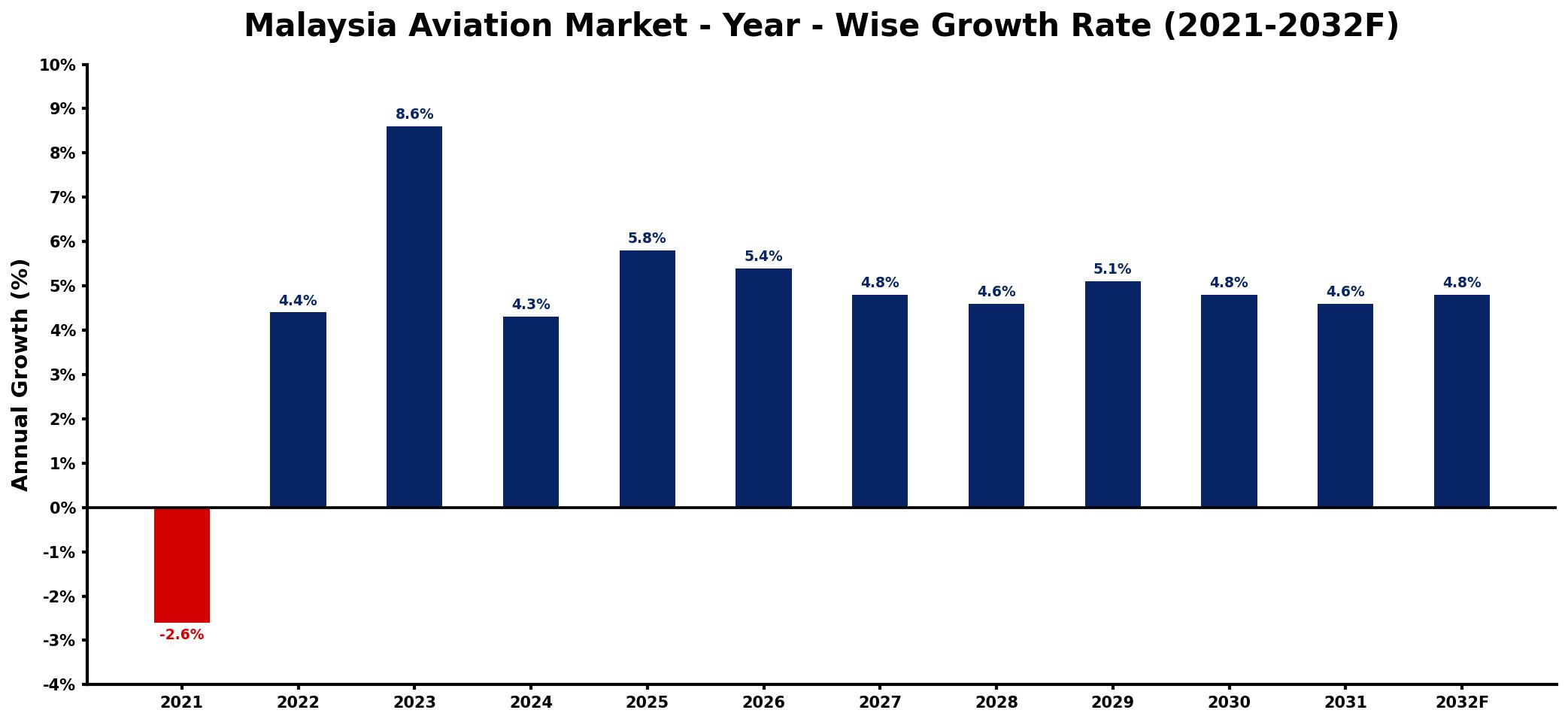
The table below presents the year‑wise growth rates along with the key drivers influencing the market
| Year | Growth Rate | Major Drivers |
| 2021 | -2.6% | decreased travel demand globally |
| 2022 | 4.4% | increased domestic leisure travel |
| 2023 | 8.6% | surge in international tourism |
| 2024 | 4.3% | expansion of airline routes |
| 2025 | 5.8% | growth in cargo transport |
| 2026 | 5.4% | rise in business travel |
| 2027 | 4.8% | enhanced airport infrastructure investment |
| 2028 | 4.6% | development of eco-friendly technologies |
| 2029 | 5.1% | increased foreign investments influx |
| 2030 | 4.8% | growing demand for low-cost carriers |
| 2031 | 4.6% | growing commercial sector adoption |
| 2032 | 4.8% | innovation in travel services |
Note: Market size estimations and growth projections presented in this report are based on 6Wresearch's proprietary forecasting methodology, utilizing the latest available industry data, government publications, and primary research inputs.
Malaysia Aviation Market Synopsis
The Malaysian aviation market stands out for its strategic positioning within Southeast Asia, facilitating a blend of both passenger and cargo traffic. Its well-established network of airports is a critical enabler, ensuring connectivity not only within the region but also to global destinations.
This sector is buoyed by a growing middle-class population, which is increasingly willing to allocate disposable income for travel experiences. Government investments in aviation infrastructure, coupled with the rise of low-cost carriers, create a dynamic environment ripe for expansion.
Malaysia Aviation Market Key Takeaways
- The aviation sector is positioned for steady growth fueled by rising air travel demand and tourism resurgence.
- Government infrastructure initiatives play a pivotal role in supporting market expansion.
- Low-cost carriers are becoming an increasingly dominant force in shaping market dynamics.
- Challenges related to safety and environmental sustainability necessitate proactive industry engagement.
- Strategic collaborations with international airlines enhance Malaysia's connectivity and competitiveness.
Evaluation of Restraints in Malaysia Aviation Market
Despite the growth potential, the Malaysia aviation market faces several real constraints. Regulatory compliance remains a significant hurdle, as airlines must navigate complex safety standards that continually evolve. The industry's recovery from the lasting impacts of the COVID-19 pandemic also presents challenges, especially in restoring consumer confidence in air travel. Additionally, competition from other regional hubs and the pressing need for environmental sustainability demand an agile and adaptive approach from market players.
Malaysia Aviation Market Trends
Several key trends are shaping the aviation landscape in Malaysia. A notable shift towards digital transformation is underway, with airlines investing in technology to streamline operations and enhance customer experiences. Moreover, sustainability is gaining traction, prompting airlines to explore greener technologies and practices. The emergence of new routes and partnerships further reflects the market's evolving nature, responding to both consumer demand and global tourism trends.
Malaysia Aviation Market Opportunities
Investment opportunities in the Malaysia aviation market are rich and varied. The ongoing expansion of airport infrastructure presents numerous avenues for public-private partnerships. Additionally, the growing demand for cargo services, driven by e-commerce, offers prospects for airlines to diversify their service offerings. Innovative passenger services and the adoption of sustainable aviation practices also create potential for differentiation and competitive advantage.
Government Initiatives in the Malaysia Aviation Market
The Malaysian government is actively supporting the aviation sector through various initiatives aimed at enhancing infrastructure and connectivity. Policies promoting tourism, such as visa facilitation and marketing campaigns, are crucial in driving passenger traffic. Additionally, investments in airport upgrades and modernization projects reflect a commitment to maintaining Malaysia's status as a competitive aviation hub in Southeast Asia. Regulatory reforms designed to streamline operations and improve safety standards further bolster industry resilience.
Future Insights of the Malaysia Aviation Market
Looking ahead to 2026-2032, the Malaysia aviation market is poised for a robust recovery and sustainable growth trajectory. As global travel dynamics stabilize, Malaysia's strategic location and enhanced air travel infrastructure will serve as key enablers of its competitiveness in the region. With ongoing investments and a focus on digital transformation, the market is likely to adapt to evolving consumer preferences, ensuring its relevance in the fast-changing aviation landscape.
Malaysia Aviation Market Latest Developments (2025 - 2026)
In recent months, the Malaysia aviation sector has seen a flurry of activity aimed at revitalizing operations post-COVID-19. Airlines are ramping up flight schedules to meet increasing demand, while airport authorities are implementing enhanced safety protocols to reassure travelers. Collaborative efforts between government bodies and private airlines focus on leveraging technology to improve operational efficiency and passenger experience. Additionally, sustainability initiatives are gaining ground as stakeholders align their strategies with global environmental goals.
Malaysia Aviation Market - Key Attractiveness of the Report
- 10 Years of Market Numbers
- Historical Data Starting from 2022 to 2025
- Base Year: 2025
- Forecast Data until 2032
- Key Performance Indicators Impacting the Market
- Major Upcoming Developments and Projects
Key Highlights of the Report:
- Malaysia Aviation Market Outlook
- Market Size of Malaysia Aviation Market, 2025
- Forecast of Malaysia Aviation Market, 2032
- Historical Data and Forecast of Malaysia Aviation Revenues & Volume for the Period 2022-2032F
- Malaysia Aviation Market Trend Evolution
- Malaysia Aviation Market Drivers and Challenges
- Malaysia Aviation Price Trends
- Malaysia Aviation Porter's Five Forces
- Malaysia Aviation Industry Life Cycle
- Historical Data and Forecast of Malaysia Aviation Market Revenues & Volume By Type for the Period 2022-2032F
- Historical Data and Forecast of Malaysia Aviation Market Revenues & Volume By Commercial Aviation for the Period 2022-2032F
- Historical Data and Forecast of Malaysia Aviation Market Revenues & Volume By Military Aviation for the Period 2022-2032F
- Historical Data and Forecast of Malaysia Aviation Market Revenues & Volume By General Aviation for the Period 2022-2032F
- Malaysia Aviation Import Export Trade Statistics
- Market Opportunity Assessment By Type
- Malaysia Aviation Top Companies Market Share
- Malaysia Aviation Competitive Benchmarking By Technical and Operational Parameters
- Malaysia Aviation Company Profiles
- Malaysia Aviation Key Strategic Recommendations






































