Malaysia Canned Fruits Market Summary
The malaysia canned fruits market was estimated at USD 155 Million in 2025 and is projected to reach USD 201 Million by 2032, growing at a CAGR of 5.5% from 2026 to 2032.
Malaysia Canned Fruits Market Year-wise Growth Rate and Key Drivers
This graph highlights how the Malaysia Canned Fruits Market has steadily grown over the past five years, supported by major growth factors.
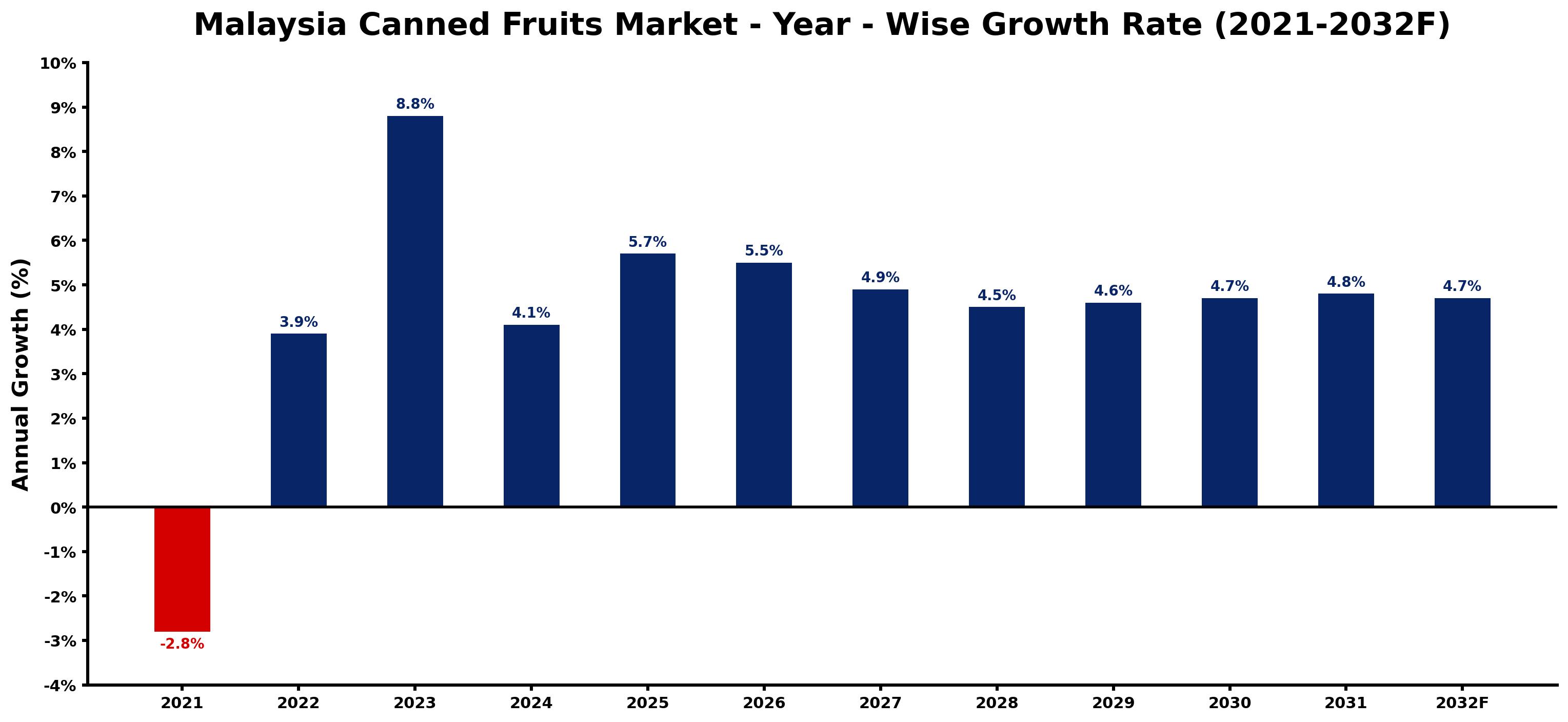
The table below presents the year wise growth rates along with the key drivers influencing the market
| Year | Growth Rate | Major Drivers |
| 2021 | -2.8% | Increased health awareness shifted consumer preferences away from sugary canned products, impacting overall sales negatively. |
| 2022 | 3.9% | Urbanization trends support higher consumption rates of convenient canned fruit products. |
| 2023 | 8.8% | Local brands frequently introduce innovative flavors, captivating customer interest significantly. |
| 2024 | 4.1% | Distribution channel expansion enhances product availability across rural and urban areas. |
| 2025 | 5.7% | Sustainability concerns lead manufacturers to adopt eco-friendly packaging solutions. |
| 2026 | 5.5% | E-commerce platforms gain traction, facilitating easier access to canned fruit products. |
| 2027 | 4.9% | Consumer preferences shift towards organic options, impacting traditional fruit canned goods. |
| 2028 | 4.5% | Cross-industry collaborations drive fresh marketing approaches, attracting diverse customer demographics. |
| 2029 | 4.6% | Health trends emphasize fruit intake, fortifying canned goods as convenient dietary solutions. |
| 2030 | 4.7% | Technological advancements streamline production, improving efficiency and reducing costs significantly. |
| 2031 | 4.8% | Global supply chain improvements stabilize raw fruit availability, enhancing local production capabilities. |
| 2032 | 4.7% | Increased tourism fuels demand for local canned fruit brands among international visitors. |
Note - Market size estimations and growth projections presented in this report are based on 6Wresearch's advanced forecasting approach, validated with industry datasets as of June 2026.
Malaysia Canned Fruits Market Synopsis
The Malaysia Canned Fruits Market is projected to reach 5.5% and witness significant growth during the forecast period (2026-2032). This growth trajectory is primarily driven by a surge in health consciousness among the Malaysian populace and an increase in disposable incomes. As consumers become more aware of the nutritional benefits of fruits, the market for canned fruits is expanding, facilitating a shift towards more convenient food options. Additionally, the fast-paced lifestyle of many Malaysians has resulted in a heightened demand for ready-to-eat and ready-to-cook food products, including canned fruits, which offer convenience without sacrificing nutritional value.
Malaysia Canned Fruits Market Growth Drivers
Several factors contribute to the robust growth of the Malaysia canned fruits market. First, the increasing health awareness among consumers has made canned fruits an attractive option for those seeking nutrient-dense foods. Second, rising disposable incomes enable consumers to spend more on higher-quality food products, further propelling market demand. Third, busy lifestyles are driving a trend towards convenience foods, with canned fruits providing a quick and easy solution to incorporate fruit into daily diets. Fourth, innovative marketing strategies and product diversification that cater to local tastes are helping companies tap into new consumer segments. Finally, the COVID-19 pandemic has shifted consumer preferences towards packaged food options, reinforcing the demand for canned fruits.
Malaysia Canned Fruits Market Trends and Opportunities
The Malaysia canned fruits market is witnessing notable trends that present compelling opportunities. One significant trend is the growing preference for natural and organic canned fruit options, as consumers increasingly scrutinize food labels for quality ingredients. Additionally, the demand for exotic flavors and limited-edition seasonal blends is gaining momentum, allowing brands to distinguish themselves in a competitive landscape. The rise of e-commerce platforms enhances market accessibility, enabling consumers to purchase canned fruits more conveniently from the comfort of their homes. Companies are also leveraging social media to promote their brands and engage with consumers, creating a direct channel to capture market insights and preferences.
Malaysia Canned Fruits Market Challenges and Restraints
Despite its growth potential, the Malaysia canned fruits market faces several challenges. A primary concern is the perception of canned fruits as less fresh compared to their fresh counterparts, which can deter health-conscious consumers. Additionally, fluctuating raw material prices impact profit margins for manufacturers, posing a challenge to sustainability in pricing strategies. The presence of stringent food safety regulations also mandates compliance, which can increase operational costs for companies. Furthermore, competition from fresh fruit vendors and alternative snack options presents ongoing challenges, requiring businesses to continuously innovate and adapt to consumer preferences.
Malaysia Canned Fruits Market Government Investment and Initiatives
The Malaysian government has recognized the potential of the canned fruits sector and is implementing various initiatives to support its growth. Investments in food processing infrastructure aim to enhance efficiency and quality, benefiting manufacturers and consumers alike. Public spending on agricultural development programs focuses on improving the supply chain for fruit growers, ensuring a steady supply of quality produce for canning. Additionally, government incentives for innovation in processing technologies are encouraging companies to adopt modern practices that increase competitiveness in the global market. Collaborative efforts between governmental bodies and industry stakeholders are fostering a supportive environment for business growth and expansion within the canned fruits sector.
Malaysia Canned Fruits Market Latest Developments (May 2025 - June 2026)
Recent developments in the Malaysia canned fruits market indicate a shift towards more diverse and health-oriented product offerings. Companies are increasingly focusing on launching products that incorporate unique flavors and high-quality ingredients, responding to the evolving consumer demand for innovation. The trend towards sustainability is gaining traction, with firms exploring eco-friendly packaging solutions to appeal to environmentally conscious consumers. Furthermore, the expansion of distribution channels, including online sales platforms, is reshaping the retail landscape, making it easier for consumers to access a wider variety of canned fruits. This period has also seen increased collaboration among brands to co-develop products, leveraging each other's strengths to capture larger market shares.
Malaysia Canned Fruits Market - Key Attractiveness of the Report
- 10 Years of Market Numbers
- Historical Data Starting from 2022 to 2025
- Base Year: 2025
- Forecast Data until 2032
- Key Performance Indicators Impacting the Market
- Major Upcoming Developments and Projects
Key Highlights of the Report:
- Malaysia Canned Fruits Market Outlook
- Market Size of Malaysia Canned Fruits Market, 2025
- Forecast of Malaysia Canned Fruits Market, 2032F
- Historical Data and Forecast of Malaysia Canned Fruits Revenues & Volume for the Period 2022-2032F
- Malaysia Canned Fruits Market Trend Evolution
- Malaysia Canned Fruits Market Drivers and Challenges
- Malaysia Canned Fruits Price Trends
- Malaysia Canned Fruits Porter's Five Forces
- Malaysia Canned Fruits Industry Life Cycle
- Historical Data and Forecast of Malaysia Canned Fruits Market Revenues & Volume By Fruit Type for the Period 2022-2032F
- Historical Data and Forecast of Malaysia Canned Fruits Market Revenues & Volume By Peaches for the Period 2022-2032F
- Historical Data and Forecast of Malaysia Canned Fruits Market Revenues & Volume By Pineapple for the Period 2022-2032F
- Historical Data and Forecast of Malaysia Canned Fruits Market Revenues & Volume By Mandarin oranges for the Period 2022-2032F
- Historical Data and Forecast of Malaysia Canned Fruits Market Revenues & Volume By Pears for the Period 2022-2032F
- Historical Data and Forecast of Malaysia Canned Fruits Market Revenues & Volume By Others for the Period 2022-2032F
- Historical Data and Forecast of Malaysia Canned Fruits Market Revenues & Volume By Form for the Period 2022-2032F
- Historical Data and Forecast of Malaysia Canned Fruits Market Revenues & Volume By Whole fruits for the Period 2022-2032F
- Historical Data and Forecast of Malaysia Canned Fruits Market Revenues & Volume By Cut fruits for the Period 2022-2032F
- Historical Data and Forecast of Malaysia Canned Fruits Market Revenues & Volume By Distribution Channel for the Period 2022-2032F
- Historical Data and Forecast of Malaysia Canned Fruits Market Revenues & Volume By Supermarkets/Hypermarkets for the Period 2022-2032F
- Historical Data and Forecast of Malaysia Canned Fruits Market Revenues & Volume By Convenience Stores for the Period 2022-2032F
- Historical Data and Forecast of Malaysia Canned Fruits Market Revenues & Volume By Online Retail for the Period 2022-2032F
- Historical Data and Forecast of Malaysia Canned Fruits Market Revenues & Volume By Other for the Period 2022-2032F
- Malaysia Canned Fruits Import Export Trade Statistics
- Market Opportunity Assessment By Fruit Type
- Market Opportunity Assessment By Form
- Market Opportunity Assessment By Distribution Channel
- Malaysia Canned Fruits Top Companies Market Share
- Malaysia Canned Fruits Competitive Benchmarking By Technical and Operational Parameters
- Malaysia Canned Fruits Company Profiles
- Malaysia Canned Fruits Key Strategic Recommendations






































