Nepal Canned Fruits Market Summary
The nepal canned fruits market was estimated at USD 208 Million in 2025 and is projected to reach USD 283 Million by 2032, growing at a CAGR of 5.3% from 2026 to 2032.
Nepal Canned Fruits Market Year-wise Growth Rate and Key Drivers
This graph highlights how the Nepal Canned Fruits Market has steadily grown over the past five years, supported by major growth factors.
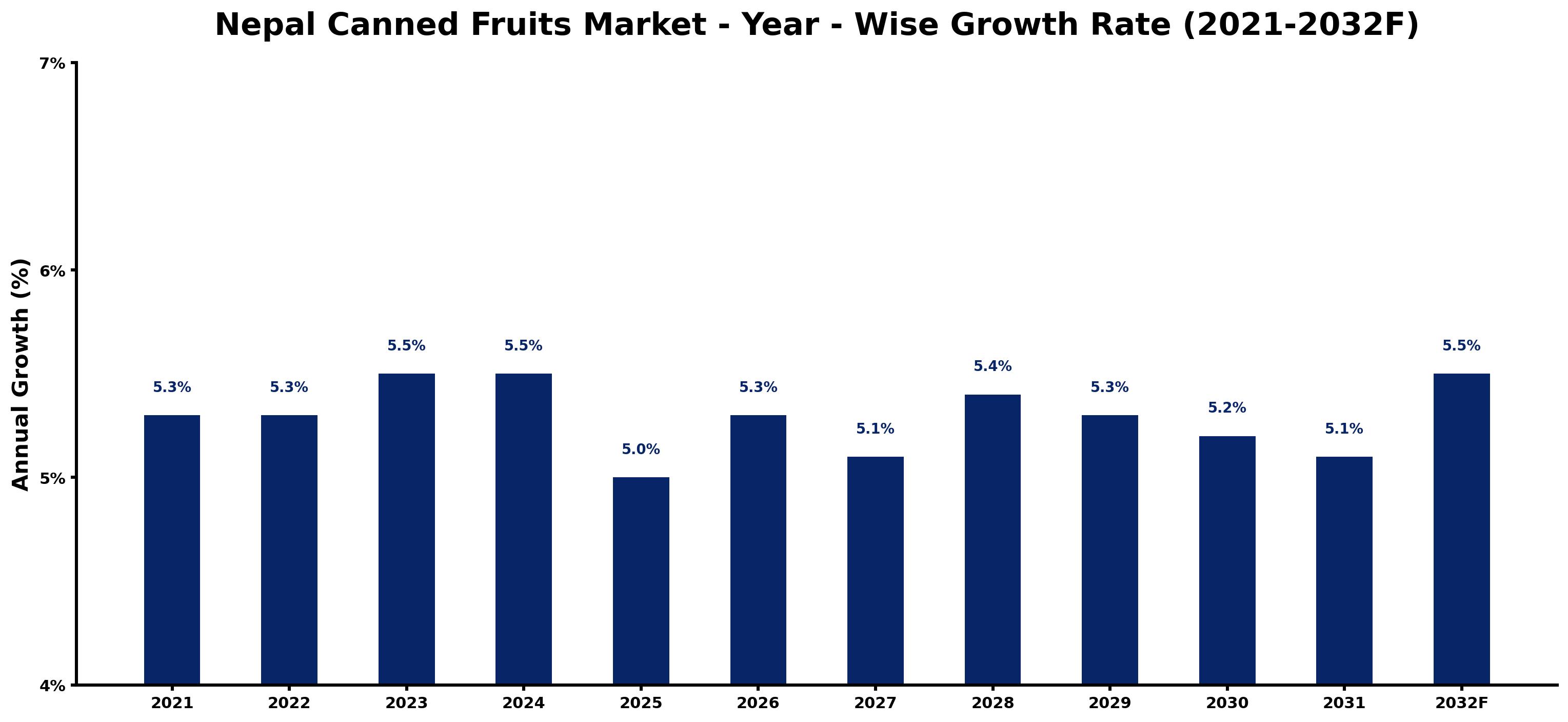
The table below presents the year wise growth rates along with the key drivers influencing the market
| Year | Growth Rate | Major Drivers |
| 2021 | 5.3% | Consumer awareness around health benefits of canned fruits began to increase noticeably. |
| 2022 | 5.3% | Retail channels expanded, with new supermarkets introducing dedicated canned fruit sections. |
| 2023 | 5.5% | Local farmers began collaborating with brands to create unique canned fruit offerings. |
| 2024 | 5.5% | Urbanization trends led to higher demand for convenient food options among busy families. |
| 2025 | 5.0% | Market players focused on sustainable sourcing, aligning with eco-conscious consumer preferences. |
| 2026 | 5.3% | E-commerce platforms gained traction, simplifying access to various canned fruit products. |
| 2027 | 5.1% | Innovative flavors and packaging attracted younger consumers seeking novel experiences. |
| 2028 | 5.4% | Regional festivals celebrated local canned producers, enhancing brand visibility and consumer loyalty. |
| 2029 | 5.3% | Health-conscious trends drove demand for low-sugar and organic canned fruit options. |
| 2030 | 5.2% | International trade agreements facilitated import of premium canned fruit brands into Nepal. |
| 2031 | 5.1% | Food service establishments increasingly incorporated canned fruits into their menu offerings. |
| 2032 | 5.5% | Rising disposable incomes allowed consumers to explore premium canned fruit products. |
Note - Market size estimations and growth projections presented in this report are based on 6Wresearch's advanced forecasting approach, validated with industry datasets as of June 2026.
Nepal Canned Fruits Market Synopsis
The Nepal Canned Fruits Market is projected to reach 5.3% and witness significant growth during the forecast period (2026-2032). This growth trajectory is attributed to shifting consumer preferences towards convenient and nutritious food options. Factors such as rising disposable incomes, urbanization, and an increasing awareness of the health benefits associated with canned fruits are driving demand. The market features a diverse array of products, including pineapples, peaches, pears, and mixed fruit cocktails, appealing to a broad consumer demographic. As convenience becomes a priority, the role of canned fruits in the daily diet continues to evolve, positioning this market for favorable prospects.
Nepal Canned Fruits Market Growth Drivers
The growth of the Nepal Canned Fruits Market can be attributed to several key drivers:
- Changing consumer lifestyles are increasingly favoring convenience, prompting a shift towards ready-to-eat products. This has elevated the profile of canned fruits as an accessible food option for busy consumers.
- Increasing disposable incomes among the Nepalese population have enhanced purchasing power, enabling consumers to opt for higher-quality canned fruit products over traditional fresh options.
- The nutritional benefits associated with canned fruits, including their longer shelf life and preservation of vitamins, resonate well with health-conscious consumers, further boosting market demand.
- Modern retail channels and the growing trend of online shopping facilitate easier access to a wide range of canned fruits, expanding market reach beyond urban centers into rural areas.
- Innovative marketing strategies and diverse product offerings are catering to evolving consumer tastes, including the introduction of gourmet and organic canned fruit options.
Nepal Canned Fruits Market Trends and Opportunities
A notable trend within the Nepal Canned Fruits Market is the increasing demand for healthier and environmentally friendly food options. Consumers are gravitating towards products that not only provide convenience but also align with their health and sustainability values.
- There is a rising inclination towards organic canned fruits, driven by growing consumer awareness about the benefits of organic produce and the harmful effects of preservatives.
- Exotic flavor profiles and gourmet canned fruit varieties are gaining traction, as consumers actively seek unique culinary experiences and premium product alternatives.
- Sustainable packaging solutions are becoming more prevalent, with companies exploring eco-friendly materials to reduce their environmental footprint and appeal to eco-conscious consumers.
- The market is witnessing an increased integration of technology, with online platforms enhancing the shopping experience, allowing consumers to browse and purchase from a broader selection.
- Health trends, including the desire for snacks with higher nutritional value, are solidifying the demand for canned fruits as a favored option in a balanced diet.
Nepal Canned Fruits Market Challenges and Restraints
Despite the positive outlook, the Nepal Canned Fruits Market faces several challenges that may hinder its growth:
- Seasonal variations limit the availability of high-quality fruits for canning, causing fluctuations in supply and impacting production consistency.
- Inconsistent supply chain infrastructure affects distribution efficiency, potentially leading to delayed product availability in various regions.
- Lack of awareness regarding the benefits of canned fruits among consumers, particularly in rural areas, constrains market penetration and broader acceptance.
- Price competition from fresh fruits and alternative snack options presents a significant challenge, as many consumers still prefer traditional, unprocessed choices.
- Compliance with packaging and labeling regulations can be complex, especially in a country with diverse climatic conditions that influence shelf-life and product freshness.
Nepal Canned Fruits Market Investment Opportunities
The evolving landscape of the Nepal Canned Fruits Market presents various investment opportunities for stakeholders:
- Investors can explore the establishment or expansion of canned fruit production facilities to meet growing consumer demand, ensuring a steady supply of products.
- Research and development initiatives focused on flavor innovation and packaging enhancements can create competitive advantages for companies in a crowded marketplace.
- Strategic partnerships with local fruit producers can foster a reliable supply chain, helping to mitigate fluctuations in raw material availability while supporting local economies.
- Exploring export potential to neighboring countries represents another opportunity for growth, as demand for canned fruits is likely to rise in regional markets.
- Investments aimed at improving sustainability practices within the industry can enhance brand reputation and appeal, aligning with shifting consumer preferences towards eco-friendly options.
Nepal Canned Fruits Market Government Investment and Initiatives
The Nepalese government has implemented various policies and initiatives aimed at supporting the canned fruits market. Key regulations include the Food Act, which establishes standards for product labeling, packaging, and quality to ensure consumer safety. Tariffs and import restrictions on canned fruits have been introduced to encourage local production and promote self-sufficiency within the market. Furthermore, the Department of Food Technology and Quality Control plays a critical role in enforcing these standards, aiming to prevent the entry of substandard products into the market. Such government initiatives are essential for fostering a competitive environment that emphasizes quality and local production, thereby shaping the landscape of the Nepal Canned Fruits Market.
Nepal Canned Fruits Market Latest Developments (May 2025 - June 2026)
Recent developments in the Nepal Canned Fruits Market indicate a growing emphasis on product diversification and sustainability. Industry players are increasingly focusing on incorporating organic ingredients and environmentally friendly packaging in response to consumer demand. The rise of online retail has also facilitated access to a broader variety of canned fruit products, while marketing efforts are being directed toward educating potential customers about the nutritional benefits associated with canned fruits. Additionally, there is an observable shift towards innovative flavors and gourmet offerings, catering to the evolving tastes of consumers. These trends suggest a dynamic market landscape, poised to evolve further as consumer preferences continue to shift.
Nepal Canned Fruits Market - Key Attractiveness of the Report
- 10 Years of Market Numbers
- Historical Data Starting from 2022 to 2025
- Base Year: 2025
- Forecast Data until 2032
- Key Performance Indicators Impacting the Market
- Major Upcoming Developments and Projects
Key Highlights of the Report:
- Nepal Canned Fruits Market Outlook
- Market Size of Nepal Canned Fruits Market, 2025
- Forecast of Nepal Canned Fruits Market, 2032F
- Historical Data and Forecast of Nepal Canned Fruits Revenues & Volume for the Period 2022-2032F
- Nepal Canned Fruits Market Trend Evolution
- Nepal Canned Fruits Market Drivers and Challenges
- Nepal Canned Fruits Price Trends
- Nepal Canned Fruits Porter's Five Forces
- Nepal Canned Fruits Industry Life Cycle
- Historical Data and Forecast of Nepal Canned Fruits Market Revenues & Volume By Fruit Type for the Period 2022-2032F
- Historical Data and Forecast of Nepal Canned Fruits Market Revenues & Volume By Peaches for the Period 2022-2032F
- Historical Data and Forecast of Nepal Canned Fruits Market Revenues & Volume By Pineapple for the Period 2022-2032F
- Historical Data and Forecast of Nepal Canned Fruits Market Revenues & Volume By Mandarin oranges for the Period 2022-2032F
- Historical Data and Forecast of Nepal Canned Fruits Market Revenues & Volume By Pears for the Period 2022-2032F
- Historical Data and Forecast of Nepal Canned Fruits Market Revenues & Volume By Others for the Period 2022-2032F
- Historical Data and Forecast of Nepal Canned Fruits Market Revenues & Volume By Form for the Period 2022-2032F
- Historical Data and Forecast of Nepal Canned Fruits Market Revenues & Volume By Whole fruits for the Period 2022-2032F
- Historical Data and Forecast of Nepal Canned Fruits Market Revenues & Volume By Cut fruits for the Period 2022-2032F
- Historical Data and Forecast of Nepal Canned Fruits Market Revenues & Volume By Distribution Channel for the Period 2022-2032F
- Historical Data and Forecast of Nepal Canned Fruits Market Revenues & Volume By Supermarkets/Hypermarkets for the Period 2022-2032F
- Historical Data and Forecast of Nepal Canned Fruits Market Revenues & Volume By Convenience Stores for the Period 2022-2032F
- Historical Data and Forecast of Nepal Canned Fruits Market Revenues & Volume By Online Retail for the Period 2022-2032F
- Historical Data and Forecast of Nepal Canned Fruits Market Revenues & Volume By Other for the Period 2022-2032F
- Nepal Canned Fruits Import Export Trade Statistics
- Market Opportunity Assessment By Fruit Type
- Market Opportunity Assessment By Form
- Market Opportunity Assessment By Distribution Channel
- Nepal Canned Fruits Top Companies Market Share
- Nepal Canned Fruits Competitive Benchmarking By Technical and Operational Parameters
- Nepal Canned Fruits Company Profiles
- Nepal Canned Fruits Key Strategic Recommendations






































