Malaysia Clutch Housing Market Size, Share & Growth Rate
The Malaysia Clutch Housing Market was estimated at USD 492 Million in 2025 and is projected to reach USD 641 Million by 2032, growing at a CAGR of 3.9% from 2026 to 2032. This growth trajectory is primarily fueled by the robust expansion of the automotive industry, which is driving demand for essential transmission components. Additionally, a rising consumer preference for fuel-efficient vehicles is pushing manufacturers to innovate in clutch housing technology.
Malaysia Clutch Housing Market Year-wise Growth Rate and Key Drivers
This graph highlights how the Malaysia Clutch Housing Market has steadily grown over the years, supported by major growth factors.
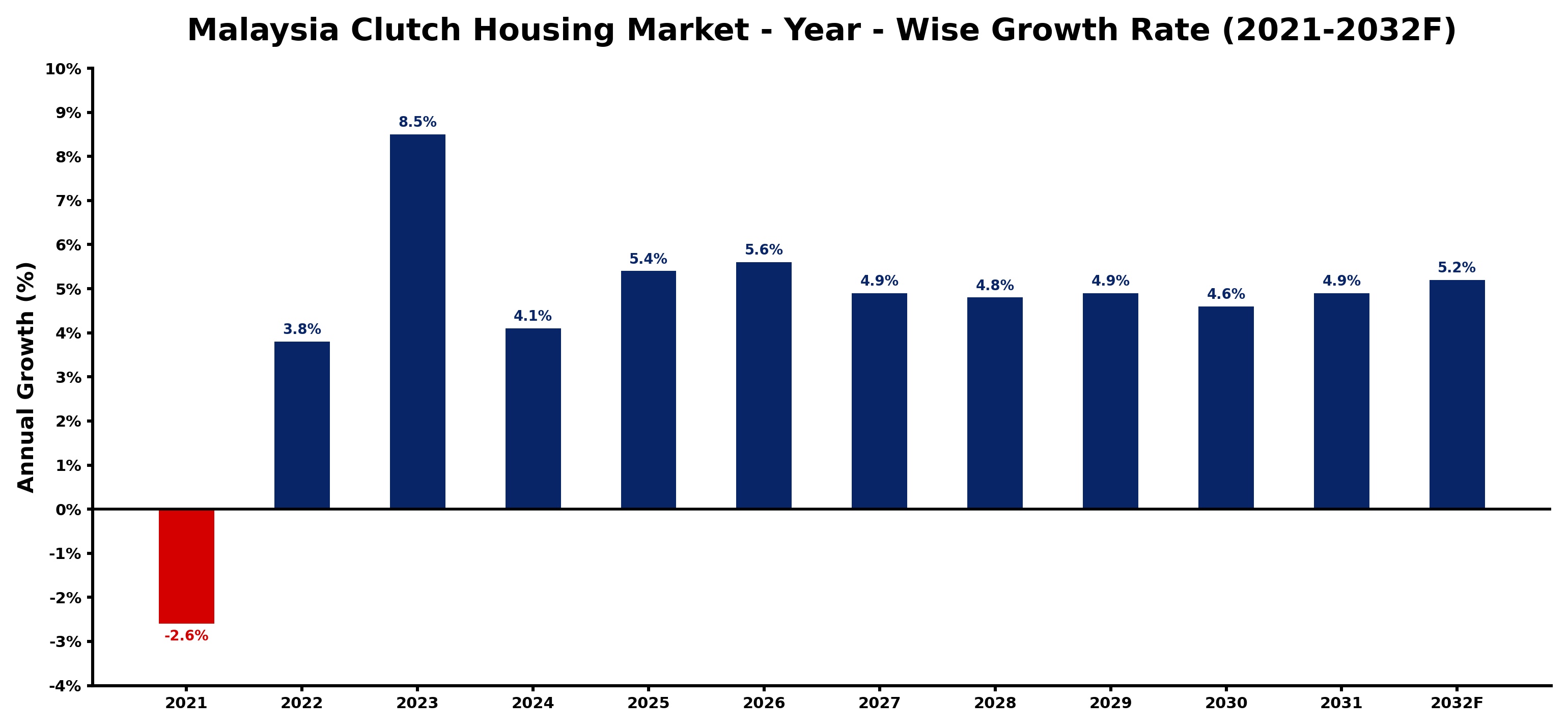
The table below presents the year‑wise growth rates along with the key drivers influencing the market
| Year | Growth Rate | Major Drivers |
| 2021 | -2.6% | Weaker automotive sector demand hindered clutch housing production output |
| 2022 | 3.8% | Export driven automotive sector modernization boosts precision machining investments |
| 2023 | 8.5% | Precision engineering investments boost clutch housing production capacity |
| 2024 | 4.1% | Export driven automotive component production boosted clutch housing demand |
| 2025 | 5.4% | Technology integration boosts precision engineering in clutch housing production |
| 2026 | 5.6% | Increased demand for precision engineering boosts clutch housing output |
| 2027 | 4.9% | Precision engineering advancements drive clutch housing production efficiencies |
| 2028 | 4.8% | Precision engineering investments enhanced clutch housing production efficiency |
| 2029 | 4.9% | Precision engineering investments boosted clutch housing manufacturing capacity |
| 2030 | 4.6% | Precision engineering advancements improved clutch housing production efficiency |
| 2031 | 4.9% | Precision engineering adoption improved clutch housing production efficiency |
| 2032 | 5.2% | OEM production ramp up boosted demand for precision machining services |
Note - Market size estimations and growth projections presented in this report are based on 6Wresearch’s advanced forecasting approach, validated with industry datasets as of June 2026.
Malaysia Clutch Housing Market Synopsis
The surge in automotive manufacturing and sales stands as the most significant force currently shaping the Malaysia Clutch Housing Market. The increasing production of passenger and commercial vehicles necessitates a reliable supply of clutch housings, thereby creating opportunities for domestic manufacturers.
Moreover, the ongoing trend towards lightweight vehicles enhances the demand for innovative clutch housing solutions. As automotive technologies evolve, there is an increasing need for materials and designs that support improved fuel efficiency without compromising performance.
Malaysia Clutch Housing Market Key Takeaways
- The market is projected to grow steadily, driven by the flourishing automotive sector.
- Consumer demand for lightweight, fuel-efficient vehicles is shaping clutch housing designs.
- Electric vehicle advancements could potentially disrupt traditional clutch component markets.
- Domestic manufacturers face competition from cost-effective imports and aftermarket solutions.
- Investment in R&D is vital for advancing clutch housing technologies and maintaining market relevance.
Evaluation of Restraints in Malaysia Clutch Housing Market
The Malaysia Clutch Housing Market faces notable restraints primarily due to the declining demand for manual transmission vehicles. As the automotive landscape increasingly shifts towards automatic and electric vehicles, the reliance on traditional clutch systems diminishes. Additionally, the influx of low-cost imports poses a challenge for local manufacturers, which may struggle to compete on price without sacrificing quality. This market dynamic necessitates strategic adaptations, emphasizing product diversification and innovation.
Malaysia Clutch Housing Market Trends
Significant trends influencing the Malaysia Clutch Housing Market include a growing emphasis on lightweight materials that enhance vehicle fuel efficiency. Manufacturers are increasingly exploring advanced composites and alloys that reduce the weight of clutch housings while improving durability. Furthermore, there is a trend towards incorporating smart technologies and automation within clutch systems, aligning with the overall push toward smarter, more efficient automotive solutions.
Malaysia Clutch Housing Market Opportunities
As the automotive industry navigates the transition towards electric and hybrid vehicles, opportunities arise for manufacturers to develop specialized clutch systems compatible with these technologies. Furthermore, the burgeoning demand for commercial vehicles presents a ripe market for tailored clutch housing solutions that cater to diverse operational requirements. Strategic collaborations and investments in technological advancements will be key for stakeholders aiming to capture these emerging opportunities.
Government Initiatives in the Malaysia Clutch Housing Market
The Malaysian government has been proactive in fostering the growth of the automotive industry through various policies and initiatives. Public investment in infrastructure and technology development is aimed at enhancing manufacturing capabilities. Additionally, incentives for research and development in automotive technology support innovation, which can benefit clutch housing manufacturers. Such initiatives are crucial for ensuring that the industry remains competitive in a rapidly evolving global market.
Future Insights of the Malaysia Clutch Housing Market
Looking ahead to 2026-2032, the Malaysia Clutch Housing Market is expected to navigate through transformative challenges and opportunities. The anticipated rise in electric and hybrid vehicle production will drive innovation in clutch technologies, potentially mitigating the decline in traditional clutch systems. Manufacturers focusing on sustainable practices and the development of lightweight materials will likely gain a competitive edge. Overall, the market appears poised for steady growth, influenced by advancements in automotive technology and changing consumer preferences.
Malaysia Clutch Housing Market Latest Developments (May 2025 - June 2026)
In recent months, the industry has witnessed a notable shift towards developing clutch systems that integrate with hybrid and electric vehicles. Companies are increasingly focusing on R&D initiatives to enhance the performance of clutch housings while reducing weight. Additionally, there is growing collaboration among manufacturers to share best practices and leverage new technologies, fostering an environment ripe for innovation within the clutch housing sector.
Malaysia Clutch Housing Market - Key Attractiveness of the Report
- 10 Years of Market Numbers
- Historical Data Starting from 2022 to 2025
- Base Year: 2025
- Forecast Data until 2032
- Key Performance Indicators Impacting the Market
- Major Upcoming Developments and Projects
Key Highlights of the Report:
- Malaysia Clutch Housing Market Outlook
- Market Size of Malaysia Clutch Housing Market, 2025
- Forecast of Malaysia Clutch Housing Market, 2032
- Historical Data and Forecast of Malaysia Clutch Housing Revenues & Volume for the Period 2022-2032F
- Malaysia Clutch Housing Market Trend Evolution
- Malaysia Clutch Housing Market Drivers and Challenges
- Malaysia Clutch Housing Price Trends
- Malaysia Clutch Housing Porter's Five Forces
- Malaysia Clutch Housing Industry Life Cycle
- Historical Data and Forecast of Malaysia Clutch Housing Market Revenues & Volume By Type for the Period 2022-2032F
- Historical Data and Forecast of Malaysia Clutch Housing Market Revenues & Volume By Heavy Clutch Housing for the Period 2022-2032F
- Historical Data and Forecast of Malaysia Clutch Housing Market Revenues & Volume By Large Clutch Housing for the Period 2022-2032F
- Historical Data and Forecast of Malaysia Clutch Housing Market Revenues & Volume By Small Clutch Housing for the Period 2022-2032F
- Historical Data and Forecast of Malaysia Clutch Housing Market Revenues & Volume By Application for the Period 2022-2032F
- Historical Data and Forecast of Malaysia Clutch Housing Market Revenues & Volume By OEM(Original Equipment Manufacturers) for the Period 2022-2032F
- Historical Data and Forecast of Malaysia Clutch Housing Market Revenues & Volume By Aftermarket for the Period 2022-2032F
- Historical Data and Forecast of Malaysia Clutch Housing Market Revenues & Volume By Material Type for the Period 2022-2032F
- Historical Data and Forecast of Malaysia Clutch Housing Market Revenues & Volume By Cast Iron for the Period 2022-2032F
- Historical Data and Forecast of Malaysia Clutch Housing Market Revenues & Volume By Aluminium for the Period 2022-2032F
- Historical Data and Forecast of Malaysia Clutch Housing Market Revenues & Volume By Others for the Period 2022-2032F
- Malaysia Clutch Housing Import Export Trade Statistics
- Market Opportunity Assessment By Type
- Market Opportunity Assessment By Application
- Market Opportunity Assessment By Material Type
- Malaysia Clutch Housing Top Companies Market Share
- Malaysia Clutch Housing Competitive Benchmarking By Technical and Operational Parameters
- Malaysia Clutch Housing Company Profiles
- Malaysia Clutch Housing Key Strategic Recommendations






































