Malaysia Cybersecurity Market Growth Rate
According to 6Wresearch internal databases and industry insights, the Malaysia Cybersecurity Market is projected to grow at a steady compound annual growth rate (CAGR) of 8.6% during the forecast period 2026–2032.
Malaysia Cybersecurity Market Year-wise Growth Rate and Key Drivers (2022-2032)
This graph illustrates the annual growth rates of the Malaysia Cybersecurity Market from 2022 to 2032, highlighting a steady upward trajectory and projected market expansion over the forecast period.
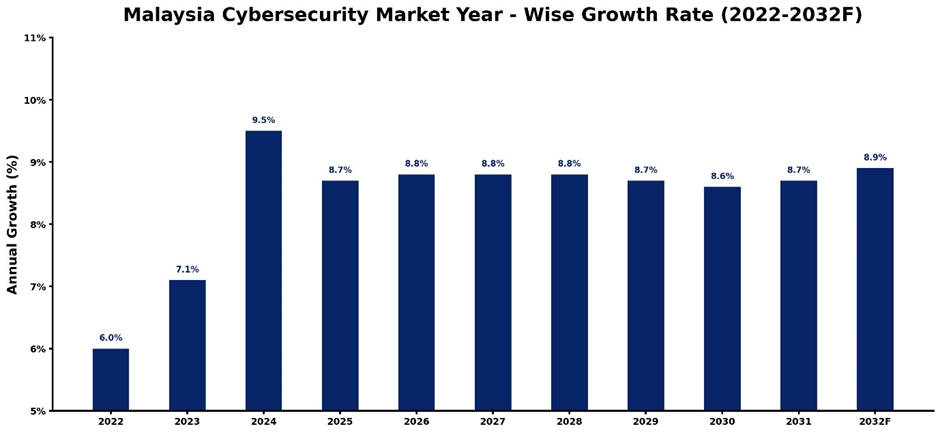
The following table summarizes the historical and forecasted growth rates of Malaysia Cybersecurity Market, along with the rationale behind each year’s performance.
| Year | Estimated Growth (%) | Market Rationale |
| 2022 | 6% | Post-COVID digital adoption and rise in ransomware attacks |
| 2023 | 7.1% | Cloud migration surge and BFSI cybersecurity expansion |
| 2024 | 9.5% | Enterprise security upgrades and compliance pressure |
| 2025 | 8.7% | Government cyber regulations and digital economy growth |
| 2026 | 8.8% | AI-based cyber threats increase security spending |
| 2027 | 8.8% | 5G expansion increases attack surface |
| 2028 | 8.8% | Cloud-first enterprise adoption strengthens |
| 2029 | 8.7% | Critical infrastructure digitization accelerates |
| 2030 | 8.6% | Smart city and Industry 4.0 cybersecurity demand |
| 2031 | 8.7% | AI-driven threat detection becomes standard |
| 2032 | 8.9% | Mature cybersecurity ecosystem and strict compliance |
Topics Covered in the Malaysia Cybersecurity Market Report
The Malaysia Cybersecurity Market report covers the market by security type, deployment, and end-user. The report provides a detailed analysis of ongoing market trends, along with key market drivers, helping stakeholders align strategies with current and future cybersecurity demand dynamics.
Malaysia Cybersecurity Market Highlights
| Report Name | Malaysia Cybersecurity Market |
| Forecast period | 2026-2032 |
| CAGR | 8.6 |
| Growing Sector | BFSI, IT & Telecom |
Malaysia Cybersecurity Market Synopsis
The Malaysia Cybersecurity Market is projected for sustained expansion, emerging as a critical pillar of the country’s digital economy transformation. The vital driving factors are the accelerated increase in cyber issues, accelerated cloud adoption across BFSI, IT & Telecom, and government sectors, and Malaysia’s push toward becoming a regional digital hub. Government initiated programs such as national cybersecurity frameworks, data protection rules and regulations, and digital economy blueprints are strengthening enterprise security investments.
Evaluation of Growth Drivers in Malaysia Cybersecurity Market (2026–2032)
Below are the major drivers influencing market dynamics:
| Drivers | Primary Segment Affected | Why It Matters (Evidence) |
| Rising Cyber Threat Landscape | BFSI, Government, Telecom | Increase in ransomware, phishing, and supply-chain attacks is forcing higher security spending across industries |
| Cloud Adoption Acceleration | IT & Telecom, BFSI | Migration to hybrid and multi-cloud environments increases demand for cloud security and identity management |
| Government Cybersecurity Regulations | Public Sector, Enterprises | Rigorous regulations and data protection laws push compliance-driven security investments |
| Digital Economy Expansion | BFSI, E-commerce, Smart Cities | National digitalization programs increase dependency on secure digital infrastructure |
| AI and Automation in Security | All Enterprise Segments | Enhanced real-time security capabilities and less breach risks, due to AI-based threat detection and response systems |
The Malaysia Cybersecurity Market Share is anticipated to grow at a CAGR of 8.6% during 2026–2032. Key drivers of the market growth are the increasing sophistication of cyberattacks, rapid cloud adoption, and the rising use of AI-powered security solutions. Expanding digital financial services leads to 70%+ of large enterprises in Malaysia to adopt integrated cybersecurity platforms, 5G networks, and connected infrastructure are further increasing the need for advanced cybersecurity frameworks.
Evaluation of Restraints in Malaysia Cybersecurity Market
Below are the major restraints influencing market dynamics:
| Restraints | Primary Segment Affected | What This Means (Evidence) |
| High Implementation Costs | SMEs, Mid Enterprises | Advanced cybersecurity solutions and skilled workforce requirements increase total cost of ownership |
| Shortage of Skilled Cybersecurity Talent | All Enterprise Segments | Lack of trained cybersecurity professionals limits rapid deployment and response capabilities |
| Complex Integration with Legacy Systems | Large Enterprises, Government | Older IT infrastructure slows adoption of modern zero-trust and cloud-native security solutions |
| Budget Constraints in SMEs | Small Businesses | Limited cybersecurity budgets delay adoption of advanced security tools |
| Evolving Threat Complexity | All Industries | Rapid evolution of AI-driven attacks makes defense strategies more difficult and costly |
Malaysia Cybersecurity Market Challenges
The market is tackling with various structural and operational challenges as it expands. One of the challenges is growing sophistication of cyberattacks, particularly AI-powered threats that can bypass traditional security systems. The shortage of skilled cybersecurity professionals that leads to 40% of cybersecurity project delays, which further limits the ability of enterprises to respond effectively to incidents, increasing overall risk exposure, and resulting in stagnant Malaysia Cybersecurity Market growth. Additionally, fragmented security infrastructure across organizations creates integration and monitoring difficulties.
Malaysia Cybersecurity Market Trends
Principal trends driving growth in the Malaysia cybersecurity market are outlined below:
- Zero Trust Architecture Adoption: Organizations are rapidly moving toward zero trust security models to reduce internal and external breach risks in distributed environments.
- AI-Driven Cyber Defense: Increasing use of artificial intelligence and machine learning for real-time threat detection, predictive analytics, and automated incident response.
- Cloud Security Expansion: Due to multi-cloud adoption, there is heavy demand for cloud-native security solutions such as CASB, CNAPP, and workload protection platforms.
- Managed Security Services Growth: Cybersecurity operations are actively outsourced by SMEs and mid-sized enterprises to MSSPs to minimize complexity and cost.
Investment Opportunities in Malaysia Cybersecurity Market
Growth-oriented investment opportunities in the Malaysia cybersecurity industry include the following:
- AI-Based Cybersecurity Platforms: Due to heavy demand for intelligent threat detection, and automated response systems, funding needed in AI-based security solutions.
- Managed Security Services (MSSP): Opportunities for scalable MSSP business models surged due to growing outsourcing trend among SMEs and enterprises.
- Cloud Security Solutions: Demand for identity security, workload protection, and cloud posture management tools, enhanced due to rising migration to cloud environments.
- Critical Infrastructure Security: Increasing demand for cybersecurity in sectors like BFSI, telecom, energy, and government ensure long-term investment opportunities in national security frameworks.
Top Leading Players in Malaysia Cybersecurity Market
A detailed compilation of major companies active in the Malaysia cybersecurity market is presented below:
1. LGMS Berhad
| Company Name | LGMS Berhad |
|---|---|
| Established Year | 2005 |
| Headquarters | Malaysia |
| Official Website | Click Here |
A leading Malaysian cybersecurity firm specializing in penetration testing, incident response, and regulatory compliance audits for enterprises and government organizations.
2. Securemetric Berhad
| Company Name | Securemetric Berhad |
|---|---|
| Established Year | 2011 |
| Headquarters | Malaysia |
| Official Website | Click Here |
Provides digital identity solutions, authentication technologies, encryption systems, and enterprise security software to support secure digital transactions and identity protection.
3. Wizlynx Group
| Company Name | Wizlynx Group |
|---|---|
| Established Year | 1999 |
| Headquarters | Switzerland |
| Official Website | Click Here |
Delivers advanced cybersecurity services including penetration testing, vulnerability assessments, and compliance consulting across global and Southeast Asian markets.
4. Ensign InfoSecurity
| Company Name | Ensign InfoSecurity |
|---|---|
| Established Year | 2018 |
| Headquarters | Singapore |
| Official Website | Click Here |
One of Asia’s largest cybersecurity providers offering managed security services, threat intelligence, incident response, and large-scale enterprise risk management solutions.
5. IBM
| Company Name | IBM |
|---|---|
| Established Year | 1911 |
| Headquarters | Armonk, New York, United States |
| Official Website | Click Here |
Global technology leader providing enterprise cybersecurity solutions, including AI-powered threat detection, cloud security, and security consulting services.
Government Initiatives being implemented in the Malaysia Cybersecurity Market
According to the Malaysian government data, cybersecurity market is actively supported by government initiatives that focused at strengthening national digital resilience. To expand the Malaysia Cybersecurity Market size, programs such as Malaysia Cyber Security Strategy will enhances protection of critical infrastructure and promotes public–private collaboration. Initiatives under the Malaysia Digital Economy Blueprint (MyDIGITAL) promote secure cloud adoption and data protection compliance. Also, the National Cyber Security Agency (NACSA) plays a key role in coordinating cybersecurity policies and threat response.
Future Insights of the in Malaysia Cybersecurity Market
The market is expected to witness sustained growth in the coming years. Rapid digital transformation is the driving factors for the growth. Increasing adoption of cloud computing, AI-based security tools, and 5G connectivity will significantly expand the threat landscape by 60% in large enterprise, results in boosting requirement for advanced cybersecurity solutions. The Malaysia Cybersecurity Market revenue will also be hiked by stricter regulations, rising investment in managed security services, and greater focus on zero-trust architecture.
Market Segmentation Analysis
This report presents a detailed analysis of the market segments along with their leading categories:
By Security Type - Cloud Led the Market and Set for Rapid Growth
According to Vasudha, Senior Research Analyst, 6Wresearch, by security type, in 2025, supported by hybrid infrastructure adoption and strong demand from BFSI and IT & Telecom sectors, Cloud Security dominated the Malaysia cybersecurity market with 24% market share. Also, by 2032, with a CAGR of 11.5%, Cloud Security remains the dominant and fastest-growing subcategory, owned by SaaS expansion and AI-driven workloads.
By Deployment - Cloud Dominated the Market and Set for Rapid Expansion
By Deployment, in 2025, the Cloud deployment led the Malaysia cybersecurity market with 58% market share, due to accelerated digital transformation and widespread SaaS adoption. And it will keep on dominating by 2032, owned by hybrid cloud expansion and zero-trust architecture adoption, with a CAGR of 10.2%.
By End-User - BFSI Led the Market and IT and Telecommunication Set for Rapid Growth
By End-User, in 2025, BFSI dominated the Malaysia cybersecurity market with 28% market share, influenced by high volumes of digital transactions and strict regulatory compliance. However, supported by cloud adoption, 5G expansion, and large-scale data security needs, IT and Telecommunication will command the market with a 9.8% CAGR, during 2026-2032.
Note: Market size estimations and growth projections presented in this report are based on 6Wresearch's proprietary forecasting methodology, utilizing the latest available industry data, government publications, and primary research inputs.
Key Attractiveness of the Report:
- 10 Years of Market Numbers
- Historical Data Starting from 2022 to 2025
- Base Year: 2025
- Forecast Data until 2032
- Key Performance Indicators Impacting the Market
- Major Upcoming Developments and Projects
Key Highlights of the Report:
- Malaysia Cybersecurity Market Outlook
- Market Size of Malaysia Cybersecurity Market, 2025
- Forecast of Malaysia Cybersecurity Market, 2032
- Historical Data and Forecast of Malaysia Cybersecurity Revenues & Volume for the Period 2022- 2032
- Malaysia Cybersecurity Market Trend Evolution
- Malaysia Cybersecurity Market Drivers and Challenges
- Malaysia Cybersecurity Price Trends
- Malaysia Cybersecurity Porter's Five Forces
- Malaysia Cybersecurity Industry Life Cycle
- Historical Data and Forecast of Malaysia Cybersecurity Market Revenues & Volume By Security Type for the Period 2022- 2032
- Historical Data and Forecast of Malaysia Cybersecurity Market Revenues & Volume By Cloud Security for the Period 2022- 2032
- Historical Data and Forecast of Malaysia Cybersecurity Market Revenues & Volume By Data Security for the Period 2022- 2032
- Historical Data and Forecast of Malaysia Cybersecurity Market Revenues & Volume By Identity Access Management for the Period 2022- 2032
- Historical Data and Forecast of Malaysia Cybersecurity Market Revenues & Volume By Network Security for the Period 2022- 2032
- Historical Data and Forecast of Malaysia Cybersecurity Market Revenues & Volume By Consumer Security for the Period 2022- 2032
- Historical Data and Forecast of Malaysia Cybersecurity Market Revenues & Volume By Infrastructure Protection for the Period 2022- 2032
- Historical Data and Forecast of Malaysia Cybersecurity Market Revenues & Volume By Others for the Period 2022- 2032
- Historical Data and Forecast of Malaysia Cybersecurity Market Revenues & Volume By Deployment for the Period 2022- 2032
- Historical Data and Forecast of Malaysia Cybersecurity Market Revenues & Volume By Cloud for the Period 2022- 2032
- Historical Data and Forecast of Malaysia Cybersecurity Market Revenues & Volume By On-Premise for the Period 2022- 2032
- Historical Data and Forecast of Malaysia Cybersecurity Market Revenues & Volume By End-User for the Period 2022- 2032
- Historical Data and Forecast of Malaysia Cybersecurity Market Revenues & Volume By BFSI for the Period 2022- 2032
- Historical Data and Forecast of Malaysia Cybersecurity Market Revenues & Volume By Healthcare for the Period 2022- 2032
- Historical Data and Forecast of Malaysia Cybersecurity Market Revenues & Volume By Manufacturing for the Period 2022- 2032
- Historical Data and Forecast of Malaysia Cybersecurity Market Revenues & Volume By Government and Defense for the Period 2022- 2032
- Historical Data and Forecast of Malaysia Cybersecurity Market Revenues & Volume By IT and Telecommunication for the Period 2022- 2032
- Historical Data and Forecast of Malaysia Cybersecurity Market Revenues & Volume By Others for the Period 2022- 2032
- Malaysia Cybersecurity Import Export Trade Statistics
- Market Opportunity Assessment By Security Type
- Market Opportunity Assessment By Deployment
- Market Opportunity Assessment By End-User
- Malaysia Cybersecurity Top Companies Market Share
- Malaysia Cybersecurity Competitive Benchmarking By Technical and Operational Parameters
- Malaysia Cybersecurity Company Profiles
- Malaysia Cybersecurity Key Strategic Recommendations
Market Covered
The report offers an extensive study of the following market segments:
By Security Type
- Cloud Security
- Data Security
- Identity Access Management
- Network Security
- Consumer Security
- Infrastructure Protection
- Others
By Dployment
- Cloud
- On-Premise
By End-User
- BFSI
- Healthcare
- Manufacturing
- Government and Defense
- IT and Telecommunication
- Others






































