Malaysia Drilling Services Market Size, Share & Growth Rate
The Malaysia Drilling Services Market was estimated at USD 276 Million in 2025 and is projected to reach USD 359 Million by 2032, growing at a CAGR of 3.8% from 2026 to 2032. This upward trajectory is primarily driven by the robust demand for exploration and extraction services in the oil and gas sector, which continues to be a cornerstone of Malaysia's economy. Additionally, the increasing interest in unconventional energy sources and infrastructure development projects is likely to further stimulate growth in this essential market.
Malaysia Drilling Services Market Year-wise Growth Rate and Key Drivers
This graph highlights how the Malaysia Drilling Services Market has steadily grown over the years, supported by major growth factors.
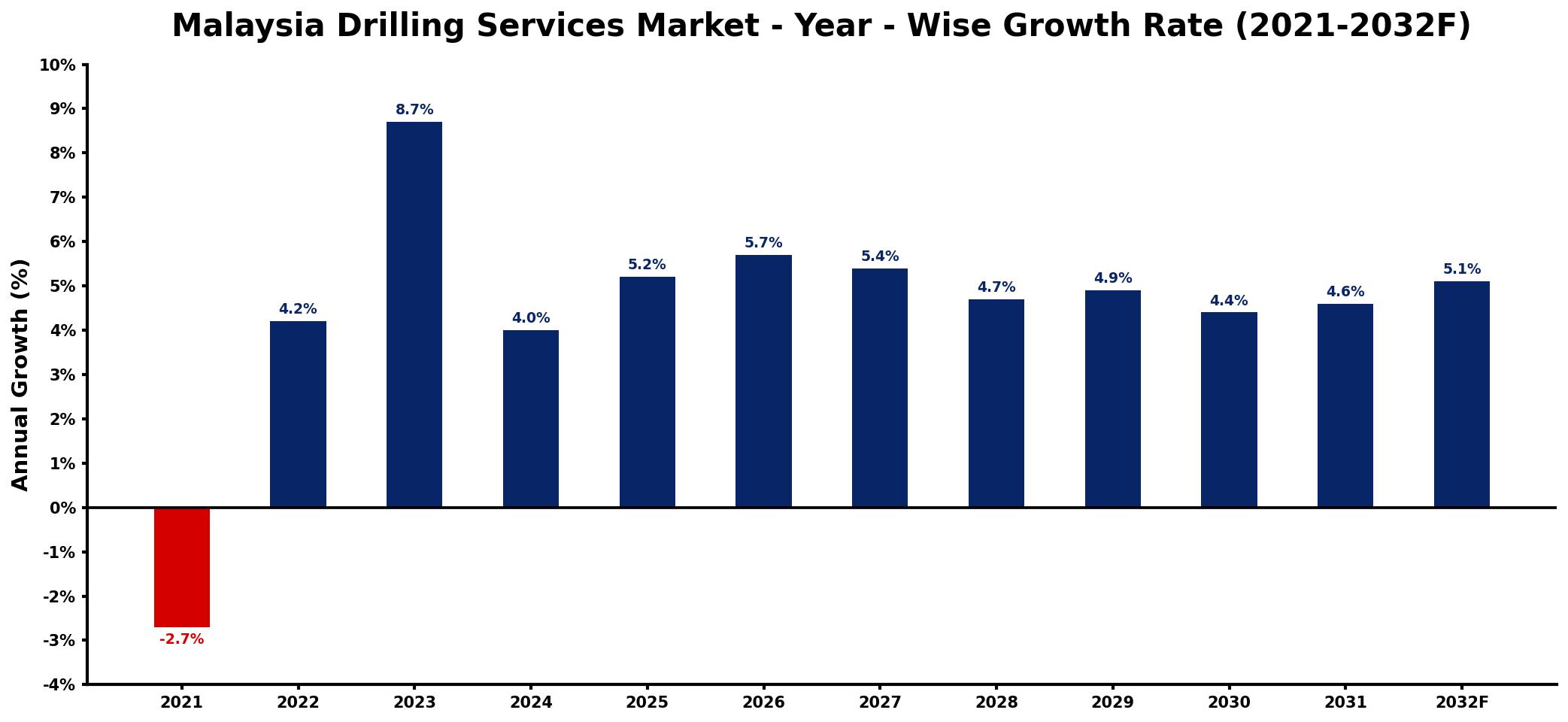
The table below presents the year‑wise growth rates along with the key drivers influencing the market
| Year | Growth Rate | Major Drivers |
| 2021 | -2.7% | decreased exploration activity levels |
| 2022 | 4.2% | rising global energy prices |
| 2023 | 8.7% | increased investment in exploration |
| 2024 | 4.0% | growing demand for natural gas |
| 2025 | 5.2% | expansion of renewable energy initiatives |
| 2026 | 5.7% | increased offshore project investments |
| 2027 | 5.4% | growing industrial energy needs |
| 2028 | 4.7% | enhanced product quality standards |
| 2029 | 4.9% | increased international market competitiveness |
| 2030 | 4.4% | rising demand for sustainable practices |
| 2031 | 4.6% | growing regional infrastructure projects |
| 2032 | 5.1% | increased partnerships and collaborations |
Note: Market size estimations and growth projections presented in this report are based on 6Wresearch's proprietary forecasting methodology, utilizing the latest available industry data, government publications, and primary research inputs.
Malaysia Drilling Services Market Synopsis
In recent years, the Malaysia drilling services market has shown a dynamic response to fluctuations in global oil prices, demonstrating resilience amid challenges. As the country grapples with these economic pressures, the sector is positioning itself for growth by diversifying into renewable energy projects and exploring geothermal opportunities.
Despite the impact of COVID-19, which temporarily slowed operations, the market is now witnessing a gradual recovery. With global oil prices rebounding and exploration activities resuming, the outlook is optimistic for the Malaysian drilling services landscape, marking a pivotal moment for industry stakeholders.
Malaysia Drilling Services Market Key Takeaways
- The market is primarily driven by oil and gas exploration and extraction activities.
- Investment in renewable energy and unconventional resources is shaping future growth.
- Compliance with environmental regulations is becoming increasingly critical for service providers.
- Infrastructure development projects are creating additional demand for drilling services.
- Market recovery post-COVID-19 is strengthening the industry's trajectory.
Evaluation of Restraints in Malaysia Drilling Services Market
The Malaysia drilling services market faces significant restraints primarily due to market volatility and stringent regulatory compliance. Fluctuating oil prices directly influence the demand for drilling services, creating a challenging environment for providers. Additionally, evolving regulations regarding environmental impacts necessitate substantial investment in sustainable practices and technologies, often straining the financial resources of companies operating within this sector. Furthermore, political and economic uncertainties can exacerbate these challenges, requiring companies to remain agile and adaptable.
Malaysia Drilling Services Market Trends
Several key trends are currently shaping the Malaysia drilling services market. The focus on green technology and renewable energy sources is prompting drilling service providers to diversify their portfolios, venturing into geothermal energy projects. Moreover, advancements in drilling technology, such as automated drilling systems, are enhancing operational efficiency and safety. The increasing emphasis on sustainable practices is driving innovation and reshaping traditional business models within the sector, presenting both opportunities and challenges for industry players.
Malaysia Drilling Services Market Opportunities
There are significant opportunities for growth in the Malaysia drilling services market, particularly in the realm of unconventional energy sources like shale gas. As the demand for energy continues to rise, the push towards more sustainable and environmentally-friendly drilling methods is creating openings for innovative technologies and practices. Additionally, government incentives for renewable energy projects are likely to open new avenues for service providers, allowing them to capitalize on emerging trends while addressing the countrys energy needs.
Government Initiatives in the Malaysia Drilling Services Market
The Malaysian government has been proactive in creating a favorable environment for the drilling services market through various policies and initiatives. Programs aimed at enhancing energy efficiency and promoting sustainable practices are being rolled out, encouraging companies to adopt greener technologies. Furthermore, public spending on infrastructure development is set to increase, offering additional opportunities for drilling services in foundational work and resource exploration, thereby reinforcing the importance of the sector within the broader economy.
Future Insights of the Malaysia Drilling Services Market
Looking ahead to 2026-2032, the Malaysia drilling services market is expected to witness a steady upward trend driven by both traditional oil and gas activities and the burgeoning renewable energy sector. As technological advancements continue to reshape the industry, companies that embrace innovation and sustainable practices will likely gain a competitive edge. Additionally, the ongoing commitment from the government to develop energy infrastructure suggests a robust environment for sustained growth, allowing the market to navigate the evolving energy landscape effectively.
Malaysia Drilling Services Market Latest Developments (2025 - 2026)
Recent developments in the Malaysia drilling services market indicate a gradual rebound from the disruptions caused by the COVID-19 pandemic. Companies are now ramping up their operations, with a renewed focus on compliance and sustainability. Initiatives are underway to explore innovative drilling techniques and optimize existing operations to meet both safety and environmental standards. As industry players navigate this recovery phase, the emphasis on strategic partnerships and technology adoption is becoming increasingly prominent.
Malaysia Drilling Services Market - Key Attractiveness of the Report
- 10 Years of Market Numbers
- Historical Data Starting from 2022 to 2025
- Base Year: 2025
- Forecast Data until 2032
- Key Performance Indicators Impacting the Market
- Major Upcoming Developments and Projects
Key Highlights of the Report:
- Malaysia Drilling Services Market Outlook
- Market Size of Malaysia Drilling Services Market, 2025
- Forecast of Malaysia Drilling Services Market, 2032
- Historical Data and Forecast of Malaysia Drilling Services Revenues & Volume for the Period 2022-2032F
- Malaysia Drilling Services Market Trend Evolution
- Malaysia Drilling Services Market Drivers and Challenges
- Malaysia Drilling Services Price Trends
- Malaysia Drilling Services Porter's Five Forces
- Malaysia Drilling Services Industry Life Cycle
- Historical Data and Forecast of Malaysia Drilling Services Market Revenues & Volume By Service for the Period 2022-2032F
- Historical Data and Forecast of Malaysia Drilling Services Market Revenues & Volume By Directional Drilling for the Period 2022-2032F
- Historical Data and Forecast of Malaysia Drilling Services Market Revenues & Volume By Non-Directional Drilling for the Period 2022-2032F
- Historical Data and Forecast of Malaysia Drilling Services Market Revenues & Volume By Application for the Period 2022-2032F
- Historical Data and Forecast of Malaysia Drilling Services Market Revenues & Volume By Onshore for the Period 2022-2032F
- Historical Data and Forecast of Malaysia Drilling Services Market Revenues & Volume By Offshore for the Period 2022-2032F
- Historical Data and Forecast of Malaysia Drilling Services Market Revenues & Volume By End-User for the Period 2022-2032F
- Historical Data and Forecast of Malaysia Drilling Services Market Revenues & Volume By Oil & Gas for the Period 2022-2032F
- Historical Data and Forecast of Malaysia Drilling Services Market Revenues & Volume By Mining for the Period 2022-2032F
- Historical Data and Forecast of Malaysia Drilling Services Market Revenues & Volume By Water Exploration for the Period 2022-2032F
- Historical Data and Forecast of Malaysia Drilling Services Market Revenues & Volume By Others for the Period 2022-2032F
- Malaysia Drilling Services Import Export Trade Statistics
- Market Opportunity Assessment By Service
- Market Opportunity Assessment By Application
- Market Opportunity Assessment By End-User
- Malaysia Drilling Services Top Companies Market Share
- Malaysia Drilling Services Competitive Benchmarking By Technical and Operational Parameters
- Malaysia Drilling Services Company Profiles
- Malaysia Drilling Services Key Strategic Recommendations






































