Malaysia Energy Efficient Lighting Market Size, Share & Growth Rate
The Malaysia Energy Efficient Lighting Market was estimated at USD 164 Million in 2025 and is projected to reach USD 214 Million by 2032, growing at a CAGR of 3.9% from 2026 to 2032. This growth trajectory is driven by an increasing demand for sustainable lighting solutions, primarily due to rising energy costs and an urgent call for environmental responsibility. The government's strategic initiatives in promoting energy-efficient technologies further bolster the adoption of LED lighting across residential, commercial, and industrial sectors.
Malaysia Energy Efficient Lighting Market Year-wise Growth Rate and Key Drivers
This graph highlights how the Malaysia Energy Efficient Lighting Market has steadily grown over the years, supported by major growth factors.
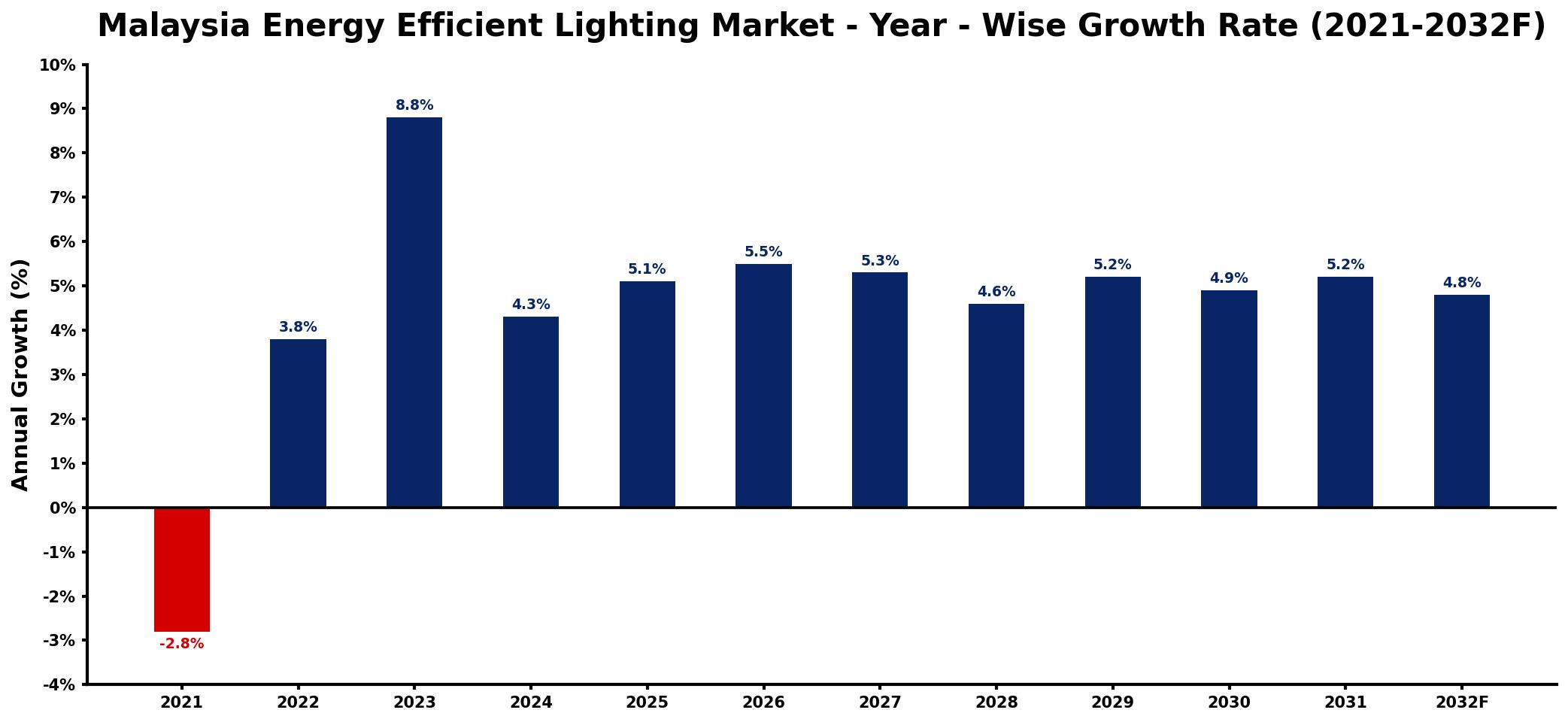
The table below presents the year‑wise growth rates along with the key drivers influencing the market
| Year | Growth Rate | Major Drivers |
| 2021 | -2.8% | decreased consumer spending habits |
| 2022 | 3.8% | growing awareness of sustainability |
| 2023 | 8.8% | increased government incentives programs |
| 2024 | 4.3% | rising demand from commercial sectors |
| 2025 | 5.1% | improved processing technologies adoption |
| 2026 | 5.5% | growth in residential retrofitting projects |
| 2027 | 5.3% | increased urban development investments |
| 2028 | 4.6% | higher adoption in hospitality sector |
| 2029 | 5.2% | enhanced technological advancements available |
| 2030 | 4.9% | expansion of smart home solutions |
| 2031 | 5.2% | growing focus on green building |
| 2032 | 4.8% | increased public sector collaborations |
Note: Market size estimations and growth projections presented in this report are based on 6Wresearch's proprietary forecasting methodology, utilizing the latest available industry data, government publications, and primary research inputs.
Malaysia Energy Efficient Lighting Market Synopsis
The Malaysian energy-efficient lighting landscape is marked by a significant shift towards sustainability, with LED technology leading the charge. The rising awareness among consumers regarding energy savings and lower electricity bills has accelerated the transition from traditional lighting to energy-efficient solutions.
In addition to consumer demand, the market is also benefitting from robust government support aimed at reducing energy consumption. As businesses and households increasingly prioritize green technologies, the energy-efficient lighting sector is poised for sustained growth in the coming years.
Malaysia Energy Efficient Lighting Market Key Takeaways
- The market is primarily driven by the demand for sustainable and cost-effective lighting solutions.
- LED technology has emerged as the dominant choice among consumers and businesses alike.
- Government initiatives and incentives play a crucial role in promoting energy efficiency.
- Consumer awareness regarding environmental impacts is rising, further fueling market growth.
- Innovations in smart lighting technologies are expected to create new opportunities in the market.
Evaluation of Restraints in Malaysia Energy Efficient Lighting Market
Despite the promising growth of the energy-efficient lighting market in Malaysia, several factors are restraining its full potential. A significant barrier is the varying levels of consumer awareness regarding energy-efficient solutions. Many still remain unfamiliar with the benefits of energy-efficient lighting technologies. Additionally, navigating the complex regulatory landscape for energy-efficient products can pose challenges for manufacturers. These factors can slow down market adoption, highlighting the need for targeted educational campaigns to elevate consumer understanding.
Malaysia Energy Efficient Lighting Market Trends
Several current and emerging trends are shaping the Malaysia Energy Efficient Lighting Market. The integration of smart technologies into lighting systems is rapidly gaining traction, allowing for better energy management and automation. Consumers are increasingly seeking customizable and controllable lighting solutions that enhance comfort and reduce energy usage. Moreover, the focus on sustainability is influencing product design and innovation, driving companies to develop eco-friendly materials and practices.
Malaysia Energy Efficient Lighting Market Opportunities
Opportunities for growth in the Malaysia Energy Efficient Lighting Market are abundant, particularly in sectors where energy consumption is critical. The commercial sector, in particular, presents vast potential for upgrading to energy-efficient lighting solutions, given the emphasis on sustainability initiatives and cost savings. Additionally, as smart home technologies become more integrated into everyday life, the demand for advanced lighting solutions that can communicate with other smart devices will create new investment avenues. Furthermore, continued government backing for green technologies will foster a favorable environment for new entrants and innovation in the market.
Government Initiatives in the Malaysia Energy Efficient Lighting Market
The Malaysian government is actively pursuing policies and initiatives aimed at promoting energy efficiency in various sectors, including lighting. Public funding for research and development of energy-efficient technologies, along with incentives for both consumers and businesses to adopt these solutions, are pivotal. Campaigns to raise awareness about the importance of energy savings also play a significant role in this effort. Through these initiatives, the government aims to enhance the overall energy efficiency of the nation while fostering sustainable economic growth.
Future Insights of the Malaysia Energy Efficient Lighting Market
Looking ahead to 2026-2032, the Malaysia Energy Efficient Lighting Market is set to experience continued expansion. As environmental concerns mount and consumers demand more sustainable products, the shift to energy-efficient lighting will gain momentum. The push for smart city initiatives will further integrate advanced lighting technologies into urban planning, providing myriad opportunities for growth. Moreover, advancements in LED technology and increased accessibility will drive down costs, making energy-efficient solutions more appealing to a broader audience.
Malaysia Energy Efficient Lighting Market Latest Developments (2025 - 2026)
Recent developments in the energy-efficient lighting market in Malaysia indicate a growing focus on innovative products that enhance energy savings and user experience. The trend toward smart lighting solutions is gaining momentum as manufacturers look to integrate cutting-edge technologies that cater to modern consumer needs. Additionally, there has been a noticeable rise in partnerships between government agencies and private companies aimed at promoting energy-efficient initiatives, which is likely to reshape the market landscape in the coming years.
Malaysia Energy Efficient Lighting Market - Key Attractiveness of the Report
- 10 Years of Market Numbers
- Historical Data Starting from 2022 to 2025
- Base Year: 2025
- Forecast Data until 2032
- Key Performance Indicators Impacting the Market
- Major Upcoming Developments and Projects
Key Highlights of the Report:
- Malaysia Energy Efficient Lighting Market Outlook
- Market Size of Malaysia Energy Efficient Lighting Market, 2025
- Forecast of Malaysia Energy Efficient Lighting Market, 2032
- Historical Data and Forecast of Malaysia Energy Efficient Lighting Revenues & Volume for the Period 2022-2032F
- Malaysia Energy Efficient Lighting Market Trend Evolution
- Malaysia Energy Efficient Lighting Market Drivers and Challenges
- Malaysia Energy Efficient Lighting Price Trends
- Malaysia Energy Efficient Lighting Porter's Five Forces
- Malaysia Energy Efficient Lighting Industry Life Cycle
- Historical Data and Forecast of Malaysia Energy Efficient Lighting Market Revenues & Volume By Product Type for the Period 2022-2032F
- Historical Data and Forecast of Malaysia Energy Efficient Lighting Market Revenues & Volume By Incandescent Lamp for the Period 2022-2032F
- Historical Data and Forecast of Malaysia Energy Efficient Lighting Market Revenues & Volume By Light Emitting Diode for the Period 2022-2032F
- Historical Data and Forecast of Malaysia Energy Efficient Lighting Market Revenues & Volume By Arc Lamp for the Period 2022-2032F
- Historical Data and Forecast of Malaysia Energy Efficient Lighting Market Revenues & Volume By Gas Discharge Lamps for the Period 2022-2032F
- Historical Data and Forecast of Malaysia Energy Efficient Lighting Market Revenues & Volume By Application for the Period 2022-2032F
- Historical Data and Forecast of Malaysia Energy Efficient Lighting Market Revenues & Volume By Commercial for the Period 2022-2032F
- Historical Data and Forecast of Malaysia Energy Efficient Lighting Market Revenues & Volume By Residential for the Period 2022-2032F
- Historical Data and Forecast of Malaysia Energy Efficient Lighting Market Revenues & Volume By Government for the Period 2022-2032F
- Historical Data and Forecast of Malaysia Energy Efficient Lighting Market Revenues & Volume By Correlated Color Temperature for the Period 2022-2032F
- Historical Data and Forecast of Malaysia Energy Efficient Lighting Market Revenues & Volume By 2700K-3000K for the Period 2022-2032F
- Historical Data and Forecast of Malaysia Energy Efficient Lighting Market Revenues & Volume By 3500K??4000K for the Period 2022-2032F
- Historical Data and Forecast of Malaysia Energy Efficient Lighting Market Revenues & Volume By 4000K-5000K for the Period 2022-2032F
- Historical Data and Forecast of Malaysia Energy Efficient Lighting Market Revenues & Volume By 5000K-6500K for the Period 2022-2032F
- Historical Data and Forecast of Malaysia Energy Efficient Lighting Market Revenues & Volume By More Than 6500K for the Period 2022-2032F
- Malaysia Energy Efficient Lighting Import Export Trade Statistics
- Market Opportunity Assessment By Product Type
- Market Opportunity Assessment By Application
- Market Opportunity Assessment By Correlated Color Temperature
- Malaysia Energy Efficient Lighting Top Companies Market Share
- Malaysia Energy Efficient Lighting Competitive Benchmarking By Technical and Operational Parameters
- Malaysia Energy Efficient Lighting Company Profiles
- Malaysia Energy Efficient Lighting Key Strategic Recommendations






































