Malaysia Facade Market Size, Share & Growth Rate
The Malaysia Facade Market was estimated at USD 446 Million in 2025 and is projected to reach USD 582 Million by 2032, growing at a CAGR of 3.9% from 2026 to 2032. This growth trajectory is propelled by the robust expansion of the commercial and residential construction sectors, where facades not only enhance visual appeal but also contribute to energy efficiency and sustainability. Furthermore, increased governmental emphasis on green building practices is likely to spur demand for innovative facade solutions, ensuring that architects and builders prioritize both aesthetics and functionality in their projects.
Malaysia Facade Market Year-wise Growth Rate and Key Drivers
This graph highlights how the Malaysia Facade Market has steadily grown over the years, supported by major growth factors.
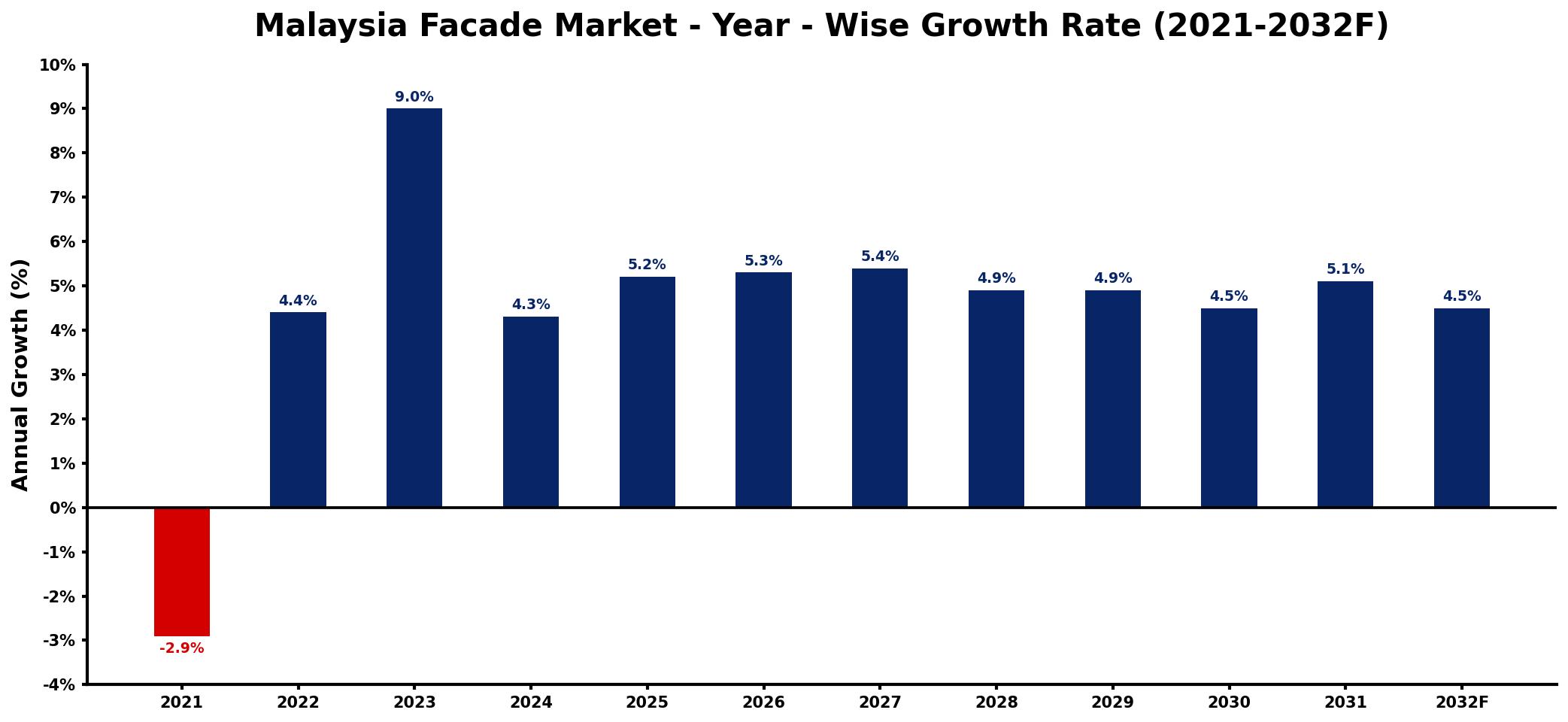
The table below presents the year‑wise growth rates along with the key drivers influencing the market
| Year | Growth Rate | Major Drivers |
| 2021 | -2.9% | decreased construction activity nationwide |
| 2022 | 4.4% | increased urban development projects |
| 2023 | 9.0% | growing demand for sustainable materials |
| 2024 | 4.3% | expansion of commercial real estate |
| 2025 | 5.2% | rising investments in infrastructure |
| 2026 | 5.3% | enhanced focus on aesthetic designs |
| 2027 | 5.4% | boost in government construction initiatives |
| 2028 | 4.9% | increased residential building permits |
| 2029 | 4.9% | expanding manufacturing base activity |
| 2030 | 4.5% | rise in green building certifications |
| 2031 | 5.1% | strengthening underlying market demand |
| 2032 | 4.5% | increased focus on energy efficiency |
Note: Market size estimations and growth projections presented in this report are based on 6Wresearch's proprietary forecasting methodology, utilizing the latest available industry data, government publications, and primary research inputs.
Malaysia Facade Market Synopsis
The demand for innovative facade designs in Malaysia is surging, driven by a burgeoning construction landscape that values aesthetic allure alongside energy efficiency. As local architects and builders increasingly adopt sustainable practices, the market is witnessing a shift towards energy-efficient and eco-friendly facade materials that align with international sustainability goals.
In addition, the influence of evolving regulatory standards and building codes cannot be understated, as they guide the adoption of advanced facade technologies. The resulting blend of functionality and style ensures that the facade market remains a critical component of Malaysia's construction industry, catering to a diverse range of applications.
Malaysia Facade Market Key Takeaways
- Continuous growth driven by increasing construction activity across commercial and residential sectors.
- Shifting consumer preferences towards sustainable and energy-efficient facade solutions.
- Strong regulatory frameworks promoting the adoption of innovative facade technologies.
- Increased competition among market players to meet rising demand for aesthetic and functional designs.
- COVID-19 has sparked renewed interest in sustainable building practices, enhancing market resilience.
Evaluation of Restraints in Malaysia Facade Market
Despite the promising growth outlook, the Malaysia facade market faces significant restraints. A primary concern is the rapid evolution of architectural trends that necessitate constant innovation. Market players are pressured to develop eco-friendly and energy-efficient products that meet both aesthetic preferences and practical functionality. Additionally, adhering to stringent building codes while maintaining affordability poses a challenge, particularly as economic fluctuations impact material costs. Companies striving to thrive in this environment must prioritize research and development to navigate these complexities effectively.
Malaysia Facade Market Trends
Emerging trends in the Malaysia facade market highlight a pronounced shift toward sustainability. Architects and builders are increasingly focused on materials that not only meet aesthetic criteria but also offer energy-saving benefits. The rise of smart facades equipped with technology that can adjust to environmental conditions is gaining traction, enhancing both functionality and efficiency. Moreover, the integration of local culture and climate into facade designs is becoming essential, fostering a deeper connection between architecture and the environment.
Malaysia Facade Market Opportunities
The future of the Malaysia facade market presents significant opportunities, particularly in the realm of sustainable building practices. Companies can capitalize on growing consumer awareness surrounding environmental impacts, leading to an increased demand for green facade solutions. Furthermore, urbanization trends are driving infrastructure development, opening avenues for innovative facade designs that cater to densely populated areas. The alignment of governmental incentives for green construction practices also paves the way for lucrative investment opportunities in this space.
Government Initiatives in the Malaysia Facade Market
The Malaysian government is actively promoting initiatives to enhance building sustainability, which significantly impacts the facade market. Programs encouraging energy-efficient building practices are being rolled out, aimed at reducing the carbon footprint of new constructions. Public spending on infrastructure improvements is also expected to rise, facilitating the adoption of advanced facade technologies. Incentives for green building certification are designed to motivate developers to integrate innovative facade solutions that align with the countrys sustainability objectives.
Future Insights of the Malaysia Facade Market
Looking ahead to 2026-2032, the Malaysia facade market is anticipated to evolve in response to changing consumer expectations and regulatory demands. The emphasis on smart and sustainable building practices will likely drive innovation, resulting in the introduction of advanced materials and technologies. As Malaysia positions itself to embrace a more sustainable urban landscape, the facade market is expected to play a pivotal role in shaping the architectural narrative, reflecting a harmonious balance between aesthetic appeal, energy efficiency, and environmental responsibility.
Malaysia Facade Market Latest Developments (2025 - 2026)
Recent developments in the Malaysia facade market indicate a clear shift towards integrating cutting-edge technology in building designs. Manufacturers are increasingly focusing on developing smart facade systems that enhance energy efficiency and reduce maintenance costs. There is also a notable trend of collaboration among industry players to promote innovative facade solutions that align with local architectural styles and environmental conditions. The market continues to respond dynamically to both regulatory changes and evolving consumer preferences, indicating a robust future ahead.
Malaysia Facade Market - Key Attractiveness of the Report
- 10 Years of Market Numbers
- Historical Data Starting from 2022 to 2025
- Base Year: 2025
- Forecast Data until 2032
- Key Performance Indicators Impacting the Market
- Major Upcoming Developments and Projects
Key Highlights of the Report:
- Malaysia Facade Market Outlook
- Market Size of Malaysia Facade Market, 2025
- Forecast of Malaysia Facade Market, 2032
- Historical Data and Forecast of Malaysia Facade Revenues & Volume for the Period 2022-2032F
- Malaysia Facade Market Trend Evolution
- Malaysia Facade Market Drivers and Challenges
- Malaysia Facade Price Trends
- Malaysia Facade Porter's Five Forces
- Malaysia Facade Industry Life Cycle
- Historical Data and Forecast of Malaysia Facade Market Revenues & Volume By Product for the Period 2022-2032F
- Historical Data and Forecast of Malaysia Facade Market Revenues & Volume By Ventilated Facades for the Period 2022-2032F
- Historical Data and Forecast of Malaysia Facade Market Revenues & Volume By Non-ventilated Facades for the Period 2022-2032F
- Historical Data and Forecast of Malaysia Facade Market Revenues & Volume By Others for the Period 2022-2032F
- Historical Data and Forecast of Malaysia Facade Market Revenues & Volume By End-use for the Period 2022-2032F
- Historical Data and Forecast of Malaysia Facade Market Revenues & Volume By Commercial for the Period 2022-2032F
- Historical Data and Forecast of Malaysia Facade Market Revenues & Volume By Residential for the Period 2022-2032F
- Historical Data and Forecast of Malaysia Facade Market Revenues & Volume By Industrial for the Period 2022-2032F
- Malaysia Facade Import Export Trade Statistics
- Market Opportunity Assessment By Product
- Market Opportunity Assessment By End-use
- Malaysia Facade Top Companies Market Share
- Malaysia Facade Competitive Benchmarking By Technical and Operational Parameters
- Malaysia Facade Company Profiles
- Malaysia Facade Key Strategic Recommendations






































