Malaysia Fashion Belt Market Size, Share & Growth Rate
The Malaysia Fashion Belt Market was estimated at USD 240 Million in 2025 and is projected to reach USD 312 Million by 2032, growing at a CAGR of 3.8% from 2026 to 2032. This upward trajectory is fueled by increasing disposable incomes, enabling consumers to invest in high-quality and fashionable belts, particularly those crafted from premium leather or sustainable materials. Moreover, the youthful demographic of Malaysia, eager to express personal style through accessories, is further driving demand, with many opting for designer belts that reflect current trends.
Malaysia Fashion Belt Market Year-wise Growth Rate and Key Drivers
This graph highlights how the Malaysia Fashion Belt Market has steadily grown over the years, supported by major growth factors.
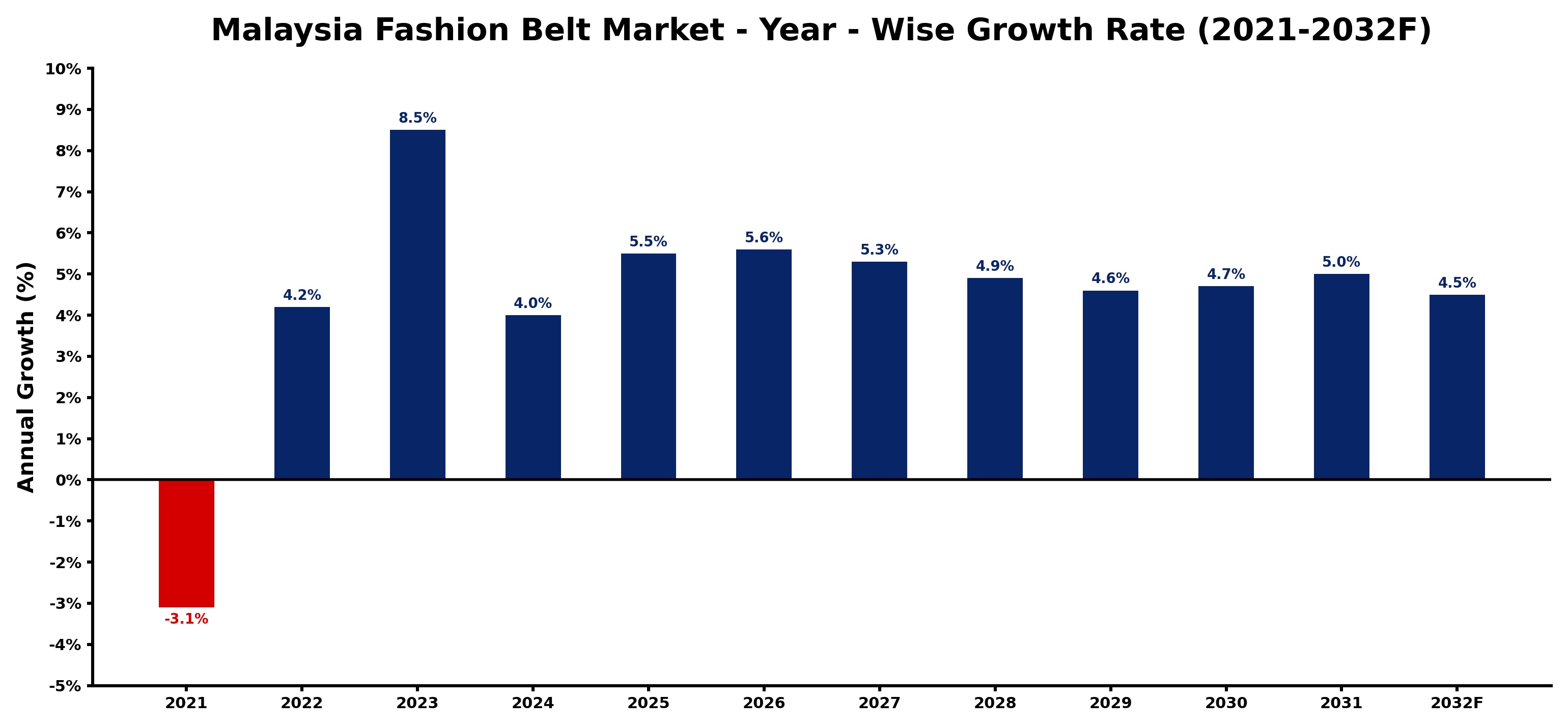
The table below presents the year‑wise growth rates along with the key drivers influencing the market
| Year | Growth Rate | Major Drivers |
| 2021 | -3.1% | Lower automotive exports limited demand for fashion belt production |
| 2022 | 4.2% | OEM production expansion fueled demand for precision fastening solutions |
| 2023 | 8.5% | Increased foreign investment boosts precision engineering machinery production rates |
| 2024 | 4.0% | Precision engineering upgrades optimized fashion belt manufacturing processes |
| 2025 | 5.5% | Smart manufacturing technologies boosted productivity in belt production facilities |
| 2026 | 5.6% | Automotive supply chain investments boost precision engineering equipment demand |
| 2027 | 5.3% | Automotive supply chain enhancements boosted demand for precision components |
| 2028 | 4.9% | Smart technology adoption streamlined production processes in fashion accessories |
| 2029 | 4.6% | Manufacturing investments in automation boost belt production capabilities |
| 2030 | 4.7% | Increased automotive assembly investments boost precision engineering demand in Malaysia |
| 2031 | 5.0% | Export driven manufacturing investments boosted precision engineering capabilities in Malaysia |
| 2032 | 4.5% | Precision engineering upgrades optimized Malaysia's belt production capabilities |
Note - Market size estimations and growth projections presented in this report are based on 6Wresearch’s advanced forecasting approach, validated with industry datasets as of June 2026.
Malaysia Fashion Belt Market Synopsis
The fashion belt market in Malaysia is witnessing a noteworthy evolution, characterized by a growing preference for unique designs and sustainability. As consumers become increasingly aware of environmental issues, belts made from recycled materials are gaining traction, aligning with global fashion movements towards eco-friendliness.
Additionally, cultural influences and local fashion designers are shaping the market landscape, encouraging consumers to support homegrown talent. This has led to a more diverse range of products available in the market, catering to varying tastes and preferences among Malaysian consumers.
Malaysia Fashion Belt Market Key Takeaways
- The market is influenced by a rising trend towards premium and sustainable fashion accessories.
- Changing consumer behaviors are steering demand towards stylish belts that offer both functionality and fashion.
- The younger population is increasingly spending on branded and designer belts.
- Local fashion initiatives are promoting creativity and diversity within the product offerings.
- Economic factors like disposable income directly correlate with market growth and consumer spending.
Evaluation of Restraints in Malaysia Fashion Belt Market
Despite the positive growth indicators, the Malaysia Fashion Belt Market faces several restraints. One significant factor is the volatility of consumer preferences, which can shift with rapidly changing fashion trends. This unpredictability necessitates continual adaptation from market players, who must innovate to keep pace with consumer desires. Additionally, economic uncertainties can dampen spending on non-essential items, such as fashion belts, impacting overall sales. Compounding these issues is the increasing competition from alternative fashion accessories and counterfeit products that challenge authentic brands, making it vital for players to establish a solid value proposition.
Malaysia Fashion Belt Market Trends
Currently, there is a marked trend towards personalization in the fashion belt segment, with consumers seeking customizable options that allow for individual expression. Furthermore, the integration of technology into fashion accessories, such as smart belts with fitness tracking features, is beginning to surface, appealing to the tech-savvy younger generation. Lastly, the rising demand for ethically produced goods is compelling brands to adopt more transparent supply chains, promoting sustainability and responsible manufacturing practices.
Malaysia Fashion Belt Market Opportunities
The expanding market offers several growth opportunities, particularly for brands that emphasize sustainability and local craftsmanship. Engaging the young adult demographic through targeted marketing campaigns that highlight unique designs and eco-friendly practices can yield significant returns. Additionally, the rise in e-commerce platforms provides a vast landscape for brands to reach broader audiences, facilitating direct-to-consumer sales. Collaborations with local artists and designers can also differentiate brands in a crowded market, creating unique offerings that attract niche consumer segments.
Government Initiatives in the Malaysia Fashion Belt Market
The Malaysian government has been actively promoting the local fashion industry through various initiatives aimed at encouraging domestic production and innovation. Support programs for small and medium enterprises (SMEs) in fashion aim to boost the sector's competitiveness. Additionally, there are tax incentives for businesses adopting sustainable practices, fostering an environment conducive to growth in eco-friendly fashion products, including belts. Such initiatives are expected to enhance the market landscape for Malaysian fashion belts, allowing homegrown brands to thrive.
Future Insights of the Malaysia Fashion Belt Market
Looking ahead to 2026-2032, the Malaysia Fashion Belt Market is poised for continued growth driven by evolving consumer preferences towards fashion-conscious, sustainable accessories. The market will likely see an increase in innovative designs and materials as brands strive to differentiate themselves. Furthermore, enhanced online shopping experiences and a greater emphasis on personal branding will propel demand. As consumers increasingly view fashion belts as essential components of their outfits, market players who can adapt to these shifts will find ample opportunities for expansion.
Malaysia Fashion Belt Market Latest Developments (May 2025 - June 2026)
The fashion belt market in Malaysia has been witnessing a dynamic shift towards online sales channels, driven by a growing preference for convenience and wider selections. There has been a noticeable increase in collaborations between local designers and international brands, aiming to create unique product offerings that cater to diverse consumer tastes. Additionally, many brands are ramping up their marketing strategies, leveraging social media platforms to enhance brand visibility and engage directly with consumers.
Malaysia Fashion Belt Market - Key Attractiveness of the Report
- 10 Years of Market Numbers
- Historical Data Starting from 2022 to 2025
- Base Year: 2025
- Forecast Data until 2032
- Key Performance Indicators Impacting the Market
- Major Upcoming Developments and Projects
Key Highlights of the Report:
- Malaysia Fashion Belt Market Outlook
- Market Size of Malaysia Fashion Belt Market, 2025
- Forecast of Malaysia Fashion Belt Market, 2032
- Historical Data and Forecast of Malaysia Fashion Belt Revenues & Volume for the Period 2022-2032F
- Malaysia Fashion Belt Market Trend Evolution
- Malaysia Fashion Belt Market Drivers and Challenges
- Malaysia Fashion Belt Price Trends
- Malaysia Fashion Belt Porter's Five Forces
- Malaysia Fashion Belt Industry Life Cycle
- Historical Data and Forecast of Malaysia Fashion Belt Market Revenues & Volume By Types for the Period 2022-2032F
- Historical Data and Forecast of Malaysia Fashion Belt Market Revenues & Volume By Grommet Belt for the Period 2022-2032F
- Historical Data and Forecast of Malaysia Fashion Belt Market Revenues & Volume By Chain Belt for the Period 2022-2032F
- Historical Data and Forecast of Malaysia Fashion Belt Market Revenues & Volume By Leather Belt for the Period 2022-2032F
- Historical Data and Forecast of Malaysia Fashion Belt Market Revenues & Volume By Others for the Period 2022-2032F
- Historical Data and Forecast of Malaysia Fashion Belt Market Revenues & Volume By Industry for the Period 2022-2032F
- Historical Data and Forecast of Malaysia Fashion Belt Market Revenues & Volume By Online Sales for the Period 2022-2032F
- Historical Data and Forecast of Malaysia Fashion Belt Market Revenues & Volume By Offline Sales for the Period 2022-2032F
- Malaysia Fashion Belt Import Export Trade Statistics
- Market Opportunity Assessment By Types
- Market Opportunity Assessment By Industry
- Malaysia Fashion Belt Top Companies Market Share
- Malaysia Fashion Belt Competitive Benchmarking By Technical and Operational Parameters
- Malaysia Fashion Belt Company Profiles
- Malaysia Fashion Belt Key Strategic Recommendations






































