Malaysia Full Grain Leather Market Size, Share & Growth Rate
The Malaysia Full Grain Leather Market was estimated at USD 329 Million in 2025 and is projected to reach USD 495 Million by 2032, growing at a CAGR of 6.0% from 2026 to 2032. This robust trajectory can be attributed to an increasing preference for high-quality leather products among consumers, especially in the luxury fashion and automotive sectors. As more consumers seek sustainable and long-lasting materials, full grain leather's reputation for durability and aesthetic appeal continues to attract significant demand across various applications.
Malaysia Full Grain Leather Market Year-wise Growth Rate and Key Drivers
This graph highlights how the Malaysia Full Grain Leather Market has steadily grown over the years, supported by major growth factors.
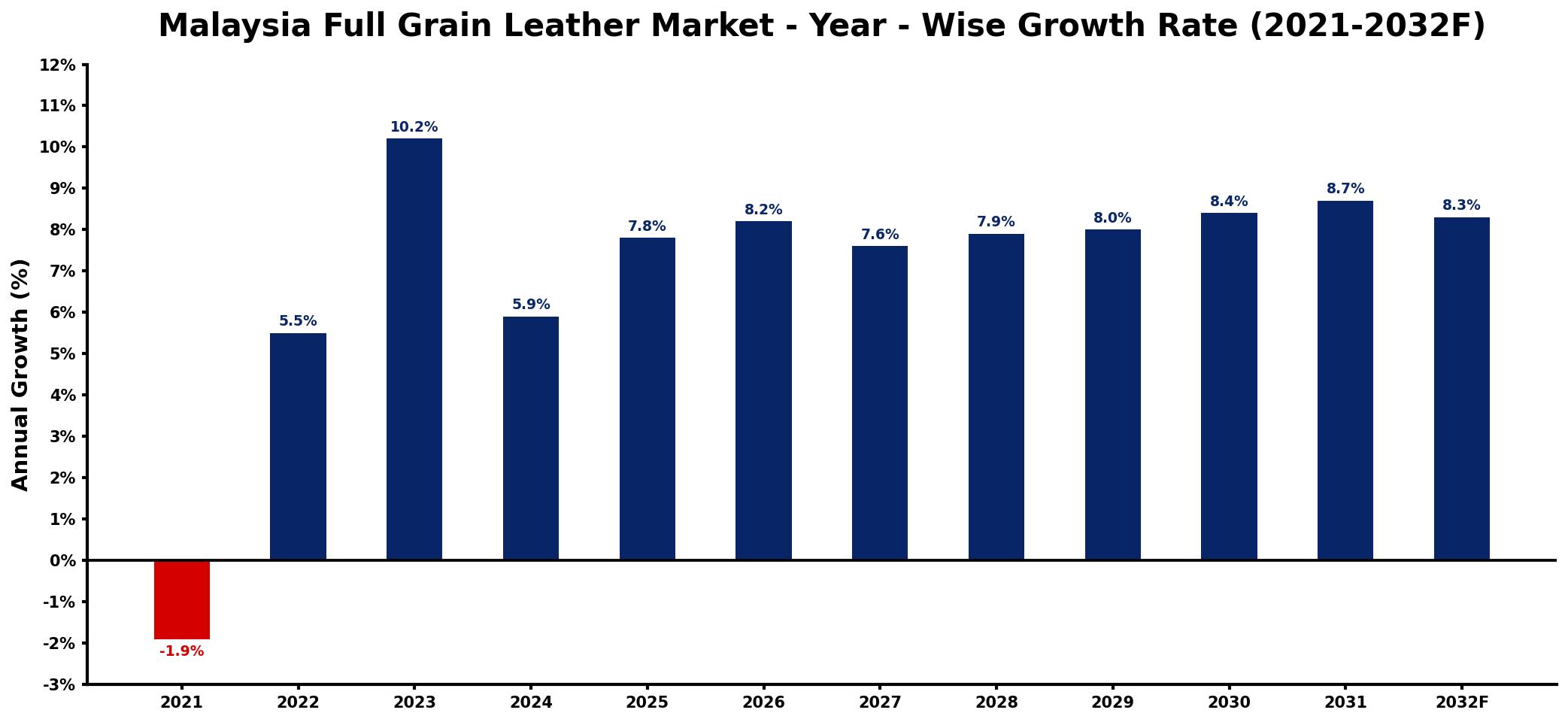
The table below presents the year‑wise growth rates along with the key drivers influencing the market
| Year | Growth Rate | Major Drivers |
| 2021 | -1.9% | decreased consumer spending in luxury |
| 2022 | 5.5% | rising interest in sustainable materials |
| 2023 | 10.2% | growing demand from fashion industry |
| 2024 | 5.9% | increased investments in manufacturing |
| 2025 | 7.8% | expansion of online retail channels |
| 2026 | 8.2% | higher consumer awareness of quality |
| 2027 | 7.6% | growing popularity of artisanal products |
| 2028 | 7.9% | increased exports to international markets |
| 2029 | 8.0% | rising disposable income among consumers |
| 2030 | 8.4% | strengthened supply chain capabilities |
| 2031 | 8.7% | growing collaborations with designers |
| 2032 | 8.3% | increased focus on luxury markets |
Note: Market size estimations and growth projections presented in this report are based on 6Wresearch's proprietary forecasting methodology, utilizing the latest available industry data, government publications, and primary research inputs.
Malaysia Full Grain Leather Market Synopsis
The strongest force shaping the Malaysia Full Grain Leather Market is the escalating demand for premium-quality leather products, particularly in luxury goods and high-end automotive interiors. As consumers become increasingly discerning about their purchases, the allure of full grain leather—known for its natural finish and longevity—continues to capture attention.
In Malaysia, the market thrives not just on consumer demand but also on the artisanal craftsmanship that characterizes the production of full grain leather goods. This attention to detail and commitment to quality has reinforced the market's overall positive outlook, positioning it as a key player in the regional leather industry.
Malaysia Full Grain Leather Market Key Takeaways
- The market is experiencing steady growth driven by consumer demand for high-quality, sustainable materials.
- Full grain leather is gaining traction in luxury fashion, furniture, and automotive sectors.
- Artisanal craftsmanship enhances the appeal of full grain leather products.
- Market players must navigate sustainability concerns while maintaining quality and brand reputation.
- Post-COVID recovery is leading to renewed interest and investment in luxury leather goods.
Evaluation of Restraints in Malaysia Full Grain Leather Market
Despite its promising growth, the Malaysia Full Grain Leather Market faces several constraints that could limit its potential. The rise of synthetic leather alternatives poses a competitive challenge, as these materials often come at a lower price point and appeal to environmentally conscious consumers. Additionally, ethical concerns surrounding animal leather production increasingly influence purchasing decisions, pushing brands to rethink their sourcing practices. Balancing these pressures while maintaining a commitment to quality and heritage is crucial for market players aiming to sustain their competitive edge.
Malaysia Full Grain Leather Market Trends
Emerging trends within the Malaysia Full Grain Leather Market include a heightened focus on sustainability and ethical sourcing practices. Consumers are increasingly looking for transparency in supply chains, prompting brands to adopt more responsible production methods. Furthermore, the integration of technology in leather processing—aimed at reducing waste and improving quality—has begun to reshape the industry landscape. A rise in e-commerce also influences purchasing behaviors, with online platforms becoming vital channels for luxury leather goods.
Malaysia Full Grain Leather Market Opportunities
The genuine growth opportunities within the Malaysia Full Grain Leather Market lie in expanding into new applications and markets. For instance, the rise of the middle class in Southeast Asia presents an opportunity to penetrate emerging markets with tailored product offerings. Additionally, collaborating with fashion designers to create exclusive collections could enhance brand visibility and attract niche consumer segments. Investing in sustainable practices may not only improve brand perception but also open doors to new customer bases that prioritize ethical consumption.
Government Initiatives in the Malaysia Full Grain Leather Market
The Malaysian government has recognized the leather industry as a key sector for economic development and has initiated various programs aimed at promoting its growth. Support for research and development in sustainable leather processing and production technologies is on the rise, alongside incentives for companies that adopt environmentally friendly practices. Public spending in related infrastructure improvements, such as logistics and export facilities, further contributes to the markets potential, positioning it for future expansion on both regional and global stages.
Future Insights of the Malaysia Full Grain Leather Market
Looking ahead to 2026-2032, the Malaysia Full Grain Leather Market is anticipated to continue its growth trajectory, supported by an expanding consumer base that values quality and craftsmanship. Increased awareness surrounding sustainability will likely encourage brands to innovate responsibly, enhancing both product offerings and brand loyalty. As the global economy recovers, the market's resilience will position it to capitalize on opportunities for collaboration and expansion, setting the stage for a vibrant and dynamic future.
Malaysia Full Grain Leather Market Latest Developments (2025 - 2026)
In recent months, the Malaysia Full Grain Leather Market has witnessed a strategic shift towards sustainable practices, with several companies announcing initiatives aimed at reducing their environmental impact. Additionally, partnerships between local artisans and international brands have emerged, promoting unique product lines that emphasize craftsmanship and cultural heritage. The ongoing recovery from the COVID-19 pandemic is further fueling demand for luxury goods, providing a timely boost to the full grain leather segment.
Malaysia Full Grain Leather Market - Key Attractiveness of the Report
- 10 Years of Market Numbers
- Historical Data Starting from 2022 to 2025
- Base Year: 2025
- Forecast Data until 2032
- Key Performance Indicators Impacting the Market
- Major Upcoming Developments and Projects
Key Highlights of the Report:
- Malaysia Full Grain Leather Market Outlook
- Market Size of Malaysia Full Grain Leather Market, 2025
- Forecast of Malaysia Full Grain Leather Market, 2032
- Historical Data and Forecast of Malaysia Full Grain Leather Revenues & Volume for the Period 2022-2032F
- Malaysia Full Grain Leather Market Trend Evolution
- Malaysia Full Grain Leather Market Drivers and Challenges
- Malaysia Full Grain Leather Price Trends
- Malaysia Full Grain Leather Porter's Five Forces
- Malaysia Full Grain Leather Industry Life Cycle
- Historical Data and Forecast of Malaysia Full Grain Leather Market Revenues & Volume By Type for the Period 2022-2032F
- Historical Data and Forecast of Malaysia Full Grain Leather Market Revenues & Volume By Coated for the Period 2022-2032F
- Historical Data and Forecast of Malaysia Full Grain Leather Market Revenues & Volume By Non-Coated for the Period 2022-2032F
- Historical Data and Forecast of Malaysia Full Grain Leather Market Revenues & Volume By Application for the Period 2022-2032F
- Historical Data and Forecast of Malaysia Full Grain Leather Market Revenues & Volume By Automobile for the Period 2022-2032F
- Historical Data and Forecast of Malaysia Full Grain Leather Market Revenues & Volume By Consumer Goods for the Period 2022-2032F
- Historical Data and Forecast of Malaysia Full Grain Leather Market Revenues & Volume By Furniture for the Period 2022-2032F
- Malaysia Full Grain Leather Import Export Trade Statistics
- Market Opportunity Assessment By Type
- Market Opportunity Assessment By Application
- Malaysia Full Grain Leather Top Companies Market Share
- Malaysia Full Grain Leather Competitive Benchmarking By Technical and Operational Parameters
- Malaysia Full Grain Leather Company Profiles
- Malaysia Full Grain Leather Key Strategic Recommendations






































