Malaysia Glass Ceramics Market Size, Share & Growth Rate
The Malaysia Glass Ceramics Market was estimated at USD 424 Million in 2025 and is projected to reach USD 553 Million by 2032, growing at a CAGR of 3.9% from 2026 to 2032. This upward trajectory is primarily fueled by increasing applications across construction and consumer goods sectors, where the demand for both functional and aesthetically appealing materials is on the rise. Furthermore, advancements in manufacturing technologies are facilitating more cost-effective production, thereby enhancing market accessibility.
Malaysia Glass Ceramics Market Year-wise Growth Rate and Key Drivers
This graph highlights how the Malaysia Glass Ceramics Market has steadily grown over the years, supported by major growth factors.
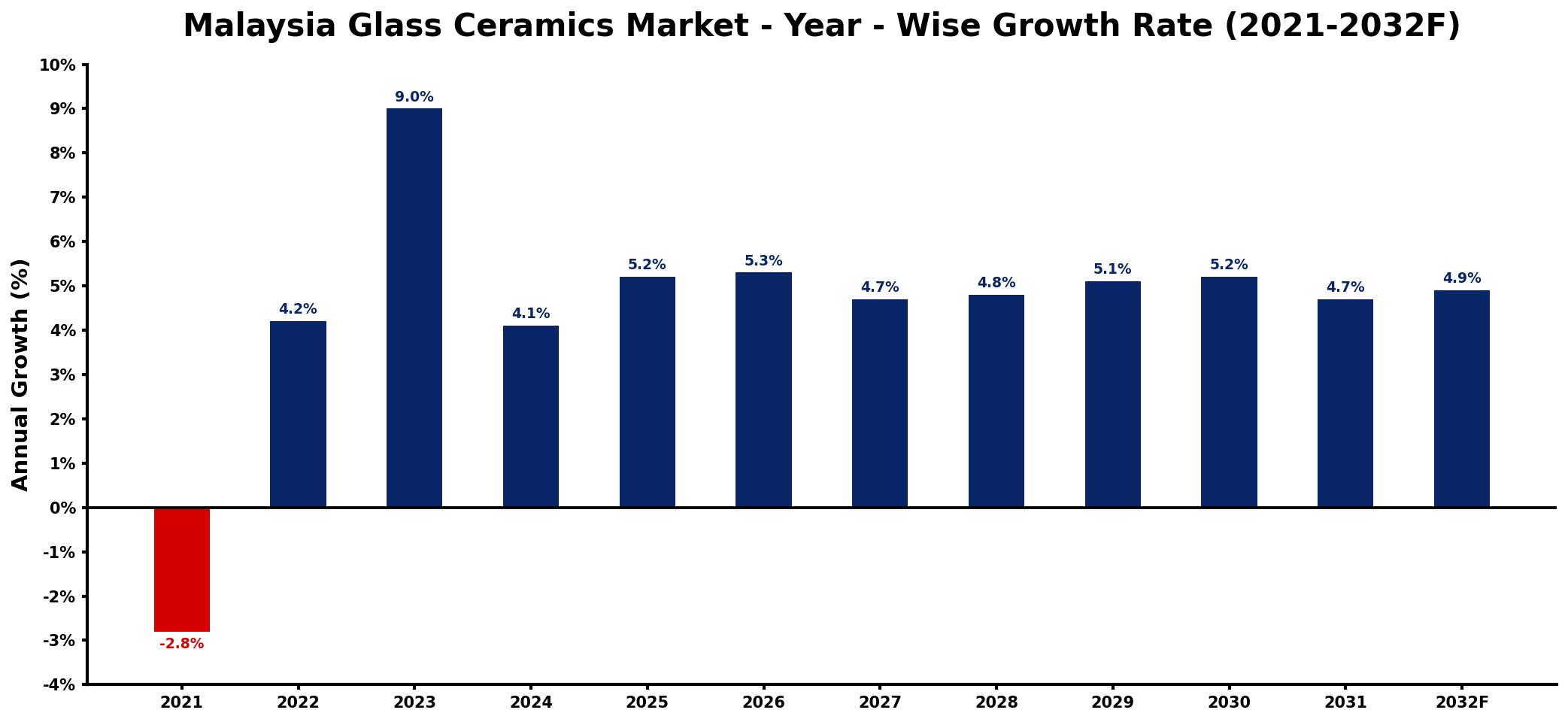
The table below presents the year‑wise growth rates along with the key drivers influencing the market
| Year | Growth Rate | Major Drivers |
| 2021 | -2.8% | decreased construction project investments |
| 2022 | 4.2% | rising consumer home renovation spending |
| 2023 | 9.0% | increased industrial manufacturing activities |
| 2024 | 4.1% | expansion of renewable energy projects |
| 2025 | 5.2% | growing demand for smart appliances |
| 2026 | 5.3% | enhanced infrastructure development initiatives |
| 2027 | 4.7% | increased automotive production requirements |
| 2028 | 4.8% | surge in hospitality sector investments |
| 2029 | 5.1% | growth in healthcare facility constructions |
| 2030 | 5.2% | rising popularity of eco-friendly designs |
| 2031 | 4.7% | rising export shipment volumes |
| 2032 | 4.9% | increased exports to international markets |
Note: Market size estimations and growth projections presented in this report are based on 6Wresearch's proprietary forecasting methodology, utilizing the latest available industry data, government publications, and primary research inputs.
Malaysia Glass Ceramics Market Synopsis
The growing interest in glass ceramics for cookware is notable, driven by consumer preferences for durable and aesthetically pleasing kitchenware. This shift towards high-quality, versatile materials is propelling the market forward, especially among discerning consumers. Additionally, the integration of glass ceramics into architectural elements is increasingly prominent, contributing to robust demand within construction projects.
Malaysia's glass ceramics market is characterized by its innovative product offerings that merge functionality with design. Companies are investing in research and development to explore new applications in specialized technical components, driven by their unique properties that blend glass and ceramic advantages. The result is a dynamic marketplace, ripe with potential as manufacturers adapt to evolving consumer trends.
Malaysia Glass Ceramics Market Key Takeaways
- The market is set to grow substantially due to rising construction and consumer goods applications.
- Innovations in manufacturing processes promise more cost-effective production methods.
- Fluctuations in raw material prices pose potential challenges to market stability.
- Expanding usage in architectural designs highlights the versatility of glass ceramics.
- Consumer preferences are shifting towards products that combine durability and aesthetic value.
Evaluation of Restraints in Malaysia Glass Ceramics Market
Despite the optimistic growth projections for the Malaysia glass ceramics market, several restraints could impede its progress. Fluctuations in raw material prices can create uncertainty in production costs, making it challenging for manufacturers to maintain competitive pricing. Additionally, the competitive landscape is increasingly populated with alternative materials, compelling traditional glass ceramics to innovate constantly. To navigate these challenges, industry players must focus on efficient sourcing and resilient supply chain management.
Malaysia Glass Ceramics Market Trends
As sustainability becomes a central theme in various industries, glass ceramics are increasingly recognized for their environmentally friendly properties. Manufacturers are adopting eco-friendly practices, appealing to a growing base of environmentally conscious consumers. Moreover, smart technologies are making their way into glass ceramics, facilitating the development of intelligent kitchenware and construction materials that offer enhanced functionality and efficiency. This trend is likely to shape future innovations and drive consumer interest.
Malaysia Glass Ceramics Market Opportunities
The current landscape presents significant growth opportunities, particularly in the construction sector. The push for modern architectural designs that utilize glass ceramics for their aesthetic and functional benefits opens new avenues for investment. Additionally, the rising trend of eco-friendly materials provides a strategic position for manufacturers focusing on sustainable production methods. Market players who leverage technological advancements could introduce innovative products that meet evolving consumer needs.
Government Initiatives in the Malaysia Glass Ceramics Market
The Malaysian government has been proactive in promoting initiatives that support the growth of various manufacturing sectors, including glass ceramics. Policies aimed at enhancing the construction industry and encouraging investments in sustainable materials are key components of national development strategies. Furthermore, government support for research and development in manufacturing processes is expected to foster innovation and improve the competitiveness of local products on the global stage.
Future Insights of the Malaysia Glass Ceramics Market
From 2026 to 2032, the Malaysia glass ceramics market is poised to see substantial evolution driven by ongoing technological advancements and changing consumer preferences. As architectural trends increasingly favor materials that are both visually appealing and highly functional, glass ceramics will likely find a more prominent place in both commercial and residential projects. This shift is expected to be complemented by innovations in manufacturing processes, leading to more cost-effective production and broader accessibility to high-quality glass ceramics.
Malaysia Glass Ceramics Market Latest Developments (2025 - 2026)
Recent developments in the Malaysia glass ceramics market indicate a shift towards smart applications within the product range. Companies are investing in advanced technologies to integrate features that cater to modern consumer demands for convenience and efficiency. Moreover, there is a notable increase in collaborative efforts between manufacturers and research institutions aimed at enhancing product offerings and exploring new market segments.
Malaysia Glass Ceramics Market - Key Attractiveness of the Report
- 10 Years of Market Numbers
- Historical Data Starting from 2022 to 2025
- Base Year: 2025
- Forecast Data until 2032
- Key Performance Indicators Impacting the Market
- Major Upcoming Developments and Projects
Key Highlights of the Report:
- Malaysia Glass Ceramics Market Outlook
- Market Size of Malaysia Glass Ceramics Market, 2025
- Forecast of Malaysia Glass Ceramics Market, 2032
- Historical Data and Forecast of Malaysia Glass Ceramics Revenues & Volume for the Period 2022-2032F
- Malaysia Glass Ceramics Market Trend Evolution
- Malaysia Glass Ceramics Market Drivers and Challenges
- Malaysia Glass Ceramics Price Trends
- Malaysia Glass Ceramics Porter's Five Forces
- Malaysia Glass Ceramics Industry Life Cycle
- Historical Data and Forecast of Malaysia Glass Ceramics Market Revenues & Volume By Material for the Period 2022-2032F
- Historical Data and Forecast of Malaysia Glass Ceramics Market Revenues & Volume By Lithium for the Period 2022-2032F
- Historical Data and Forecast of Malaysia Glass Ceramics Market Revenues & Volume By Mangnesium for the Period 2022-2032F
- Historical Data and Forecast of Malaysia Glass Ceramics Market Revenues & Volume By Zinc for the Period 2022-2032F
- Historical Data and Forecast of Malaysia Glass Ceramics Market Revenues & Volume By Application for the Period 2022-2032F
- Historical Data and Forecast of Malaysia Glass Ceramics Market Revenues & Volume By Building and Construction for the Period 2022-2032F
- Historical Data and Forecast of Malaysia Glass Ceramics Market Revenues & Volume By Electrical & Electronics for the Period 2022-2032F
- Historical Data and Forecast of Malaysia Glass Ceramics Market Revenues & Volume By Healthcare for the Period 2022-2032F
- Historical Data and Forecast of Malaysia Glass Ceramics Market Revenues & Volume By Aerospace for the Period 2022-2032F
- Historical Data and Forecast of Malaysia Glass Ceramics Market Revenues & Volume By Optical for the Period 2022-2032F
- Malaysia Glass Ceramics Import Export Trade Statistics
- Market Opportunity Assessment By Material
- Market Opportunity Assessment By Application
- Malaysia Glass Ceramics Top Companies Market Share
- Malaysia Glass Ceramics Competitive Benchmarking By Technical and Operational Parameters
- Malaysia Glass Ceramics Company Profiles
- Malaysia Glass Ceramics Key Strategic Recommendations






































