Malaysia Glass Lens Market Size, Share & Growth Rate
The Malaysia Glass Lens Market was estimated at USD 357 Million in 2025 and is projected to reach USD 466 Million by 2032, growing at a CAGR of 3.9% from 2026 to 2032. This growth is primarily fueled by the increasing demand for high-quality lenses across the automotive and consumer electronics sectors. The continuous evolution of imaging technologies, coupled with consumer preference for superior optical performance, significantly contributes to this upward trajectory.
Malaysia Glass Lens Market Year-wise Growth Rate and Key Drivers
This graph highlights how the Malaysia Glass Lens Market has steadily grown over the years, supported by major growth factors.
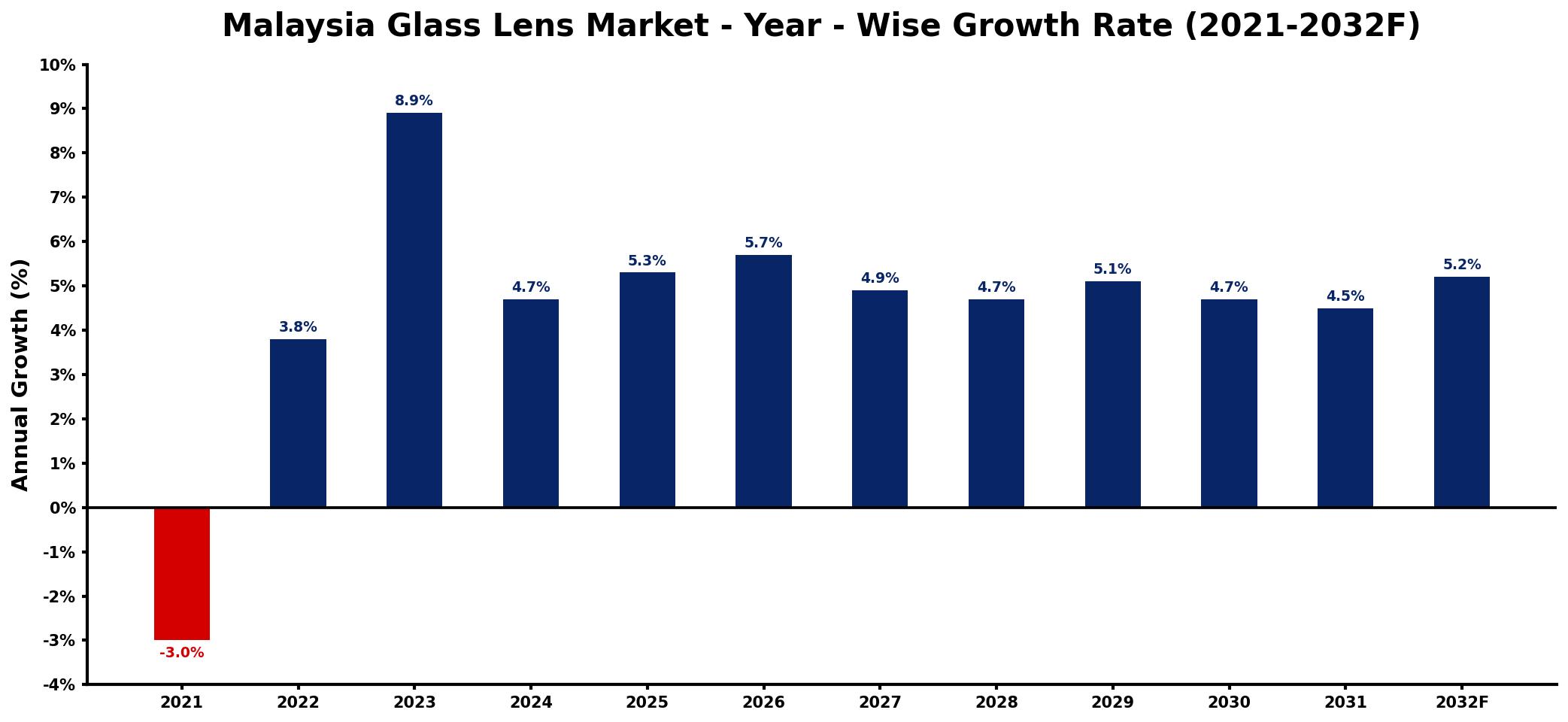
The table below presents the year‑wise growth rates along with the key drivers influencing the market
| Year | Growth Rate | Major Drivers |
| 2021 | -3.0% | decrease in consumer spending |
| 2022 | 3.8% | rising demand for eyewear |
| 2023 | 8.9% | increased health awareness campaigns |
| 2024 | 4.7% | growing investments in retail |
| 2025 | 5.3% | expansion of online sales platforms |
| 2026 | 5.7% | emergence of new fashion trends |
| 2027 | 4.9% | enhanced product innovation efforts |
| 2028 | 4.7% | increased pharmaceutical industry usage |
| 2029 | 5.1% | growing middle class population |
| 2030 | 4.7% | increased focus on sustainability |
| 2031 | 4.5% | rising number of eye clinics |
| 2032 | 5.2% | improved raw material availability |
Note: Market size estimations and growth projections presented in this report are based on 6Wresearch's proprietary forecasting methodology, utilizing the latest available industry data, government publications, and primary research inputs.
Malaysia Glass Lens Market Synopsis
A major force currently shaping the Malaysia glass lens market is the robust demand for high-precision optical components. This demand is prominently observed in the automotive and electronics industries, where glass lenses are essential for enhanced imaging and sensing capabilities.
As manufacturers embrace technological advancements in lens production, the market is benefitting from innovations that improve optical clarity and durability. This focus on high-quality performance will likely sustain momentum as consumers increasingly prioritize quality in their choice of photographic and optical equipment.
Malaysia Glass Lens Market Key Takeaways
- The market is witnessing steady growth, propelled by advancements in imaging technologies.
- High demand from the automotive and consumer electronics sectors is a crucial driver.
- Technological innovations are enhancing optical performance and lens durability.
- Market players are increasingly focusing on sustainable practices amidst changing consumer preferences.
- Post-pandemic recovery is expected to boost demand significantly in the coming years.
Evaluation of Restraints in Malaysia Glass Lens Market
Despite the positive outlook, the Malaysia glass lens market grapples with certain constraints. One significant challenge is the rapid technological evolution that demands continuous innovation. Manufacturers must stay ahead of trends in photography and consumer electronics, which can strain R&D resources. Additionally, environmental concerns around sustainability are prompting shifts in production methods and materials, which can pose operational challenges. These factors may hinder market players from fully capitalizing on growth opportunities.
Malaysia Glass Lens Market Trends
Key trends influencing the Malaysia glass lens market include the rising adoption of augmented reality (AR) and virtual reality (VR) technologies. These applications demand high-performance lenses for immersive experiences, thereby creating new market segments. Moreover, the increasing integration of smart technology in everyday devices drives the demand for advanced optical components, prompting manufacturers to invest in innovative lens designs and coatings.
Malaysia Glass Lens Market Opportunities
Growth opportunities within the Malaysia glass lens market are primarily found in expanding applications in healthcare and telecommunications. As precision optics becomes crucial in medical imaging and diagnostics, demand for specialized lenses is on the rise. Additionally, as the telecommunications sector gears up for 5G rollouts, there is potential for increased demand for high-quality optical components to facilitate advanced imaging and sensing technologies.
Government Initiatives in the Malaysia Glass Lens Market
The Malaysian government has been proactive in fostering an environment conducive to innovation within the glass lens market. Policies aimed at encouraging R&D in optical technologies, along with incentives for sustainable manufacturing practices, are crucial for industry growth. Public spending on infrastructure developments is expected to enhance market conditions, particularly in sectors that rely heavily on optical components.
Future Insights of the Malaysia Glass Lens Market
Looking ahead to 2026-2032, the Malaysia glass lens market is expected to witness a transformation driven by technological advancements and changing consumer behaviors. The continuous evolution in imaging technologies, particularly in sectors such as automotive safety systems and consumer electronics, will likely sustain growth momentum. As sustainability becomes a significant consideration, market players that adopt eco-friendly manufacturing processes may capture a competitive edge. Overall, the future appears promising, with several opportunities for growth across various applications.
Malaysia Glass Lens Market Latest Developments (2025 - 2026)
The recent months have seen a noticeable pivot towards integrating AI-driven manufacturing processes within the glass lens sector. These advancements aim to enhance production efficiency and product quality. Additionally, collaborations between technology firms and lens manufacturers are emerging, focusing on developing customized solutions that address the specific needs of various industries. The recovery trajectory post-COVID-19 has prompted renewed interest in high-quality optical products, indicating a favorable market environment for stakeholders.
Malaysia Glass Lens Market - Key Attractiveness of the Report
- 10 Years of Market Numbers
- Historical Data Starting from 2022 to 2025
- Base Year: 2025
- Forecast Data until 2032
- Key Performance Indicators Impacting the Market
- Major Upcoming Developments and Projects
Key Highlights of the Report:
- Malaysia Glass Lens Market Outlook
- Market Size of Malaysia Glass Lens Market, 2025
- Forecast of Malaysia Glass Lens Market, 2032
- Historical Data and Forecast of Malaysia Glass Lens Revenues & Volume for the Period 2022-2032F
- Malaysia Glass Lens Market Trend Evolution
- Malaysia Glass Lens Market Drivers and Challenges
- Malaysia Glass Lens Price Trends
- Malaysia Glass Lens Porter's Five Forces
- Malaysia Glass Lens Industry Life Cycle
- Historical Data and Forecast of Malaysia Glass Lens Market Revenues & Volume By Product Type for the Period 2022-2032F
- Historical Data and Forecast of Malaysia Glass Lens Market Revenues & Volume By Single Vision Lenses for the Period 2022-2032F
- Historical Data and Forecast of Malaysia Glass Lens Market Revenues & Volume By Progressive Lenses for the Period 2022-2032F
- Historical Data and Forecast of Malaysia Glass Lens Market Revenues & Volume By Bifocal and Trifocal Lenses for the Period 2022-2032F
- Historical Data and Forecast of Malaysia Glass Lens Market Revenues & Volume By Photochromic Lenses for the Period 2022-2032F
- Historical Data and Forecast of Malaysia Glass Lens Market Revenues & Volume By Polarized Lenses for the Period 2022-2032F
- Historical Data and Forecast of Malaysia Glass Lens Market Revenues & Volume By Others for the Period 2022-2032F
- Historical Data and Forecast of Malaysia Glass Lens Market Revenues & Volume By Coating for the Period 2022-2032F
- Historical Data and Forecast of Malaysia Glass Lens Market Revenues & Volume By Anti-Reflective for the Period 2022-2032F
- Historical Data and Forecast of Malaysia Glass Lens Market Revenues & Volume By Blue Light Reduction for the Period 2022-2032F
- Historical Data and Forecast of Malaysia Glass Lens Market Revenues & Volume By Scratch-Resistant for the Period 2022-2032F
- Historical Data and Forecast of Malaysia Glass Lens Market Revenues & Volume By UV Protection for the Period 2022-2032F
- Historical Data and Forecast of Malaysia Glass Lens Market Revenues & Volume By Distribution Channel for the Period 2022-2032F
- Historical Data and Forecast of Malaysia Glass Lens Market Revenues & Volume By Offline for the Period 2022-2032F
- Historical Data and Forecast of Malaysia Glass Lens Market Revenues & Volume By Online for the Period 2022-2032F
- Malaysia Glass Lens Import Export Trade Statistics
- Market Opportunity Assessment By Product Type
- Market Opportunity Assessment By Coating
- Market Opportunity Assessment By Distribution Channel
- Malaysia Glass Lens Top Companies Market Share
- Malaysia Glass Lens Competitive Benchmarking By Technical and Operational Parameters
- Malaysia Glass Lens Company Profiles
- Malaysia Glass Lens Key Strategic Recommendations






































