Malaysia High Strength Steel Market Size, Share & Growth Rate
The Malaysia High Strength Steel Market was estimated at USD 417 Million in 2025 and is projected to reach USD 547 Million by 2032, growing at a CAGR of 4.0% from 2026 to 2032. This growth trajectory is primarily fueled by the automotive industry's increasing demand for lightweight materials to enhance fuel efficiency and safety. Additionally, the construction sector's push for high-rise buildings and sustainable practices further contributes to the market's expansion.
Malaysia High Strength Steel Market Year-wise Growth Rate and Key Drivers
This graph highlights how the Malaysia High Strength Steel Market has steadily grown over the years, supported by major growth factors.
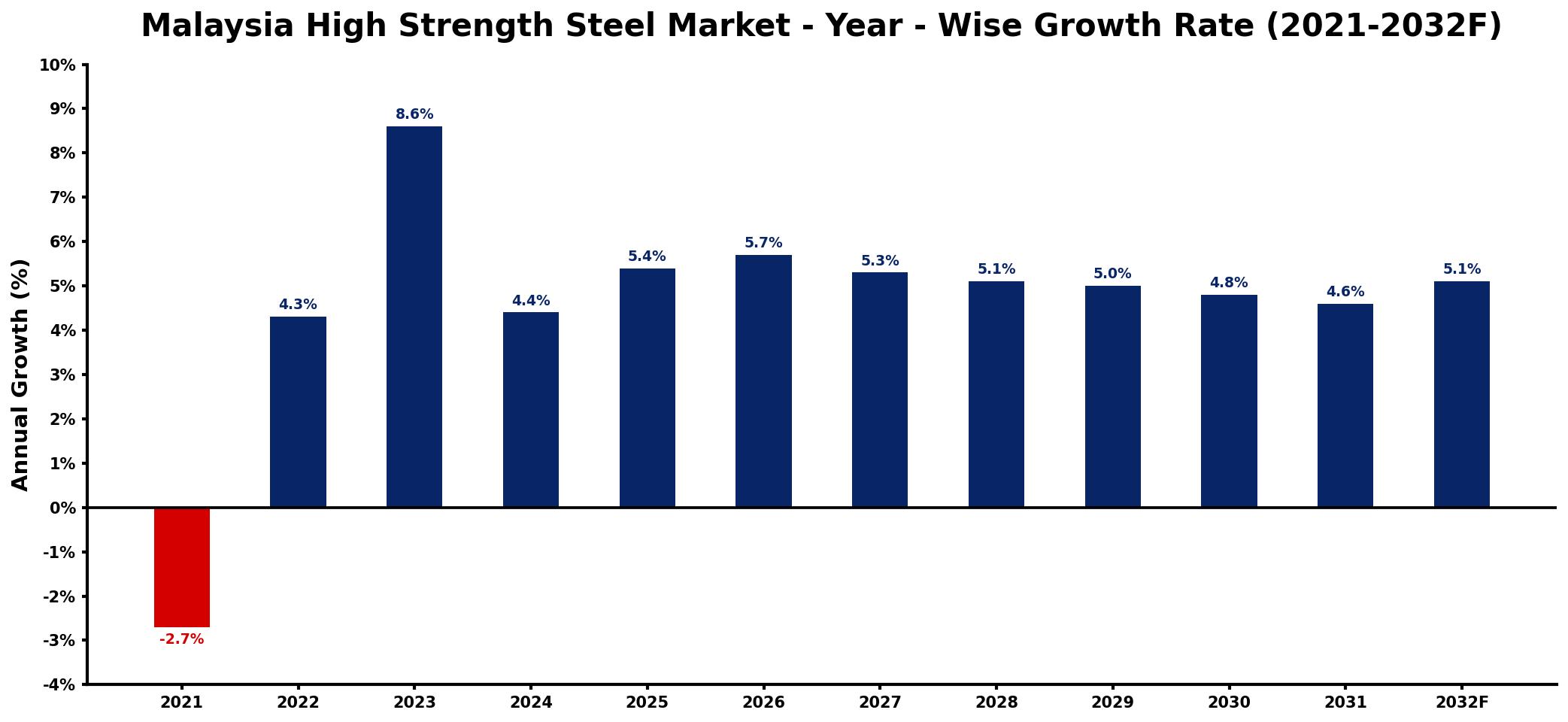
The table below presents the year‑wise growth rates along with the key drivers influencing the market
| Year | Growth Rate | Major Drivers |
| 2021 | -2.7% | decreased construction sector investments |
| 2022 | 4.3% | rising automotive manufacturing demand |
| 2023 | 8.6% | increased infrastructure development projects |
| 2024 | 4.4% | growing renewable energy initiatives |
| 2025 | 5.4% | expansion in manufacturing capabilities |
| 2026 | 5.7% | rising demand from electronics |
| 2027 | 5.3% | increased exports to neighboring countries |
| 2028 | 5.1% | growing urbanization and construction |
| 2029 | 5.0% | rising technological advancements adoption |
| 2030 | 4.8% | increased focus on sustainability practices |
| 2031 | 4.6% | stronger distribution network expansion |
| 2032 | 5.1% | expansion of transportation infrastructure projects |
Note: Market size estimations and growth projections presented in this report are based on 6Wresearch's proprietary forecasting methodology, utilizing the latest available industry data, government publications, and primary research inputs.
Malaysia High Strength Steel Market Synopsis
Currently, the high strength steel market in Malaysia is witnessing a notable upsurge, primarily driven by advancements in automotive technologies and construction methodologies. The adoption of high strength steel enables manufacturers to produce lighter and more durable products, essential for meeting stringent fuel efficiency and safety standards.
As industries evolve, high strength steel's applications extend beyond automotive and construction to manufacturing, where it enhances product longevity and performance. With Malaysia's commitment to technological innovation, the market is poised for sustained growth, backed by strategic investments and infrastructural development.
Malaysia High Strength Steel Market Key Takeaways
- The automotive and construction sectors are pivotal in driving the high strength steel market in Malaysia.
- Government initiatives aimed at promoting sustainable construction practices are expected to boost demand.
- Investment in advanced manufacturing technologies will be crucial for overcoming production cost challenges.
- The resilience of the market amidst disruptions, such as the COVID-19 pandemic, highlights its foundational importance across industries.
- Key players are investing heavily in R&D to innovate and offer superior high-strength steel products.
Evaluation of Restraints in Malaysia High Strength Steel Market
Despite the promising outlook, the high strength steel market in Malaysia faces several challenges that could temper its growth. One major restraint is the high cost associated with the production of high strength steel, which can deter smaller manufacturers from entering the market. Furthermore, the necessity for advanced manufacturing processes presents an additional barrier, as significant investment in technology and skilled labor is required to produce high-quality products. These factors could limit the speed at which the market can expand, emphasizing the need for strategic solutions to enhance competitiveness.
Malaysia High Strength Steel Market Trends
The Malaysian high strength steel market is currently shaped by several dynamic trends. Firstly, the increasing focus on lightweight automotive solutions aligns perfectly with the enhanced properties of high strength steel, prompting automotive manufacturers to integrate these materials extensively. Additionally, the trend towards smart construction methods promotes the use of high strength steel to ensure safety and durability in infrastructure development. Moreover, rising environmental awareness is driving a shift towards sustainable manufacturing practices, leading to an upsurge in the demand for eco-friendly high strength steel alternatives.
Malaysia High Strength Steel Market Opportunities
There are substantial opportunities for growth in the Malaysia high strength steel market, particularly within the automotive and construction sectors. The increasing demand for electric vehicles (EVs) presents a unique chance for high strength steel to play a vital role in vehicle efficiency. Furthermore, with Malaysia's urban development initiatives underway, there is an elevated need for high-strength materials in infrastructure projects, creating an attractive investment landscape. Collaborations between public and private sectors could also spur innovation and adoption of high strength steel, unlocking further market potential.
Government Initiatives in the Malaysia High Strength Steel Market
The Malaysian government is actively supporting the high strength steel market through various initiatives aimed at promoting sustainable construction and manufacturing practices. Investments in infrastructure development, along with incentives for adopting advanced technologies in steel production, reflect a commitment to enhancing the nation's industrial capabilities. Programs focusing on research and development in materials science are fostering innovation, setting a strong foundation for the growth of high strength steel applications across multiple sectors.
Future Insights of the Malaysia High Strength Steel Market
Looking ahead, the Malaysia high strength steel market is expected to enter a phase of accelerated growth between 2026 and 2032. As industries increasingly prioritize lightweight and high-performance materials, high strength steel will become indispensable in manufacturing, automotive, and construction. The anticipated technological advancements in production processes will likely reduce costs and improve accessibility for new entrants. Furthermore, the government's continued focus on sustainability will drive further integration of high strength steel in eco-friendly projects, solidifying its position in the Malaysian market.
Malaysia High Strength Steel Market Latest Developments (2025 - 2026)
Recent developments in the Malaysia high strength steel market indicate a growing interest in automation and advanced manufacturing techniques. As companies adapt to market demands, investments in cutting-edge technology are becoming more prevalent, enhancing production efficiency and product quality. Collaborative efforts between industry players and research institutions are fostering innovations that focus on sustainability, leading to the introduction of novel high strength steel formulations that cater to modern applications.
Malaysia High Strength Steel Market - Key Attractiveness of the Report
- 10 Years of Market Numbers
- Historical Data Starting from 2022 to 2025
- Base Year: 2025
- Forecast Data until 2032
- Key Performance Indicators Impacting the Market
- Major Upcoming Developments and Projects
Key Highlights of the Report:
- Malaysia High Strength Steel Market Outlook
- Market Size of Malaysia High Strength Steel Market, 2025
- Forecast of Malaysia High Strength Steel Market, 2032
- Historical Data and Forecast of Malaysia High Strength Steel Revenues & Volume for the Period 2022-2032F
- Malaysia High Strength Steel Market Trend Evolution
- Malaysia High Strength Steel Market Drivers and Challenges
- Malaysia High Strength Steel Price Trends
- Malaysia High Strength Steel Porter's Five Forces
- Malaysia High Strength Steel Industry Life Cycle
- Historical Data and Forecast of Malaysia High Strength Steel Market Revenues & Volume By Product Type for the Period 2022-2032F
- Historical Data and Forecast of Malaysia High Strength Steel Market Revenues & Volume By Dual Phase Steel for the Period 2022-2032F
- Historical Data and Forecast of Malaysia High Strength Steel Market Revenues & Volume By Bake Hardenable Steel for the Period 2022-2032F
- Historical Data and Forecast of Malaysia High Strength Steel Market Revenues & Volume By Carbon Manganese Steel for the Period 2022-2032F
- Historical Data and Forecast of Malaysia High Strength Steel Market Revenues & Volume By Other Product Types for the Period 2022-2032F
- Historical Data and Forecast of Malaysia High Strength Steel Market Revenues & Volume By Application for the Period 2022-2032F
- Historical Data and Forecast of Malaysia High Strength Steel Market Revenues & Volume By Automotive for the Period 2022-2032F
- Historical Data and Forecast of Malaysia High Strength Steel Market Revenues & Volume By Construction for the Period 2022-2032F
- Historical Data and Forecast of Malaysia High Strength Steel Market Revenues & Volume By Yellow Goods and Mining Equipment for the Period 2022-2032F
- Historical Data and Forecast of Malaysia High Strength Steel Market Revenues & Volume By Aviation and Marine for the Period 2022-2032F
- Historical Data and Forecast of Malaysia High Strength Steel Market Revenues & Volume By Other Applications for the Period 2022-2032F
- Malaysia High Strength Steel Import Export Trade Statistics
- Market Opportunity Assessment By Product Type
- Market Opportunity Assessment By Application
- Malaysia High Strength Steel Top Companies Market Share
- Malaysia High Strength Steel Competitive Benchmarking By Technical and Operational Parameters
- Malaysia High Strength Steel Company Profiles
- Malaysia High Strength Steel Key Strategic Recommendations






































