Malaysia Hollow Section Steel Market Size, Share & Growth Rate
The Malaysia Hollow Section Steel Market was estimated at USD 173 Million in 2025 and is projected to reach USD 224 Million by 2032, growing at a CAGR of 3.8% from 2026 to 2032. This growth trajectory is fundamentally driven by an increasing demand from the booming construction and infrastructure sectors, where hollow section steel plays a pivotal role in structural applications. The ongoing urbanization, supported by significant government initiatives, ensures that the market's expansion is both steady and substantial.
Malaysia Hollow Section Steel Market Year-wise Growth Rate and Key Drivers
This graph highlights how the Malaysia Hollow Section Steel Market has steadily grown over the years, supported by major growth factors.
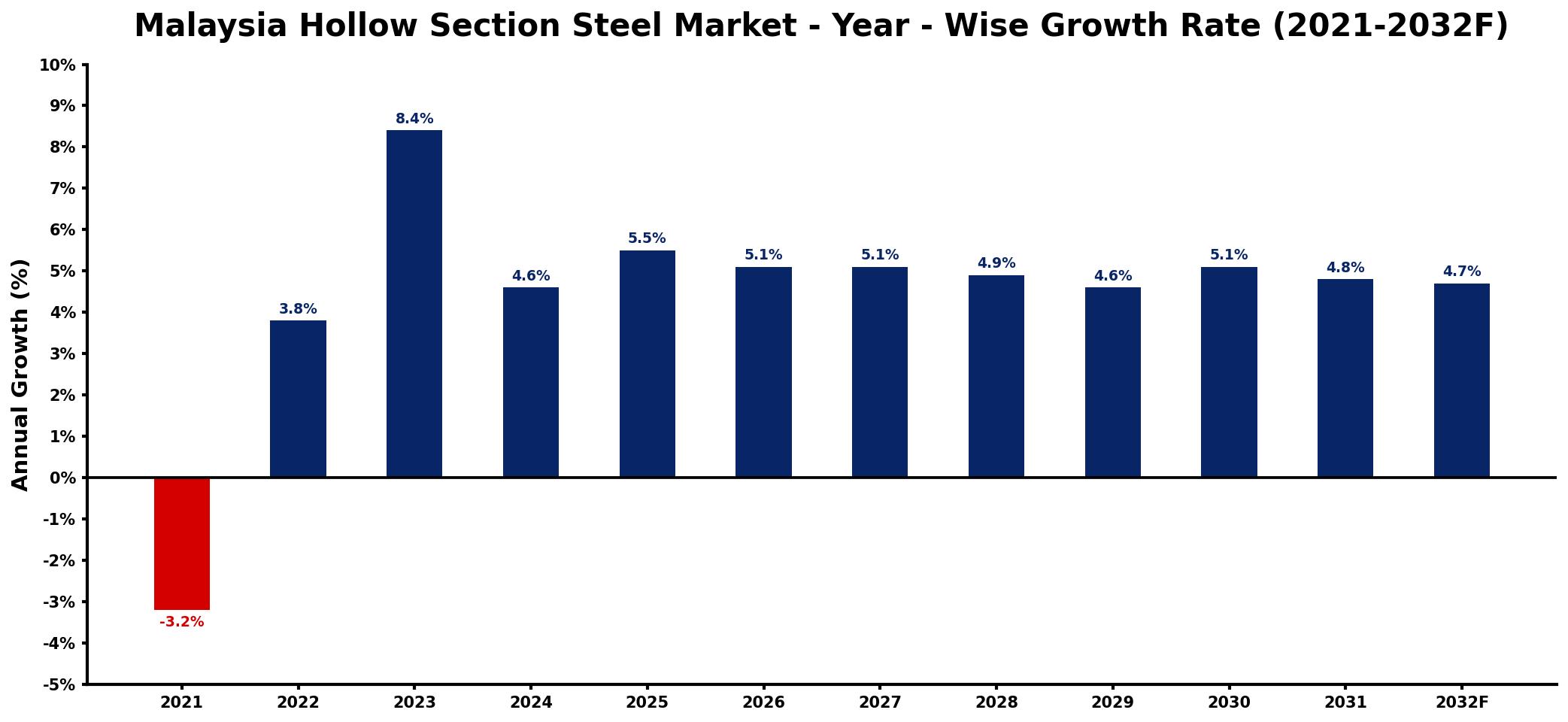
The table below presents the year‑wise growth rates along with the key drivers influencing the market
| Year | Growth Rate | Major Drivers |
| 2021 | -3.2% | construction project cancellations impact demand |
| 2022 | 3.8% | increased infrastructure investments drive growth |
| 2023 | 8.4% | renewable energy projects boost requirements |
| 2024 | 4.6% | rising construction activity supports expansion |
| 2025 | 5.5% | automotive sector demands higher supplies |
| 2026 | 5.1% | urbanization trends enhance market potential |
| 2027 | 5.1% | government initiatives promote construction projects |
| 2028 | 4.9% | technological advancements improve production efficiency |
| 2029 | 4.6% | export opportunities expand market reach |
| 2030 | 5.1% | sustainability trends drive material innovation |
| 2031 | 4.8% | increased residential development fuels demand |
| 2032 | 4.7% | public transport expansion enhances requirements |
Note: Market size estimations and growth projections presented in this report are based on 6Wresearch's proprietary forecasting methodology, utilizing the latest available industry data, government publications, and primary research inputs.
Malaysia Hollow Section Steel Market Synopsis
In Malaysia, the hollow section steel market is witnessing a transformative phase, propelled by a surge in construction activities across the nation. Major infrastructure projects, including highways and bridges, increasingly incorporate hollow section steel due to its superior strength-to-weight ratio and versatility.
Moreover, advancements in manufacturing technologies have made it possible to produce hollow section steel that meets sustainability goals while remaining economically viable. As a result, this market is not only adapting to current needs but is also shaping the future of construction methodologies in the region.
Malaysia Hollow Section Steel Market Key Takeaways
- The market is driven by the rising demand for hollow section steel in construction and infrastructure projects.
- Government infrastructure initiatives are expected to bolster market growth significantly over the forecast period.
- Advancements in manufacturing technologies contribute to the production of cost-effective and sustainable products.
- The market is poised for steady growth as urbanization continues to accelerate in Malaysia.
- Leading manufacturers are investing in research and development to enhance product quality and market competitiveness.
Evaluation of Restraints in Malaysia Hollow Section Steel Market
While the hollow section steel market in Malaysia is on a positive growth trajectory, there are several constraints that could hinder its potential. Fluctuations in raw material prices and global economic uncertainties may pose challenges to manufacturers, impacting profit margins and pricing strategies. Additionally, the market may face competition from alternative materials that could appeal to budget-conscious projects, requiring continuous innovation and adaptation from industry players to maintain market share.
Malaysia Hollow Section Steel Market Trends
Key trends shaping the Malaysia hollow section steel market include a shift towards sustainable construction practices and increased investment in smart infrastructure. Manufacturers are exploring innovative production techniques that not only enhance product durability but also reduce environmental impact. Furthermore, the integration of technology in the construction process is becoming more prevalent, creating opportunities for hollow section steel to be utilized in modern, high-tech building designs.
Malaysia Hollow Section Steel Market Opportunities
The demand for hollow section steel presents numerous growth opportunities, especially in urban development projects focusing on sustainability. The government's commitment to infrastructure investments, particularly in public transportation and smart cities, creates an ideal landscape for increased hollow section steel application. Additionally, as Malaysia advances towards Industry 4.0, there is a distinct opportunity for manufacturers to leverage automation and digital solutions to enhance production efficiency and product quality.
Government Initiatives in the Malaysia Hollow Section Steel Market
The Malaysian government has recognized the importance of infrastructure development as a catalyst for economic growth. Initiatives aimed at modernizing transportation networks and enhancing urban infrastructure are actively supported through public spending and incentives. Programs promoting the use of sustainable materials and technologies are further encouraging the adoption of hollow section steel in construction projects, positioning this sector for continued growth in the coming years.
Future Insights of the Malaysia Hollow Section Steel Market
Looking ahead to 2026-2032, the Malaysia hollow section steel market is set to evolve alongside the nations rapid urbanization and infrastructure ambitions. With an ongoing push for modernization and sustainability, demand for hollow section steel is expected to increase significantly. Manufacturers will need to remain agile, embracing technological advancements while focusing on sustainability to secure their position in a competitive landscape that is continually changing.
Malaysia Hollow Section Steel Market Latest Developments (2025 - 2026)
Recent developments in the Malaysia hollow section steel market indicate a strong focus on innovation and sustainability. Manufacturers are increasingly collaborating with construction firms to explore new applications for hollow section steel, particularly in smart city projects. There is a noticeable uptick in R&D investments aimed at enhancing product performance while minimizing environmental impact. Additionally, the government's infrastructure projects are gaining momentum, further driving the demand for hollow section steel in various sectors.
Malaysia Hollow Section Steel Market - Key Attractiveness of the Report
- 10 Years of Market Numbers
- Historical Data Starting from 2022 to 2025
- Base Year: 2025
- Forecast Data until 2032
- Key Performance Indicators Impacting the Market
- Major Upcoming Developments and Projects
Key Highlights of the Report:
- Malaysia Hollow Section Steel Market Outlook
- Market Size of Malaysia Hollow Section Steel Market, 2025
- Forecast of Malaysia Hollow Section Steel Market, 2032
- Historical Data and Forecast of Malaysia Hollow Section Steel Revenues & Volume for the Period 2022-2032F
- Malaysia Hollow Section Steel Market Trend Evolution
- Malaysia Hollow Section Steel Market Drivers and Challenges
- Malaysia Hollow Section Steel Price Trends
- Malaysia Hollow Section Steel Porter's Five Forces
- Malaysia Hollow Section Steel Industry Life Cycle
- Historical Data and Forecast of Malaysia Hollow Section Steel Market Revenues & Volume By Type for the Period 2022-2032F
- Historical Data and Forecast of Malaysia Hollow Section Steel Market Revenues & Volume By Rectangular Hollow Section for the Period 2022-2032F
- Historical Data and Forecast of Malaysia Hollow Section Steel Market Revenues & Volume By Square Hollow Section for the Period 2022-2032F
- Historical Data and Forecast of Malaysia Hollow Section Steel Market Revenues & Volume By Circular Hollow Section for the Period 2022-2032F
- Historical Data and Forecast of Malaysia Hollow Section Steel Market Revenues & Volume By Other for the Period 2022-2032F
- Historical Data and Forecast of Malaysia Hollow Section Steel Market Revenues & Volume By Application for the Period 2022-2032F
- Historical Data and Forecast of Malaysia Hollow Section Steel Market Revenues & Volume By Agricultural for the Period 2022-2032F
- Historical Data and Forecast of Malaysia Hollow Section Steel Market Revenues & Volume By Construction for the Period 2022-2032F
- Historical Data and Forecast of Malaysia Hollow Section Steel Market Revenues & Volume By General Engineering for the Period 2022-2032F
- Historical Data and Forecast of Malaysia Hollow Section Steel Market Revenues & Volume By Mechanical Application for the Period 2022-2032F
- Historical Data and Forecast of Malaysia Hollow Section Steel Market Revenues & Volume By Others for the Period 2022-2032F
- Historical Data and Forecast of Malaysia Hollow Section Steel Market Revenues & Volume By Global Hollow Section Steel Market dynamics for the Period 2022-2032F
- Historical Data and Forecast of Malaysia Hollow Section Steel Market Revenues & Volume By Global Hollow Section Steel Market size for the Period 2022-2032F
- Historical Data and Forecast of Malaysia Hollow Section Steel Market Revenues & Volume By Supply & Demand for the Period 2022-2032F
- Malaysia Hollow Section Steel Import Export Trade Statistics
- Market Opportunity Assessment By Type
- Market Opportunity Assessment By Application
- Malaysia Hollow Section Steel Top Companies Market Share
- Malaysia Hollow Section Steel Competitive Benchmarking By Technical and Operational Parameters
- Malaysia Hollow Section Steel Company Profiles
- Malaysia Hollow Section Steel Key Strategic Recommendations






































