Malaysia Home Appliances Market Summary
The malaysia home appliances market was estimated at USD 414 Million in 2025 and is projected to reach USD 537 Million by 2032, growing at a CAGR of 5.5% from 2026 to 2032.
Malaysia Home Appliances Market Year-wise Growth Rate and Key Drivers
This graph highlights how the Malaysia Home Appliances Market has steadily grown over the past five years, supported by major growth factors.
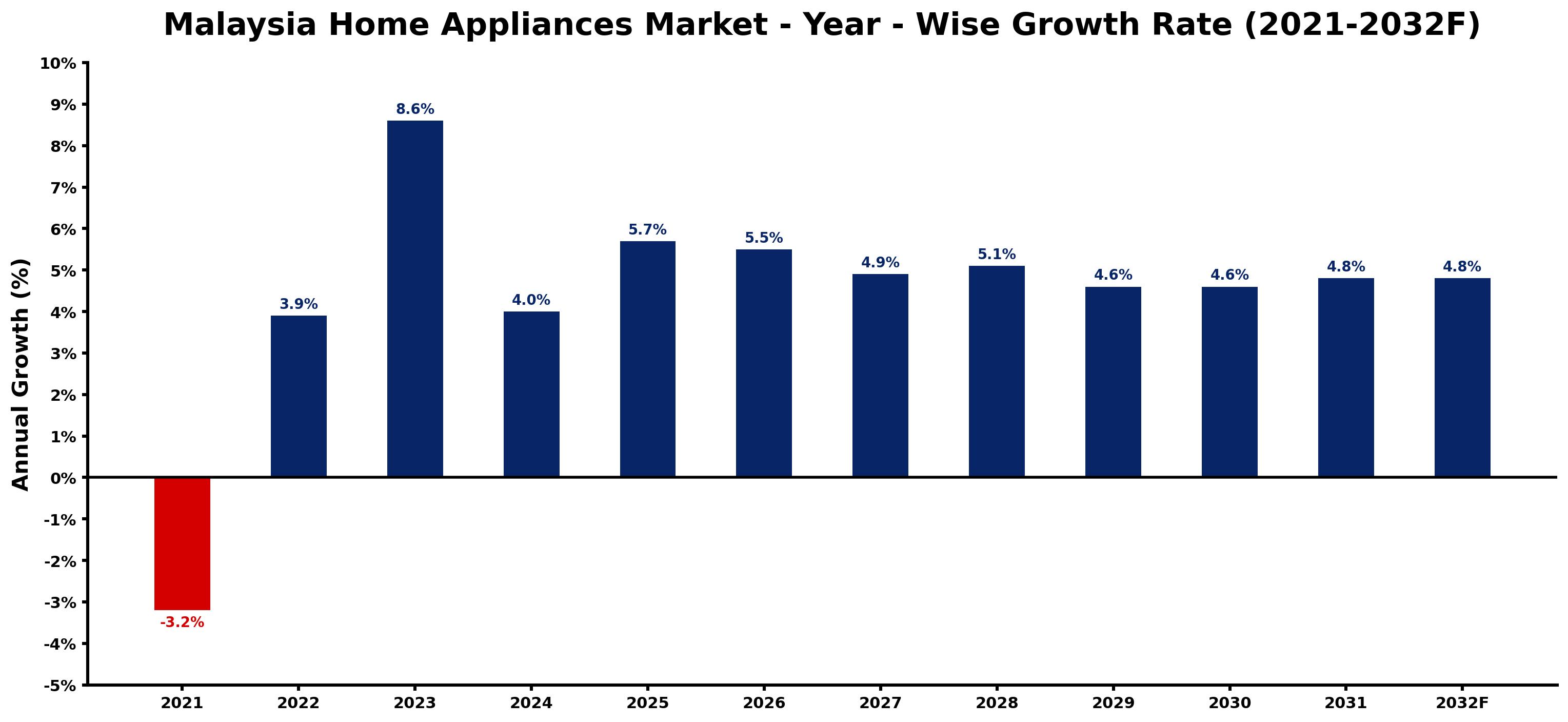
The table below presents the year wise growth rates along with the key drivers influencing the market
| Year | Growth Rate | Major Drivers |
| 2021 | -3.2% | Supply chain disruptions due to the pandemic hampered availability and delayed deliveries of essential home appliances. |
| 2022 | 3.9% | Increased disposable income allowed families to invest in premium home appliances. |
| 2023 | 8.6% | Corporate sustainability commitments led to demand for energy-efficient product lines. |
| 2024 | 4.0% | Manufacturers sought to enhance product durability in response to competitive pressures. |
| 2025 | 5.7% | Home renovation trends fueled purchases of smart kitchen appliances across urban areas. |
| 2026 | 5.5% | Local production capabilities improved, reducing costs and shortening supply chains significantly. |
| 2027 | 4.9% | Technological integrations in appliances became appealing to tech-savvy Malaysian consumers. |
| 2028 | 5.1% | Urbanization trends continued, creating a larger market for compact, multifunctional devices. |
| 2029 | 4.6% | Consumer education programs highlighted benefits of energy-efficient appliances, shifting preferences. |
| 2030 | 4.6% | Home automation trends expanded, encouraging integration with smart home ecosystems. |
| 2031 | 4.8% | Sustainable living trends emerged, prompting demand for eco-friendly appliance options. |
| 2032 | 4.8% | Product innovations in performance and design captivated younger generations entering the market. |
Note - Market size estimations and growth projections presented in this report are based on 6Wresearch's advanced forecasting approach, validated with industry datasets as of June 2026.
Malaysia Home Appliances Market Synopsis
The Malaysia Home Appliances Market is projected to reach 5.5% and witness significant growth during the forecast period (2026-2032). This growth trajectory can be attributed to several key factors fueling demand for home appliances in the region. Notable among these factors are rising disposable income levels, accelerated urbanization, technological advancements, and an increased focus on energy efficiency among consumers. The surge in internet penetration in Malaysia has further enhanced opportunities for manufacturers to reach a broader audience, particularly through online platforms, thereby increasing sales. Furthermore, the introduction of connected home appliances that can be controlled remotely has contributed to a more convenient consumer experience, driving demand across various segments of the market.
Malaysia Home Appliances Market Growth Drivers
Several critical drivers are shaping the dynamics of the Malaysia Home Appliances Market. These include:
- Increasing Disposable Income: As consumers enjoy higher disposable incomes, they are more inclined to invest in modern home appliances that enhance comfort and efficiency.
- Urbanization: Rapid urbanization is leading to a shift in consumer preferences towards state-of-the-art home appliances that cater to modern living standards.
- Technological Advancements: Continuous innovations and technology integration in home appliances, such as smart features, are making products more attractive to tech-savvy consumers.
- Energy Efficiency Awareness: Growing environmental awareness is driving consumers to opt for energy-efficient appliances, aligning with global sustainability trends.
- E-commerce Growth: With the rise of e-commerce, manufacturers are capitalizing on online sales channels to reach consumers directly, thus expanding their market footprint.
Malaysia Home Appliances Market Trends and Opportunities
The Malaysia Home Appliances Market is witnessing several trends that present new opportunities for growth. These trends include:
- Smart Appliances: The proliferation of smart home technology is leading to increased demand for appliances that offer connectivity and can be controlled via mobile applications.
- Sustainable Products: Consumers are now prioritizing eco-friendly and sustainable home appliances, creating opportunities for manufacturers to innovate in this space.
- Customization: There is a growing trend toward personalized home appliances that meet the specific needs of consumers, allowing manufacturers to differentiate their offerings.
- Health-Conscious Products: Post-pandemic, there is an increased demand for appliances that promote health and hygiene, such as air purifiers and advanced cleaning devices.
- Online Shopping Experience: Enhanced online shopping experiences, including virtual showrooms and augmented reality applications, are becoming vital in engaging consumers.
Malaysia Home Appliances Market Challenges and Restraints
Despite the positive growth outlook for the Malaysia Home Appliances Market, several challenges may hinder progress. These include:
- Premium Product Costs: The higher price points associated with premium home appliances can limit accessibility for certain consumer segments.
- Economic Slowdown: Economic uncertainties and impacts from the COVID-19 pandemic may affect consumer spending and confidence in high-value purchases.
- Supply Chain Disruptions: Ongoing global supply chain challenges can lead to delays and increased costs for manufacturers, affecting product availability.
- Regulatory Compliance: Stricter environmental and energy standards may pose challenges for manufacturers in terms of compliance and adapting to new requirements.
- Market Saturation: Increasing competition and market saturation can limit growth opportunities for newer entrants and existing players alike.
Malaysia Home Appliances Market Government Investment and Initiatives
The role of the Malaysian government is integral to the development of the home appliances sector. Several initiatives and investments are being directed toward this market to foster growth:
- Promotion of Local Manufacturing: The government is encouraging local manufacturing through incentives, aiming to reduce dependency on imports and boost the domestic economy.
- Energy Efficiency Programs: Initiatives aimed at promoting energy-efficient appliances are being implemented, which include consumer education and subsidies to encourage adoption.
- Public Investment in Infrastructure: Investments in infrastructure development support improved logistics and distribution channels for home appliance manufacturers.
- Research and Development Grants: The government offers grants for R&D in technology and innovation, fostering product development in the home appliances market.
- Environmental Regulations: The establishment of stringent environmental regulations is driving manufacturers to innovate and develop greener appliances, aligning with global sustainability goals.
Malaysia Home Appliances Market Latest Developments (May 2025 - June 2026)
Recent developments in the Malaysia Home Appliances Market indicate a dynamic evolution of consumer preferences and technological advancements. Over the period from May 2025 to June 2026, trends show a heightened focus on smart appliances, with manufacturers investing in connected technologies. Additionally, the push for sustainability has encouraged many companies to launch energy-efficient products that meet new regulatory standards. The e-commerce sector has seen substantial growth, with businesses exploring innovative methods to enhance online shopping experiences. Furthermore, consumer education regarding the benefits of advanced home appliances has gained traction, leading to a shift in purchasing decisions.
Malaysia Home Appliances Market - Key Attractiveness of the Report
- 10 Years of Market Numbers
- Historical Data Starting from 2022 to 2025
- Base Year: 2025
- Forecast Data until 2032
- Key Performance Indicators Impacting the Market
- Major Upcoming Developments and Projects
Key Highlights of the Report:
- Malaysia Home Appliances Market Outlook
- Market Size of Malaysia Home Appliances Market, 2025
- Forecast of Malaysia Home Appliances Market, 2032F
- Historical Data and Forecast of Malaysia Home Appliances Revenues & Volume for the Period 2022-2032F
- Malaysia Home Appliances Market Trend Evolution
- Malaysia Home Appliances Market Drivers and Challenges
- Malaysia Home Appliances Price Trends
- Malaysia Home Appliances Porter's Five Forces
- Malaysia Home Appliances Industry Life Cycle
- Historical Data and Forecast of Malaysia Home Appliances Market Revenues & Volume By Product Types for the Period 2022-2032F
- Historical Data and Forecast of Malaysia Home Appliances Market Revenues & Volume By Kitchen Appliances for the Period 2022-2032F
- Historical Data and Forecast of Malaysia Home Appliances Market Revenues & Volume By Washing Appliances for the Period 2022-2032F
- Historical Data and Forecast of Malaysia Home Appliances Market Revenues & Volume By Entertainment Appliances for the Period 2022-2032F
- Historical Data and Forecast of Malaysia Home Appliances Market Revenues & Volume By Air Conditioner for the Period 2022-2032F
- Historical Data and Forecast of Malaysia Home Appliances Market Revenues & Volume By Others for the Period 2022-2032F
- Historical Data and Forecast of Malaysia Home Appliances Market Revenues & Volume By Technology for the Period 2022-2032F
- Historical Data and Forecast of Malaysia Home Appliances Market Revenues & Volume By Wi-Fi for the Period 2022-2032F
- Historical Data and Forecast of Malaysia Home Appliances Market Revenues & Volume By Bluetooth for the Period 2022-2032F
- Historical Data and Forecast of Malaysia Home Appliances Market Revenues & Volume By ZigBee for the Period 2022-2032F
- Historical Data and Forecast of Malaysia Home Appliances Market Revenues & Volume By Radio Frequency Identification for the Period 2022-2032F
- Historical Data and Forecast of Malaysia Home Appliances Market Revenues & Volume By Cellular Technology for the Period 2022-2032F
- Historical Data and Forecast of Malaysia Home Appliances Market Revenues & Volume By IoT for the Period 2022-2032F
- Historical Data and Forecast of Malaysia Home Appliances Market Revenues & Volume By Distribution Channel for the Period 2022-2032F
- Historical Data and Forecast of Malaysia Home Appliances Market Revenues & Volume By Retail for the Period 2022-2032F
- Historical Data and Forecast of Malaysia Home Appliances Market Revenues & Volume By E-commerce for the Period 2022-2032F
- Historical Data and Forecast of Malaysia Home Appliances Market Revenues & Volume By Others for the Period 2022-2032F
- Malaysia Home Appliances Import Export Trade Statistics
- Market Opportunity Assessment By Product Types
- Market Opportunity Assessment By Technology
- Market Opportunity Assessment By Distribution Channel
- Malaysia Home Appliances Top Companies Market Share
- Malaysia Home Appliances Competitive Benchmarking By Technical and Operational Parameters
- Malaysia Home Appliances Company Profiles
- Malaysia Home Appliances Key Strategic Recommendations






































