Malaysia Household Textile Market Summary
The malaysia household textile market was estimated at USD 418 Million in 2025 and is projected to reach USD 544 Million by 2032, growing at a CAGR of 5.6% from 2026 to 2032.
Malaysia Household Textile Market Year-wise Growth Rate and Key Drivers
This graph highlights how the Malaysia Household Textile Market has steadily grown over the past five years, supported by major growth factors.
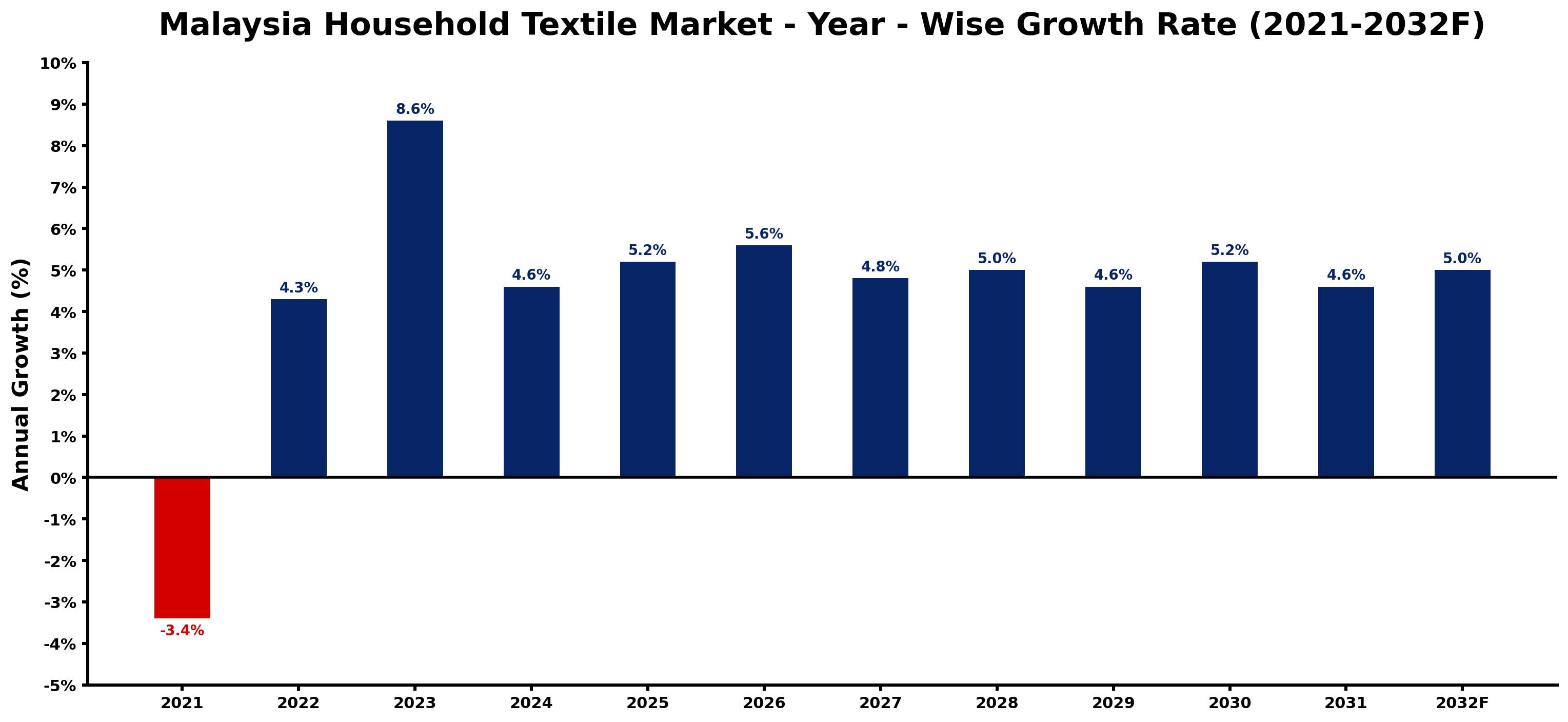
The table below presents the year wise growth rates along with the key drivers influencing the market
| Year | Growth Rate | Major Drivers |
| 2021 | -3.4% | Supply chain disruptions significantly hindered product availability, leading to decreased consumer purchases of household textiles. |
| 2022 | 4.3% | Local manufacturers innovate with unique designs appealing to younger demographics. |
| 2023 | 8.6% | E-commerce platforms expand, enhancing accessibility to diverse household textile products. |
| 2024 | 4.6% | Increased disposable income empowers consumers to invest in premium textile brands. |
| 2025 | 5.2% | Cultural festivals spur demand for traditional textiles, enriching market diversity. |
| 2026 | 5.6% | Urbanization trends lead to smaller living spaces, impacting textile choices significantly. |
| 2027 | 4.8% | Home decor trends evolve, spotlighting textiles as key design elements in interiors. |
| 2028 | 5.0% | Technological advancements enable smart textiles, creating new market segments and opportunities. |
| 2029 | 4.6% | Health awareness promotes antimicrobial textiles, driving consumer interest and purchases. |
| 2030 | 5.2% | Consumer interest shifts to multifunctional products, blending aesthetics with practicality. |
| 2031 | 4.6% | Sustainability certifications become significant, influencing brand loyalty among informed consumers. |
| 2032 | 5.0% | Global supply chain enhancements reduce costs, broadening access to quality textiles locally. |
Note - Market size estimations and growth projections presented in this report are based on 6Wresearch's advanced forecasting approach, validated with industry datasets as of June 2026.
Malaysia Household Textile Market Synopsis
The Malaysia Household Textile Market is projected to reach 5.6% and witness significant growth during the forecast period (2026-2032). This market is set to experience a compound annual growth rate (CAGR) of 5.8%, driven by an increasing demand for home décor products, a growing middle-class population with higher disposable income, and the flourishing e-commerce industry. Furthermore, there is a notable rise in consumer preference for organic textiles, attributed to their environmentally friendly attributes, which is further propelling the market's expansion.
Malaysia Household Textile Market Growth Drivers
Several key factors are influencing the growth trajectory of the Malaysia Household Textile Market. Firstly, the rise of athleisure fabrics, such as Lycra and spandex, has gained popularity due to their comfort and durability, thereby attracting consumers looking for versatile home textiles. Secondly, the increasing urbanization in Malaysia is leading to changes in living styles, creating a demand for stylish and functional textile products.
- The growing influence of social media and home improvement shows is driving consumer awareness and trends in home décor.
- The expansion of online retail platforms is making household textiles more accessible, allowing consumers to explore a variety of options from the comfort of their homes.
- Technological advancements in textile manufacturing, including digital printing technology, are enabling manufacturers to produce high-quality, customized household textiles, enhancing consumer choices.
- There is an increasing focus on sustainable and eco-friendly products, with consumers more inclined to choose textiles made from organic materials.
- Government initiatives aimed at boosting the manufacturing sector in Malaysia are creating a favorable environment for growth in the household textile industry.
Malaysia Household Textile Market Challenges and Restraints
Despite its promising growth, the Malaysia Household Textile Market faces several challenges. Fluctuations in raw material prices can affect production costs and pricing strategies for manufacturers. Additionally, competition from cheaper imported textiles may pressure local manufacturers to innovate continuously, which can be resource-intensive. There is also a need for greater consumer education on the benefits of investing in higher-quality textiles, which may limit market potential.
- The difficulty in sourcing organic and sustainable materials can pose a challenge for manufacturers looking to align with consumer preferences.
- Market saturation in certain textile segments can lead to price wars, diminishing profit margins for local producers.
- Supply chain disruptions have become more common, impacting the timely delivery of products to retailers and customers.
- Increasing consumer demand for immediate delivery times can strain the logistics capabilities of some manufacturers.
- Variability in consumer preferences can make it challenging for companies to stay ahead of market trends.
Malaysia Household Textile Market Investment Opportunities
The Malaysia Household Textile Market presents various investment opportunities through its growth drivers and evolving consumer preferences. As the e-commerce sector continues to thrive, companies have the chance to invest in digital marketing strategies to better reach potential customers. Furthermore, tapping into the organic textile segment could cater to the increasing demand for environmentally friendly home products.
- Investing in research and development can lead to innovative textile solutions that meet changing consumer demands.
- Partnerships with online platforms for distribution can help traditional manufacturers expand their market reach.
- Developing new product lines that focus on sustainable materials can capture the interest of eco-conscious consumers.
- Establishing collaborations with interior designers and home décor influencers can enhance brand visibility and credibility.
- Utilizing advanced manufacturing technologies can reduce production costs and improve product quality, providing a competitive edge.
Malaysia Household Textile Market Government Investment and Initiatives
The Malaysian government has implemented numerous initiatives aimed at bolstering the household textile sector. These include public investments in the textile manufacturing industry, focusing on modernization and sustainable practices. The government encourages the adoption of technology in production processes, thus helping local manufacturers improve efficiency and quality. Various development plans are in place to enhance trade and investment in the textile industry, addressing both local market needs and export opportunities.
- Incentives for small and medium-sized manufacturers are designed to promote innovation and competitiveness in the textile industry.
- Programs supporting skill development and vocational training for workers in the textile sector are essential to ensure a proficient workforce.
- The government aims to attract foreign direct investment by establishing favorable policies for international companies in the textile and apparel sectors.
- Environmental regulations are being introduced to guide manufacturers towards sustainable practices, thereby benefiting the eco-friendly segment of the market.
- Collaborations between industry stakeholders and educational institutions are encouraged to drive research and development efforts in textiles.
Malaysia Household Textile Market Latest Developments (May 2025 - June 2026)
In the period from May 2025 to June 2026, the Malaysia Household Textile Market has experienced notable advancements in technology and product offerings. Manufacturers have increasingly adopted digital printing techniques, which enable more intricate designs and customization options for consumers. Additionally, there has been a marked emphasis on integrating sustainable practices within production processes, with many companies pivoting towards organic textile lines in response to consumer demand. Furthermore, partnerships between manufacturers and e-commerce players have strengthened, facilitating improved distribution channels and enhancing consumer access to a wider array of household textile products.
- Innovative marketing strategies focusing on social media platforms have gained traction, increasing brand visibility among younger consumers.
- Greater investment in research and development has led to advancements in fabric technology, improving the functional aspects of household textiles.
- Emerging trends in health and wellness have prompted manufacturers to explore antimicrobial and hypoallergenic textile options.
- Local textile fairs and exhibitions have been organized to promote Malaysian textile products, fostering connection between consumers and local manufacturers.
- Interviewing focus groups has provided valuable consumer insight that is being used to direct product development efforts effectively.
Malaysia Household Textile Market - Key Attractiveness of the Report
- 10 Years of Market Numbers
- Historical Data Starting from 2022 to 2025
- Base Year: 2025
- Forecast Data until 2032
- Key Performance Indicators Impacting the Market
- Major Upcoming Developments and Projects
Key Highlights of the Report:
- Malaysia Household Textile Market Outlook
- Market Size of Malaysia Household Textile Market, 2025
- Forecast of Malaysia Household Textile Market, 2032
- Historical Data and Forecast of Malaysia Household Textile Revenues & Volume for the Period 2022-2032F
- Malaysia Household Textile Market Trend Evolution
- Malaysia Household Textile Market Drivers and Challenges
- Malaysia Household Textile Price Trends
- Malaysia Household Textile Porter's Five Forces
- Malaysia Household Textile Industry Life Cycle
- Historical Data and Forecast of Malaysia Household Textile Market Revenues & Volume By Type for the Period 2022-2032F
- Historical Data and Forecast of Malaysia Household Textile Market Revenues & Volume By Non-woven Textile for the Period 2022-2032F
- Historical Data and Forecast of Malaysia Household Textile Market Revenues & Volume By Woven Textile for the Period 2022-2032F
- Historical Data and Forecast of Malaysia Household Textile Market Revenues & Volume By Application for the Period 2022-2032F
- Historical Data and Forecast of Malaysia Household Textile Market Revenues & Volume By Bed for the Period 2022-2032F
- Historical Data and Forecast of Malaysia Household Textile Market Revenues & Volume By Furniture for the Period 2022-2032F
- Historical Data and Forecast of Malaysia Household Textile Market Revenues & Volume By Door & Window for the Period 2022-2032F
- Historical Data and Forecast of Malaysia Household Textile Market Revenues & Volume By Dining & Wash for the Period 2022-2032F
- Historical Data and Forecast of Malaysia Household Textile Market Revenues & Volume By Ground for the Period 2022-2032F
- Malaysia Household Textile Import Export Trade Statistics
- Market Opportunity Assessment By Type
- Market Opportunity Assessment By Application
- Malaysia Household Textile Top Companies Market Share
- Malaysia Household Textile Competitive Benchmarking By Technical and Operational Parameters
- Malaysia Household Textile Company Profiles
- Malaysia Household Textile Key Strategic Recommendations






































