Malaysia Industrial Machinery Market Size, Share & Growth Rate
The Malaysia Industrial Machinery Market was estimated at USD 256 Million in 2025 and is projected to reach USD 333 Million by 2032, growing at a CAGR of 3.8% from 2026 to 2032. This robust growth trajectory is fueled by the expansion of the manufacturing sector, particularly in electronics and automotive, where advanced machinery is critical for enhancing operational efficiency. Additionally, government initiatives aimed at promoting local industrialization and modernization are significantly contributing to market dynamics.
Malaysia Industrial Machinery Market Year-wise Growth Rate and Key Drivers
This graph highlights how the Malaysia Industrial Machinery Market has steadily grown over the years, supported by major growth factors.
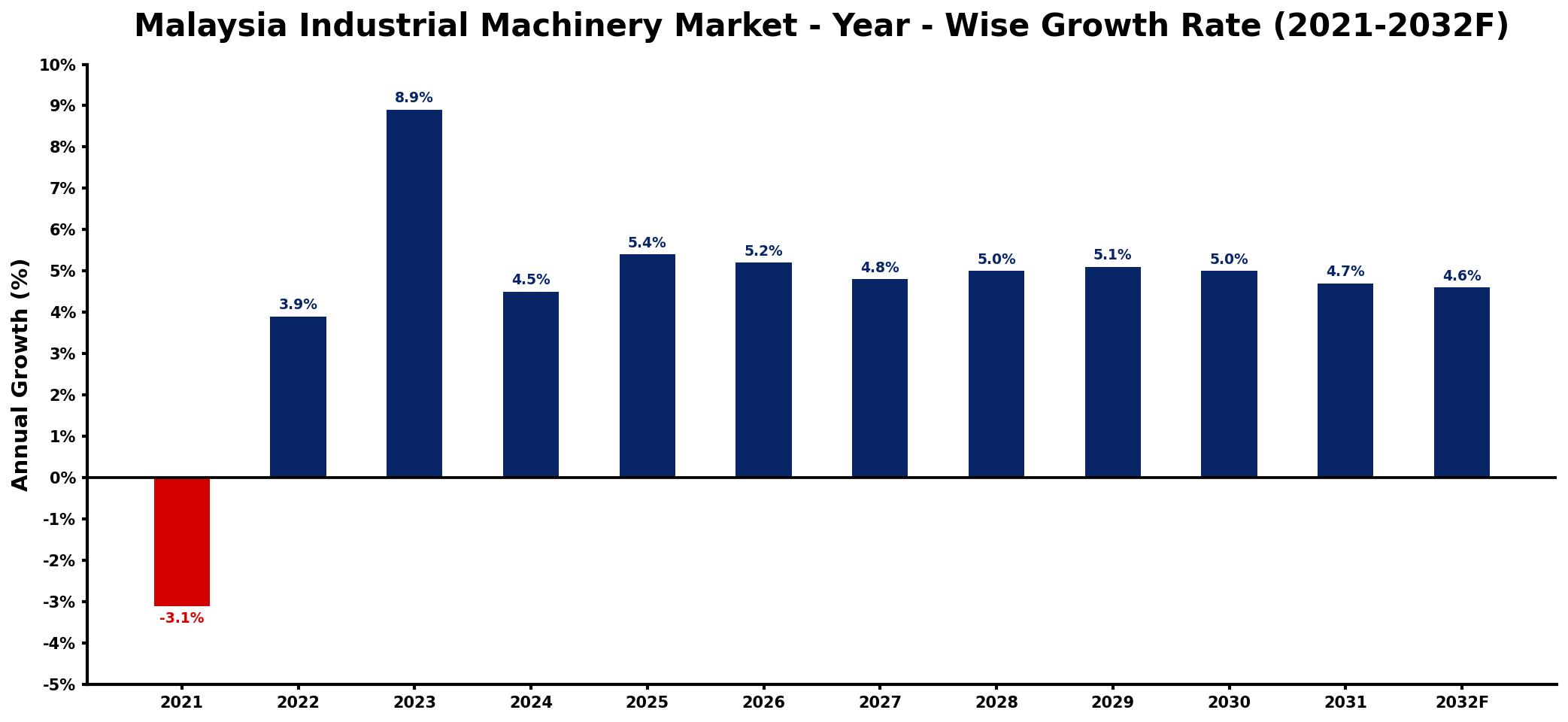
The table below presents the year‑wise growth rates along with the key drivers influencing the market
| Year | Growth Rate | Major Drivers |
| 2021 | -3.1% | decreased investment in construction projects |
| 2022 | 3.9% | increased demand for automation solutions |
| 2023 | 8.9% | growth in renewable energy sector |
| 2024 | 4.5% | expansion of manufacturing capabilities |
| 2025 | 5.4% | rising infrastructure development projects |
| 2026 | 5.2% | enhanced focus on sustainability initiatives |
| 2027 | 4.8% | stronger distribution network expansion |
| 2028 | 5.0% | advancements in technology adoption |
| 2029 | 5.1% | increased private sector investments |
| 2030 | 5.0% | stronger emphasis on efficiency improvements |
| 2031 | 4.7% | growing need for skilled workforce |
| 2032 | 4.6% | expanding manufacturing base activity |
Note: Market size estimations and growth projections presented in this report are based on 6Wresearch's proprietary forecasting methodology, utilizing the latest available industry data, government publications, and primary research inputs.
Malaysia Industrial Machinery Market Synopsis
The demand for industrial machinery in Malaysia is surging, driven by the need for automation in manufacturing and construction. This increased reliance on cutting-edge technology is essential for improving productivity and maintaining competitiveness in a global market. Furthermore, the push for modernization in agriculture also necessitates the adoption of sophisticated machinery, further expanding market opportunities.
As Malaysia continues to enhance its industrial capabilities, the integration of Industry 4.0 technologies presents a significant opportunity for the machinery market. Companies are increasingly replacing outdated equipment with state-of-the-art machines designed to optimize production processes, thereby elevating the demand for advanced industrial solutions.
Malaysia Industrial Machinery Market Key Takeaways
- The market is poised for robust growth driven by the manufacturing and construction sectors.
- Technological advancements and the shift to automation are reshaping industry dynamics.
- Government initiatives are fostering investments in local manufacturing capabilities.
- COVID-19 recovery efforts are contributing to a rebound in machinery demand.
- Challenges related to rapidly evolving technologies necessitate ongoing innovation.
Evaluation of Restraints in Malaysia Industrial Machinery Market
While the Malaysia Industrial Machinery Market is on an upward trajectory, certain restraints hinder its full potential. The rapid pace of technological change poses challenges for manufacturers aiming to keep their machinery up to date. Moreover, strict quality standards imposed by regulatory bodies can complicate compliance for local manufacturers, affecting their ability to innovate and compete on a global scale. Furthermore, workforce skill gaps in operating advanced machinery may also limit growth, necessitating investment in training and development programs.
Malaysia Industrial Machinery Market Trends
Current trends in the Malaysia Industrial Machinery Market reflect a significant shift towards smart manufacturing and automation. Companies are increasingly adopting IoT-enabled machinery to enhance data collection and operational efficiency. Additionally, sustainability concerns are driving the demand for energy-efficient machines, as industries look to minimize their environmental footprint. The rise of robotics in manufacturing processes is another notable trend, as organizations seek to automate repetitive tasks and improve overall productivity.
Malaysia Industrial Machinery Market Opportunities
The evolving landscape of the Malaysia Industrial Machinery Market reveals substantial growth and investment opportunities. With the government's commitment to enhancing local manufacturing, businesses can explore partnerships that leverage technological advancements. Additionally, the increasing focus on sustainability presents a chance for the development of eco-friendly machinery that meets contemporary environmental standards. Investment in research and development for innovative solutions is another promising avenue for companies looking to capitalize on the evolving market needs.
Government Initiatives in the Malaysia Industrial Machinery Market
The Malaysian government has implemented various initiatives to bolster the industrial machinery sector, aligning with its broader goals of economic diversification and modernization. Programs aimed at promoting local manufacturing and enhancing infrastructure development are key components of this strategy. The government is also actively providing incentives for research and development, supporting businesses that invest in advanced technologies and automation, thus paving the way for sustainable industrial growth.
Future Insights of the Malaysia Industrial Machinery Market
Looking ahead to the period from 2026 to 2032, the Malaysia Industrial Machinery Market is expected to witness significant transformation. The continuous integration of automation and smart technologies will likely dominate market developments, pushing industries toward greater efficiency and productivity. Moreover, as Malaysia strengthens its manufacturing base and invests in infrastructure, the market's growth will be further accelerated by the introduction of innovative machinery solutions tailored to meet industry demands. This evolution will set the stage for the country to become a competitive player in the global industrial landscape.
Malaysia Industrial Machinery Market Latest Developments (2025 - 2026)
Recent developments in the Malaysia Industrial Machinery Market have focused on advancements in automation technology. Companies are increasingly investing in robotics and AI-driven solutions to enhance production capabilities. There has been a noticeable uptick in infrastructure projects as part of economic recovery efforts, which are expected to further drive demand for industrial machinery. Additionally, trends indicate that manufacturers are prioritizing sustainable practices, leading to innovations in energy-efficient machinery.
Malaysia Industrial Machinery Market - Key Attractiveness of the Report
- 10 Years of Market Numbers
- Historical Data Starting from 2022 to 2025
- Base Year: 2025
- Forecast Data until 2032
- Key Performance Indicators Impacting the Market
- Major Upcoming Developments and Projects
Key Highlights of the Report:
- Malaysia Industrial Machinery Market Outlook
- Market Size of Malaysia Industrial Machinery Market, 2025
- Forecast of Malaysia Industrial Machinery Market, 2032
- Historical Data and Forecast of Malaysia Industrial Machinery Revenues & Volume for the Period 2022-2032F
- Malaysia Industrial Machinery Market Trend Evolution
- Malaysia Industrial Machinery Market Drivers and Challenges
- Malaysia Industrial Machinery Price Trends
- Malaysia Industrial Machinery Porter's Five Forces
- Malaysia Industrial Machinery Industry Life Cycle
- Historical Data and Forecast of Malaysia Industrial Machinery Market Revenues & Volume By Application for the Period 2022-2032F
- Historical Data and Forecast of Malaysia Industrial Machinery Market Revenues & Volume By Agriculture for the Period 2022-2032F
- Historical Data and Forecast of Malaysia Industrial Machinery Market Revenues & Volume By Construction for the Period 2022-2032F
- Historical Data and Forecast of Malaysia Industrial Machinery Market Revenues & Volume By Packaging for the Period 2022-2032F
- Historical Data and Forecast of Malaysia Industrial Machinery Market Revenues & Volume By Food Processing for the Period 2022-2032F
- Historical Data and Forecast of Malaysia Industrial Machinery Market Revenues & Volume By Mining for the Period 2022-2032F
- Historical Data and Forecast of Malaysia Industrial Machinery Market Revenues & Volume By Semiconductor Manufacturing for the Period 2022-2032F
- Malaysia Industrial Machinery Import Export Trade Statistics
- Market Opportunity Assessment By Application
- Malaysia Industrial Machinery Top Companies Market Share
- Malaysia Industrial Machinery Competitive Benchmarking By Technical and Operational Parameters
- Malaysia Industrial Machinery Company Profiles
- Malaysia Industrial Machinery Key Strategic Recommendations






































