Malaysia Industrial Rubber Products Market Size, Share & Growth Rate
The Malaysia Industrial Rubber Products Market was estimated at USD 421 Million in 2025 and is projected to reach USD 549 Million by 2032, growing at a CAGR of 3.9% from 2026 to 2032. This growth trajectory is primarily driven by the nation's expanding manufacturing sector, as industrial rubber products are integral to various applications, notably in automotive and construction industries. Increased investments in infrastructure and a push towards eco-friendly materials are further accelerating the demand for quality rubber products.
Malaysia Industrial Rubber Products Market Year-wise Growth Rate and Key Drivers
This graph highlights how the Malaysia Industrial Rubber Products Market has steadily grown over the years, supported by major growth factors.
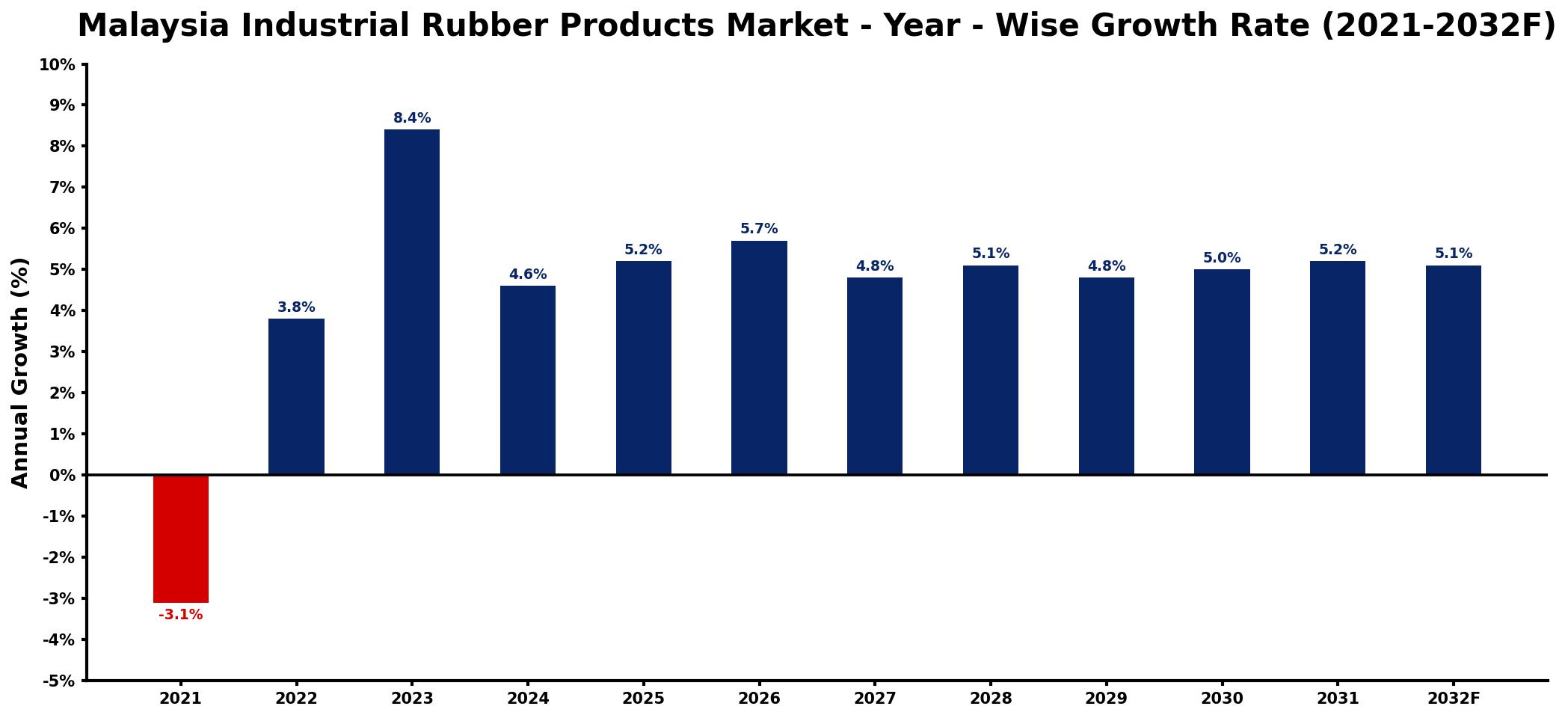
The table below presents the year‑wise growth rates along with the key drivers influencing the market
| Year | Growth Rate | Major Drivers |
| 2021 | -3.1% | decreased demand from construction sector |
| 2022 | 3.8% | increased automotive manufacturing activities |
| 2023 | 8.4% | growing renewable energy investments |
| 2024 | 4.6% | expansion in healthcare applications |
| 2025 | 5.2% | rising demand from electronics industry |
| 2026 | 5.7% | increased infrastructure development projects |
| 2027 | 4.8% | growing construction sector activities |
| 2028 | 5.1% | expansion of transportation networks |
| 2029 | 4.8% | increased exports to neighboring countries |
| 2030 | 5.0% | rising consumer goods production |
| 2031 | 5.2% | growing demand from agriculture sector |
| 2032 | 5.1% | growing automotive sector requirements |
Note: Market size estimations and growth projections presented in this report are based on 6Wresearch's proprietary forecasting methodology, utilizing the latest available industry data, government publications, and primary research inputs.
Malaysia Industrial Rubber Products Market Synopsis
The strongest force currently shaping the Malaysia Industrial Rubber Products Market is the robust growth of its manufacturing sector. With an increasing focus on quality, customization, and sustainability, manufacturers are poised to leverage these trends to enhance their competitive edge.
As the automotive and construction industries burgeon, the demand for essential components such as hoses, gaskets, and seals is expected to rise. Manufacturers who can innovate while maintaining cost-effectiveness will stand to gain significantly in this evolving market landscape.
Malaysia Industrial Rubber Products Market Key Takeaways
- Projected growth driven by the expanding manufacturing and automotive sectors.
- Emerging focus on sustainable materials is reshaping product offerings.
- Customization and quality control are becoming critical success factors.
- Global supply chain disruptions highlight the need for strategic sourcing.
- Increasing competition from other rubber-producing nations presents challenges.
Evaluation of Restraints in Malaysia Industrial Rubber Products Market
The Malaysia Industrial Rubber Products Market faces several restraints, particularly related to the volatility of raw material prices. Fluctuations in natural rubber prices can severely impact production costs, creating uncertainties for manufacturers. Moreover, issues surrounding quality control remain pivotal, as inferior products can result in safety risks and legal ramifications. Additionally, while international trade opportunities are plentiful, competition from established rubber-producing countries poses a challenge that companies must navigate carefully to maintain their market position.
Malaysia Industrial Rubber Products Market Trends
Key trends shaping the Malaysia Industrial Rubber Products Market include an increasing emphasis on eco-friendly manufacturing processes and materials. As businesses respond to global sustainability pressures, innovations in rubber technology are emerging, leading to the development of greener alternatives. Furthermore, the integration of automation and advanced manufacturing techniques is expected to enhance production efficiency, thereby driving growth within the sector.
Malaysia Industrial Rubber Products Market Opportunities
Significant growth and investment opportunities lie in the development of specialty rubber products tailored for niche applications. The rising demand for high-performance materials in automotive parts and construction applications presents a prime avenue for expansion. Additionally, the increasing focus on exporting Malaysian rubber products to emerging markets offers a pathway to enhance profitability and market reach.
Government Initiatives in the Malaysia Industrial Rubber Products Market
The Malaysian government has implemented various initiatives aimed at bolstering the industrial rubber products sector. These include policies to promote sustainable production practices and incentives for companies investing in innovative technologies. Public spending on infrastructure and transportation projects is expected to further stimulate demand for industrial rubber products, creating a supportive environment for industry growth.
Future Insights of the Malaysia Industrial Rubber Products Market
Looking ahead to 2026-2032, the Malaysia Industrial Rubber Products Market is anticipated to continue its upward trajectory, primarily fueled by technological advancements and an expanding global market. As manufacturers embrace sustainable practices and innovative materials, the demand for high-quality, customized products will likely increase. With strategic positioning and responsiveness to market dynamics, companies can effectively capitalize on emerging opportunities in this evolving landscape.
Malaysia Industrial Rubber Products Market Latest Developments (2025 - 2026)
Recent developments in the Malaysia Industrial Rubber Products Market indicate a shift towards automation and digital transformation within manufacturing processes. Companies are investing in state-of-the-art technologies to streamline production and improve quality control measures. Additionally, collaboration between businesses and research institutions is gaining momentum, facilitating innovation and sustainability in rubber product development.
Malaysia Industrial Rubber Products Market - Key Attractiveness of the Report
- 10 Years of Market Numbers
- Historical Data Starting from 2022 to 2025
- Base Year: 2025
- Forecast Data until 2032
- Key Performance Indicators Impacting the Market
- Major Upcoming Developments and Projects
Key Highlights of the Report:
- Malaysia Industrial Rubber Products Market Outlook
- Market Size of Malaysia Industrial Rubber Products Market, 2025
- Forecast of Malaysia Industrial Rubber Products Market, 2032
- Historical Data and Forecast of Malaysia Industrial Rubber Products Revenues & Volume for the Period 2022-2032F
- Malaysia Industrial Rubber Products Market Trend Evolution
- Malaysia Industrial Rubber Products Market Drivers and Challenges
- Malaysia Industrial Rubber Products Price Trends
- Malaysia Industrial Rubber Products Porter's Five Forces
- Malaysia Industrial Rubber Products Industry Life Cycle
- Historical Data and Forecast of Malaysia Industrial Rubber Products Market Revenues & Volume By Rubber Type for the Period 2022-2032F
- Historical Data and Forecast of Malaysia Industrial Rubber Products Market Revenues & Volume By Natural Rubber for the Period 2022-2032F
- Historical Data and Forecast of Malaysia Industrial Rubber Products Market Revenues & Volume By Styrene Butadiene Rubber for the Period 2022-2032F
- Historical Data and Forecast of Malaysia Industrial Rubber Products Market Revenues & Volume By Polybutadiene for the Period 2022-2032F
- Historical Data and Forecast of Malaysia Industrial Rubber Products Market Revenues & Volume By Ethylene-propylene for the Period 2022-2032F
- Historical Data and Forecast of Malaysia Industrial Rubber Products Market Revenues & Volume By Nitrile Butadiene Rubber for the Period 2022-2032F
- Historical Data and Forecast of Malaysia Industrial Rubber Products Market Revenues & Volume By Others for the Period 2022-2032F
- Historical Data and Forecast of Malaysia Industrial Rubber Products Market Revenues & Volume By Process for the Period 2022-2032F
- Historical Data and Forecast of Malaysia Industrial Rubber Products Market Revenues & Volume By Molded for the Period 2022-2032F
- Historical Data and Forecast of Malaysia Industrial Rubber Products Market Revenues & Volume By Extruded for the Period 2022-2032F
- Historical Data and Forecast of Malaysia Industrial Rubber Products Market Revenues & Volume By Fabricated for the Period 2022-2032F
- Historical Data and Forecast of Malaysia Industrial Rubber Products Market Revenues & Volume By Latex-Based for the Period 2022-2032F
- Historical Data and Forecast of Malaysia Industrial Rubber Products Market Revenues & Volume By Others for the Period 2022-2032F
- Historical Data and Forecast of Malaysia Industrial Rubber Products Market Revenues & Volume By Product for the Period 2022-2032F
- Historical Data and Forecast of Malaysia Industrial Rubber Products Market Revenues & Volume By Mechanical Rubber Products for the Period 2022-2032F
- Historical Data and Forecast of Malaysia Industrial Rubber Products Market Revenues & Volume By Rubber Hoses for the Period 2022-2032F
- Historical Data and Forecast of Malaysia Industrial Rubber Products Market Revenues & Volume By Rubber Belts for the Period 2022-2032F
- Historical Data and Forecast of Malaysia Industrial Rubber Products Market Revenues & Volume By Rubber Roofing for the Period 2022-2032F
- Historical Data and Forecast of Malaysia Industrial Rubber Products Market Revenues & Volume By Others for the Period 2022-2032F
- Historical Data and Forecast of Malaysia Industrial Rubber Products Market Revenues & Volume By End-use for the Period 2022-2032F
- Historical Data and Forecast of Malaysia Industrial Rubber Products Market Revenues & Volume By Construction & Infrastructure for the Period 2022-2032F
- Historical Data and Forecast of Malaysia Industrial Rubber Products Market Revenues & Volume By Automotive for the Period 2022-2032F
- Historical Data and Forecast of Malaysia Industrial Rubber Products Market Revenues & Volume By Aerospace for the Period 2022-2032F
- Historical Data and Forecast of Malaysia Industrial Rubber Products Market Revenues & Volume By Energy for the Period 2022-2032F
- Historical Data and Forecast of Malaysia Industrial Rubber Products Market Revenues & Volume By Others for the Period 2022-2032F
- Malaysia Industrial Rubber Products Import Export Trade Statistics
- Market Opportunity Assessment By Rubber Type
- Market Opportunity Assessment By Process
- Market Opportunity Assessment By Product
- Market Opportunity Assessment By End-use
- Malaysia Industrial Rubber Products Top Companies Market Share
- Malaysia Industrial Rubber Products Competitive Benchmarking By Technical and Operational Parameters
- Malaysia Industrial Rubber Products Company Profiles
- Malaysia Industrial Rubber Products Key Strategic Recommendations






































