Malaysia Inorganic Chemicals Market Size, Share & Growth Rate
The Malaysia Inorganic Chemicals Market was estimated at USD 233 Million in 2025 and is projected to reach USD 303 Million by 2032, growing at a CAGR of 3.8% from 2026 to 2032. This upward trajectory is propelled by robust industrial growth, particularly in construction and agriculture, where inorganic chemicals play a pivotal role. The continued expansion of infrastructure projects and increasing agricultural practices are expected to further stimulate demand, creating a vibrant market landscape.
Malaysia Inorganic Chemicals Market Year-wise Growth Rate and Key Drivers
This graph highlights how the Malaysia Inorganic Chemicals Market has steadily grown over the years, supported by major growth factors.
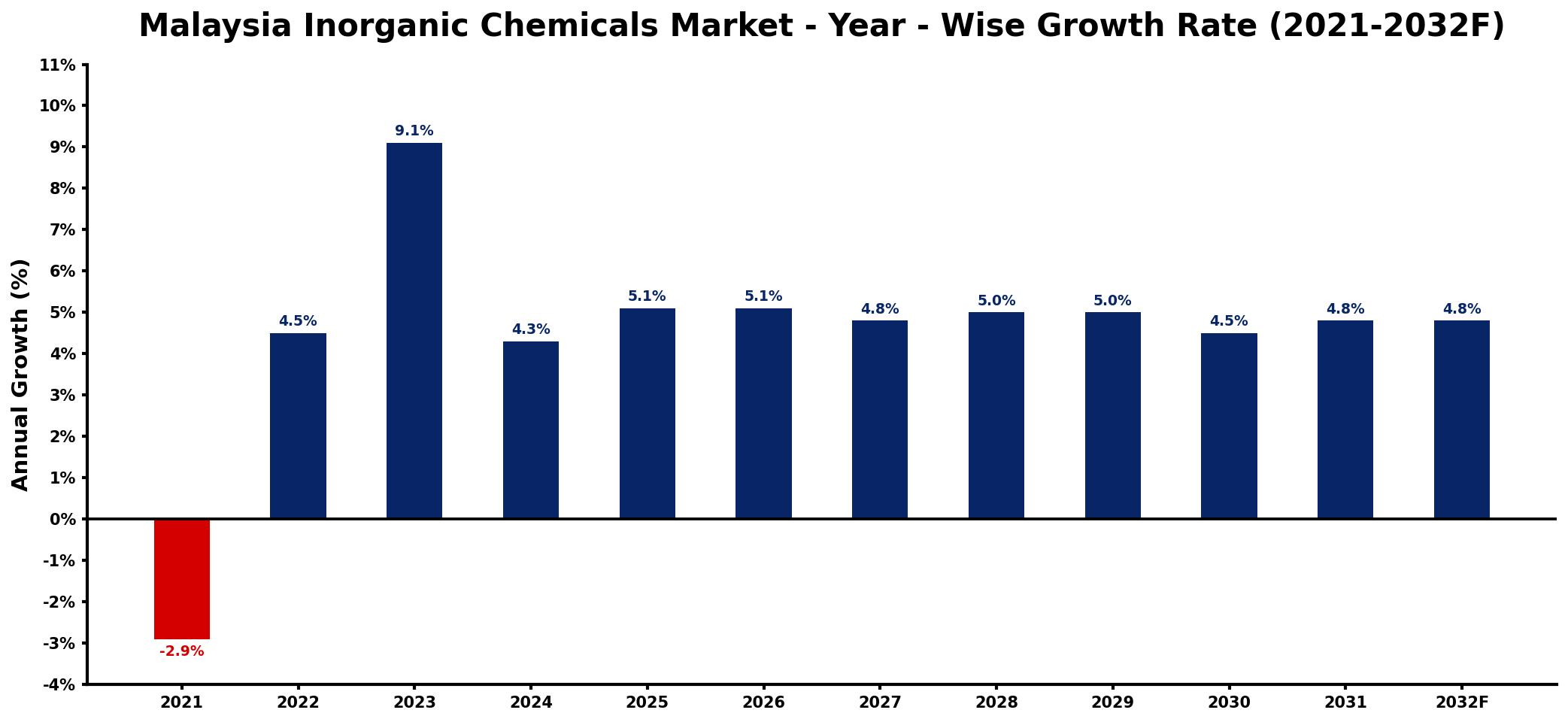
The table below presents the year‑wise growth rates along with the key drivers influencing the market
| Year | Growth Rate | Major Drivers |
| 2021 | -2.9% | decreased industrial production activity |
| 2022 | 4.5% | rising construction sector investments |
| 2023 | 9.1% | increased agricultural sector demand |
| 2024 | 4.3% | expansion of manufacturing capabilities |
| 2025 | 5.1% | growing demand from automotive industry |
| 2026 | 5.1% | enhanced infrastructure development projects |
| 2027 | 4.8% | increase in electronics manufacturing |
| 2028 | 5.0% | growing renewable energy investments |
| 2029 | 5.0% | increased pharmaceutical industry usage |
| 2030 | 4.5% | increased focus on sustainability initiatives |
| 2031 | 4.8% | rising demand from healthcare sector |
| 2032 | 4.8% | development of new applications |
Note: Market size estimations and growth projections presented in this report are based on 6Wresearch's proprietary forecasting methodology, utilizing the latest available industry data, government publications, and primary research inputs.
Malaysia Inorganic Chemicals Market Synopsis
The inorganic chemicals market in Malaysia is characterized by its diverse applications across various sectors, including manufacturing, agriculture, and construction. Recent trends indicate a growing reliance on these chemicals, driven by the need for sustainable practices and innovative solutions in production processes.
With industries rebounding from the impacts of the COVID-19 pandemic, the inorganic chemicals sector is poised for recovery and growth. Notably, chemicals such as calcium carbonate and titanium dioxide are vital in meeting the demands of key industries, thereby solidifying the markets foundation.
Malaysia Inorganic Chemicals Market Key Takeaways
- The market is witnessing a steady growth rate, with a projected CAGR of 3.8% from 2026 to 2032.
- Demand is driven by construction, agriculture, and automotive industries, which are rapidly expanding in Malaysia.
- Investment in sustainable practices is increasingly influencing market dynamics and production methods.
- Fluctuations in raw material costs and environmental regulations present ongoing challenges to manufacturers.
- Key players are focusing on innovations and technology to enhance efficiency and meet evolving market needs.
Evaluation of Restraints in Malaysia Inorganic Chemicals Market
The Malaysia Inorganic Chemicals Market faces significant restraints stemming from fluctuating raw material prices and global supply chain disruptions. These variables can heavily influence production costs, leading to price volatility that may affect local manufacturers competitiveness. Furthermore, the evolving landscape of environmental regulations necessitates substantial investments in sustainable practices. Companies must adapt to these challenges while focusing on cost optimization and resilient supply chain strategies to maintain their market presence.
Malaysia Inorganic Chemicals Market Trends
Emerging trends in the Malaysia Inorganic Chemicals Market indicate a shift towards eco-friendly practices and innovative chemical solutions. The increasing emphasis on sustainability is prompting companies to invest in research and development aimed at creating greener alternatives. Additionally, advancements in technology are optimizing production processes, reducing waste, and enhancing efficiency.
The rise of digitalization in manufacturing is also shaping the market, with industries exploring smart manufacturing solutions to improve operations. This trend aligns with global initiatives to adopt Industry 4.0 standards, which can potentially position Malaysian manufacturers more competitively on the international stage.
Malaysia Inorganic Chemicals Market Opportunities
Significant growth opportunities lie in the agricultural sector, where the demand for high-quality fertilizers and soil additives is escalating. Additionally, the ongoing urbanization and infrastructure projects in Malaysia present a lucrative avenue for inorganic chemical suppliers. Furthermore, as industries embrace sustainable practices, there's potential for market players to innovate and provide eco-friendly chemical solutions, tapping into a growing consumer base that prioritizes environmental consciousness.
Government Initiatives in the Malaysia Inorganic Chemicals Market
The Malaysian government has implemented several initiatives aimed at boosting the chemical sector, including funding for research and development in sustainable practices. Programs promoting domestic production and incentives for industries transitioning towards environmentally friendly operations are also key. Additionally, the government is likely to introduce regulations supporting cleaner production technologies, aligning with global sustainability goals.
Future Insights of the Malaysia Inorganic Chemicals Market
Looking ahead to the period from 2026 to 2032, the Malaysia Inorganic Chemicals Market is expected to continue its upward trend, bolstered by industrial advancements and increased demand across sectors. Companies that invest in sustainable practices and innovative technologies are likely to gain a competitive edge, as environmental considerations become more central to consumer preferences. The intersection of growth and sustainability will be crucial in shaping the market's landscape.
Malaysia Inorganic Chemicals Market Latest Developments (2025 - 2026)
The inorganic chemicals sector is witnessing a notable shift towards sustainability, with several companies launching initiatives aimed at reducing their environmental footprint. Investment in innovative production technologies has become a focal point, reflecting a broader trend toward efficiency and sustainability. As industries resume operations post-pandemic, there is a renewed focus on optimizing supply chains and enhancing production processes to meet growing demand.
Malaysia Inorganic Chemicals Market - Key Attractiveness of the Report
- 10 Years of Market Numbers
- Historical Data Starting from 2022 to 2025
- Base Year: 2025
- Forecast Data until 2032
- Key Performance Indicators Impacting the Market
- Major Upcoming Developments and Projects
Key Highlights of the Report:
- Malaysia Inorganic Chemicals Market Outlook
- Market Size of Malaysia Inorganic Chemicals Market, 2025
- Forecast of Malaysia Inorganic Chemicals Market, 2032
- Historical Data and Forecast of Malaysia Inorganic Chemicals Revenues & Volume for the Period 2022-2032F
- Malaysia Inorganic Chemicals Market Trend Evolution
- Malaysia Inorganic Chemicals Market Drivers and Challenges
- Malaysia Inorganic Chemicals Price Trends
- Malaysia Inorganic Chemicals Porter's Five Forces
- Malaysia Inorganic Chemicals Industry Life Cycle
- Historical Data and Forecast of Malaysia Inorganic Chemicals Market Revenues & Volume By Type for the Period 2022-2032F
- Historical Data and Forecast of Malaysia Inorganic Chemicals Market Revenues & Volume By Ammonia for the Period 2022-2032F
- Historical Data and Forecast of Malaysia Inorganic Chemicals Market Revenues & Volume By Chlor alkali for the Period 2022-2032F
- Historical Data and Forecast of Malaysia Inorganic Chemicals Market Revenues & Volume By Ammonium nitrate for the Period 2022-2032F
- Historical Data and Forecast of Malaysia Inorganic Chemicals Market Revenues & Volume By Ammonium sulfate for the Period 2022-2032F
- Historical Data and Forecast of Malaysia Inorganic Chemicals Market Revenues & Volume By Inorganic acid for the Period 2022-2032F
- Historical Data and Forecast of Malaysia Inorganic Chemicals Market Revenues & Volume By Sodium hydroxide for the Period 2022-2032F
- Historical Data and Forecast of Malaysia Inorganic Chemicals Market Revenues & Volume By Hydrogen peroxide for the Period 2022-2032F
- Historical Data and Forecast of Malaysia Ammonia Inorganic Chemicals Market Revenues & Volume By Oxygen for the Period 2022-2032F
- Malaysia Inorganic Chemicals Import Export Trade Statistics
- Market Opportunity Assessment By Type
- Malaysia Inorganic Chemicals Top Companies Market Share
- Malaysia Inorganic Chemicals Competitive Benchmarking By Technical and Operational Parameters
- Malaysia Inorganic Chemicals Company Profiles
- Malaysia Inorganic Chemicals Key Strategic Recommendations






































