Malaysia Malt Beverages Market Summary
The malaysia malt beverages market was estimated at USD 467 Million in 2025 and is projected to reach USD 692 Million by 2032, growing at a CAGR of 7.6% from 2026 to 2032.
Malaysia Malt Beverages Market Year-wise Growth Rate and Key Drivers
This graph highlights how the Malaysia Malt Beverages Market has steadily grown over the past five years, supported by major growth factors.
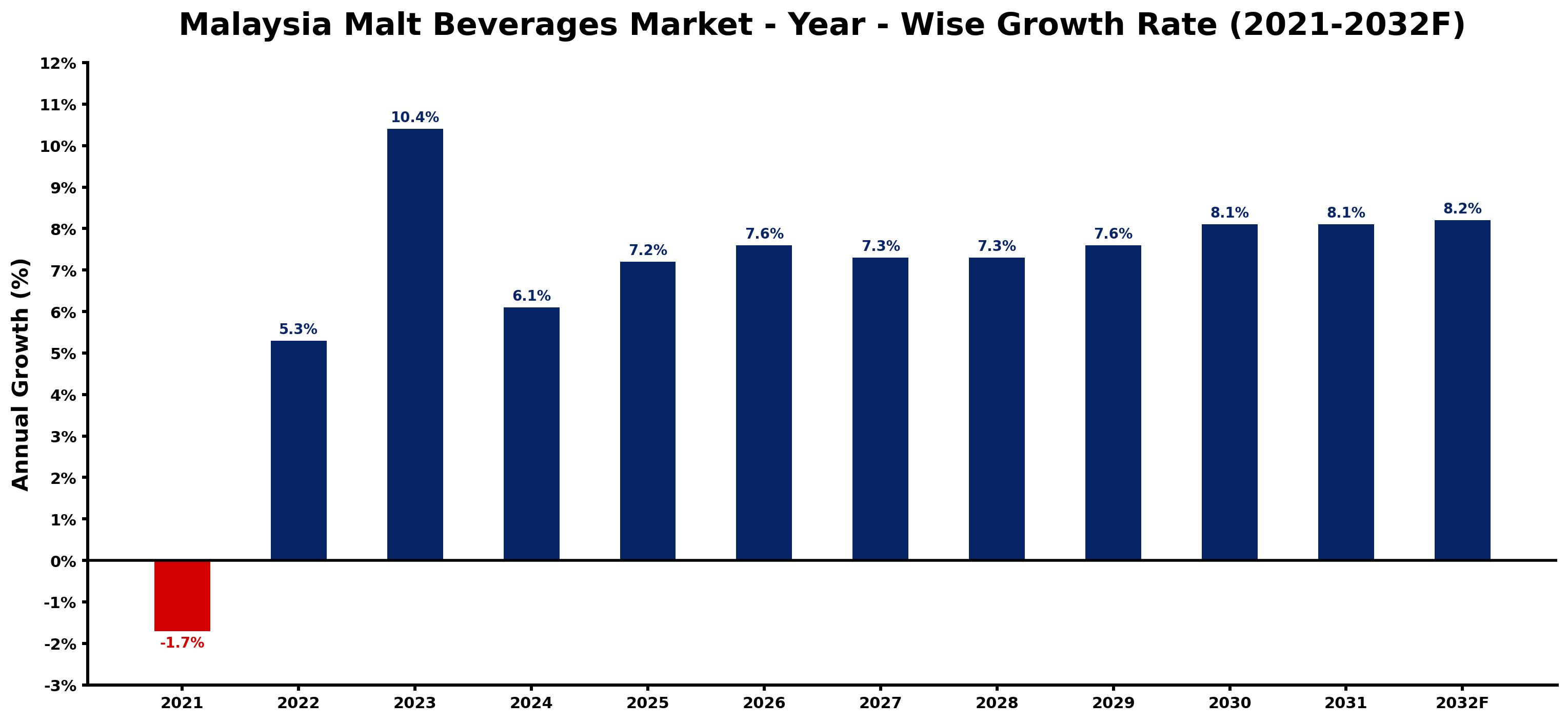
The table below presents the year wise growth rates along with the key drivers influencing the market
| Year | Growth Rate | Major Drivers |
| 2021 | -1.7% | Health concerns regarding sugary drinks prompted consumers to shift towards healthier beverage options. |
| 2022 | 5.3% | New product launches targeted health-conscious millennials expanded the customer base significantly. |
| 2023 | 10.4% | Increased local production capabilities lowered costs and improved product availability nationwide. |
| 2024 | 6.1% | Emerging craft breweries tapped into niche markets, enhancing product diversity and appeal. |
| 2025 | 7.2% | Experiential marketing initiatives attracted younger audiences to malt beverage tasting events. |
| 2026 | 7.6% | Collaborations with local influencers strengthened brand loyalty and community engagement. |
| 2027 | 7.3% | Sustainability trends prompted brands to explore eco-friendly packaging and production methods. |
| 2028 | 7.3% | E-commerce platforms expanded distribution channels, making products more accessible for consumers. |
| 2029 | 7.6% | International brands entered the market, increasing competition and product variety for consumers. |
| 2030 | 8.1% | Health benefits associated with malt beverages gained recognition, shifting consumer perceptions positively. |
| 2031 | 8.1% | Increased disposable incomes allowed consumers to indulge in premium malt beverages regularly. |
| 2032 | 8.2% | Cultural events and festivals celebrating local beverages fostered community support and brand loyalty. |
Note - Market size estimations and growth projections presented in this report are based on 6Wresearch's advanced forecasting approach, validated with industry datasets as of June 2026.
Malaysia Malt Beverages Market Synopsis
The Malaysia Malt Beverages Market is projected to reach 7.6% and witness significant growth during the forecast period (2026-2032). This growth is anticipated due to several factors, including an increasing population, rising disposable incomes, and a shift in consumer preferences towards healthier beverage options. As health consciousness among consumers rises, malt beverages, which are often fortified with vitamins and minerals, are becoming more popular. Furthermore, the vibrant youth demographic in Malaysia, coupled with effective marketing strategies, is expected to further propel the growth of the Malaysia malt beverages market.
Malaysia Malt Beverages Market Growth Drivers
Several key drivers are contributing to the expansion of the Malaysia malt beverages market. Firstly, the beer segment has emerged as a dominant force, primarily due to its wide availability across various retail channels, including convenience stores and supermarkets. Secondly, the innovative product offerings that cater specifically to younger consumers have resulted in increased sales. Thirdly, rising disposable income levels enable consumers to spend more on premium malt beverage products, further boosting the market. Fourthly, there is a noticeable trend towards healthier beverages, as consumers actively seek options that provide essential nutrients without compromising on taste. Finally, strategic marketing campaigns by various stakeholders are effectively targeting diverse audience segments, thus enhancing market visibility and sales.
Malaysia Malt Beverages Market Trends and Opportunities
The Malaysia malt beverages market is witnessing several emerging trends that present opportunities for growth. One significant trend is the increasing preference for low-alcohol and alcohol-free malt beverages, driven by changing consumer attitudes towards alcohol consumption. Additionally, the incorporation of local flavors and ingredients into malt beverages is creating unique product offerings that appeal to Malaysian consumers. The market is also benefiting from e-commerce trends, as online platforms provide convenient access to a broader range of malt beverages. Another noteworthy trend is the rising interest in sustainable and eco-friendly packaging, as consumers become more environmentally conscious. Finally, educational campaigns emphasizing the nutritional benefits of malt beverages are enhancing consumer awareness and fostering demand.
Malaysia Malt Beverages Market Challenges and Restraints
Despite the favorable growth trajectory, the Malaysia malt beverages market faces certain challenges. One primary restraint is the increasing competition from other beverage segments, such as soft drinks and bottled water, which can impact market share. Additionally, evolving consumer preferences pose a challenge, as brands must continuously innovate to meet changing tastes. Regulatory policies regarding advertising and content can also restrict promotional activities for malt beverages. Furthermore, economic fluctuations can affect consumer spending patterns, potentially leading to a decline in discretionary purchases. Lastly, supply chain disruptions, particularly in the wake of global events, can hinder product availability and impact sales.
Malaysia Malt Beverages Market Government Investment and Initiatives
The Malaysian government has initiated several programs aimed at supporting the growth of the malt beverages market. Investment in agricultural sectors to ensure a steady supply of raw materials for malt beverages is a key focus. Furthermore, government policies promoting local manufacturing and reducing import tariffs on raw ingredients bolster domestic production capabilities. Public health initiatives encouraging the consumption of beverages with nutritional benefits also play a role in increasing market demand. Additionally, the government is investing in infrastructure improvements to enhance distribution channels, ensuring that malt beverages reach consumers efficiently. These initiatives create a conducive environment for growth and sustainability within the Malaysia malt beverages market.
Malaysia Malt Beverages Market Latest Developments (May 2025 - June 2026)
In the latest developments within the Malaysia malt beverages market, there has been a marked increase in the introduction of innovative product lines, particularly in the craft beer and alcohol-free segments. Companies are also focusing on leveraging digital marketing strategies to engage consumers effectively, particularly through social media platforms. Additionally, collaborations between local producers and international brands aim to enhance product variety and appeal. Consumer interest in sustainable practices has led to a rise in eco-friendly packaging initiatives among manufacturers. Furthermore, there is an ongoing trend towards transparency in ingredient sourcing, as consumers increasingly demand to know about the quality and origin of their beverages, pushing brands to adapt accordingly.
Malaysia Malt Beverages Market - Key Attractiveness of the Report
- 10 Years of Market Numbers
- Historical Data Starting from 2022 to 2025
- Base Year: 2025
- Forecast Data until 2032
- Key Performance Indicators Impacting the Market
- Major Upcoming Developments and Projects
Key Highlights of the Report:
- Malaysia Malt Beverages Market Outlook
- Market Size of Malaysia Malt Beverages Market, 2025
- Forecast of Malaysia Malt Beverages Market, 2032
- Historical Data and Forecast of Malaysia Malt Beverages Revenues & Volume for the Period 2022-2032F
- Malaysia Malt Beverages Market Trend Evolution
- Malaysia Malt Beverages Market Drivers and Challenges
- Malaysia Malt Beverages Price Trends
- Malaysia Malt Beverages Porter's Five Forces
- Malaysia Malt Beverages Industry Life Cycle
- Historical Data and Forecast of Malaysia Malt Beverages Market Revenues & Volume By Product Type for the Period 2022-2032F
- Historical Data and Forecast of Malaysia Malt Beverages Market Revenues & Volume By Flavored for the Period 2022-2032F
- Historical Data and Forecast of Malaysia Malt Beverages Market Revenues & Volume By Unflavored for the Period 2022-2032F
- Historical Data and Forecast of Malaysia Malt Beverages Market Revenues & Volume By Applications for the Period 2022-2032F
- Historical Data and Forecast of Malaysia Malt Beverages Market Revenues & Volume By Alcoholic for the Period 2022-2032F
- Historical Data and Forecast of Malaysia Malt Beverages Market Revenues & Volume By Non-Alcoholic for the Period 2022-2032F
- Malaysia Malt Beverages Import Export Trade Statistics
- Market Opportunity Assessment By Product Type
- Market Opportunity Assessment By Applications
- Malaysia Malt Beverages Top Companies Market Share
- Malaysia Malt Beverages Competitive Benchmarking By Technical and Operational Parameters
- Malaysia Malt Beverages Company Profiles
- Malaysia Malt Beverages Key Strategic Recommendations






































