Malaysia Nickel Mining Market Size, Share & Growth Rate
The Malaysia Nickel Mining Market was estimated at USD 484 Million in 2025 and is projected to reach USD 628 Million by 2032, growing at a CAGR of 3.8% from 2026 to 2032. This growth is primarily driven by the escalating demand for nickel in electric vehicle (EV) battery production, positioning Malaysia as a strategic player in Southeast Asia. Furthermore, advancements in eco-friendly mining practices will likely facilitate sustainable extraction methods, promoting market expansion.
Malaysia Nickel Mining Market Year-wise Growth Rate and Key Drivers
This graph highlights how the Malaysia Nickel Mining Market has steadily grown over the years, supported by major growth factors.
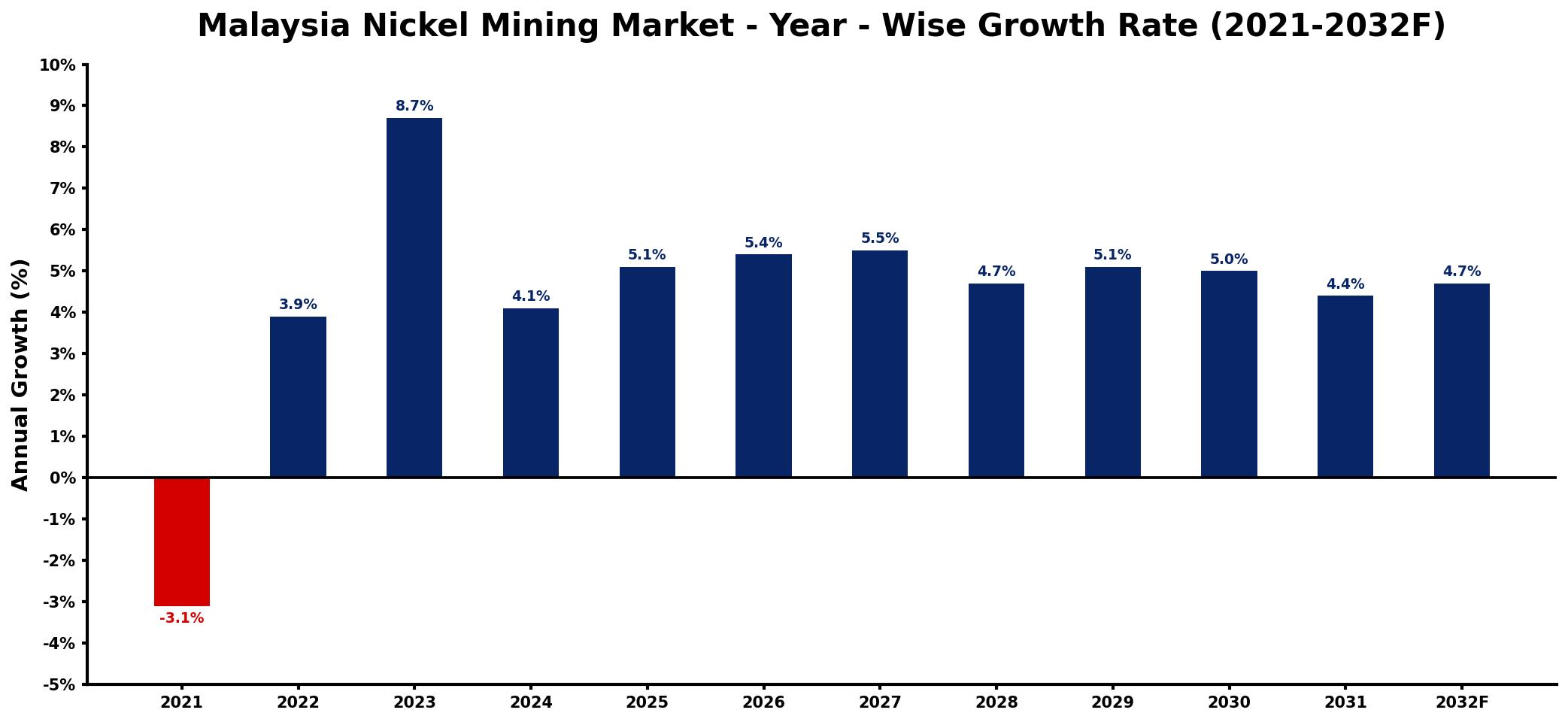
The table below presents the year‑wise growth rates along with the key drivers influencing the market
| Year | Growth Rate | Major Drivers |
| 2021 | -3.1% | Decreased industrial production globally |
| 2022 | 3.9% | Rising electric vehicle demand |
| 2023 | 8.7% | Increased renewable energy investments |
| 2024 | 4.1% | Expansion of battery manufacturing sector |
| 2025 | 5.1% | Growth in stainless steel production |
| 2026 | 5.4% | Surge in technology adoption rates |
| 2027 | 5.5% | Boost in infrastructure development projects |
| 2028 | 4.7% | Higher consumer electronics consumption |
| 2029 | 5.1% | Advancements in recycling technologies |
| 2030 | 5.0% | Emergence of new applications |
| 2031 | 4.4% | Strengthened global trade partnerships |
| 2032 | 4.7% | Enhanced sustainability initiatives adoption |
Note: Market size estimations and growth projections presented in this report are based on 6Wresearch's proprietary forecasting methodology, utilizing the latest available industry data, government publications, and primary research inputs.
Malaysia Nickel Mining Market Synopsis
The increasing reliance on nickel for battery production in the automotive sector is the most significant force shaping the Malaysia Nickel Mining Market today. As electric vehicles gain traction, the urgency for sustainable sourcing intensifies, challenging mining operations to balance profitability with ecological considerations.
Additionally, Malaysia's favorable geographic location provides a competitive edge, enhancing its capacity to supply nickel to both regional and global markets. However, the industry grapples with price volatility and stringent environmental regulations that shape operational dynamics.
Malaysia Nickel Mining Market Key Takeaways
- The market is experiencing growth fueled by the electric vehicle sector's demand for nickel.
- Sustainable mining practices are becoming a priority to address environmental concerns.
- Price volatility and regulatory challenges pose ongoing risks for local operations.
- Technological advancements are expected to play a critical role in enhancing mining efficiency.
- Strategic investments in eco-friendly technologies could unlock new opportunities in the market.
Evaluation of Restraints in Malaysia Nickel Mining Market
The Malaysia Nickel Mining Market faces substantial constraints primarily linked to environmental regulations and sustainability standards. As the demand for nickel surges, the industry must navigate complex permitting processes and adhere to increasingly stringent guidelines aimed at minimizing ecological impact. Furthermore, price fluctuations in the global market create uncertainties for mining companies, complicating financial planning and long-term investments. Thus, while opportunities abound, these challenges require careful management and innovative solutions.
Malaysia Nickel Mining Market Trends
Current trends in the Malaysia Nickel Mining Market include a marked shift towards sustainable mining practices. Companies are increasingly investing in technologies that reduce environmental impact, such as advanced water management systems and energy-efficient processing methods. Additionally, there is a growing trend in collaboration between mining companies and technology firms to develop innovative solutions for more efficient extraction and processing of nickel. The push for greater transparency and responsible sourcing is also reshaping industry standards and consumer expectations.
Malaysia Nickel Mining Market Opportunities
Significant growth opportunities lie in the expanding electric vehicle market, which is projected to continue its ascent in the coming years. With Malaysia's strategic location, there is potential for increased exports of nickel to meet global demands. Moreover, the adoption of emerging technologies in the mining process not only enhances productivity but also opens avenues for companies to differentiate themselves through sustainability. Partnerships and investments in research and development could further drive innovation and establish Malaysia as a leader in responsible nickel mining.
Government Initiatives in the Malaysia Nickel Mining Market
The Malaysian government is actively promoting policies aimed at enhancing the sustainability of its mining sector. Initiatives focused on increasing regulatory clarity and efficiency in permitting processes are in place to encourage responsible mining practices. Furthermore, public investments in infrastructure and technological innovation are designed to support the mining industry while fostering environmental stewardship. Collaborative efforts between the government and private sectors aim to bolster compliance with international sustainability standards.
Future Insights of the Malaysia Nickel Mining Market
Looking ahead to 2026-2032, the Malaysia Nickel Mining Market is poised for significant transformation. The escalating global push for clean energy solutions will likely increase nickel demand, particularly for battery applications. Consequently, companies that prioritize sustainable practices and innovate in mining technologies will thrive. As the market matures, there will be an increased emphasis on collaboration between stakeholders to establish resilient supply chains that can withstand market fluctuations while adhering to evolving regulatory frameworks.
Malaysia Nickel Mining Market Latest Developments (2025 - 2026)
Recent developments in the Malaysia Nickel Mining Market indicate a strong focus on sustainability and technological advancement. There has been a rise in partnerships aimed at enhancing eco-friendly practices within the industry. New mining projects are increasingly being scrutinized for their environmental impact, leading to a greater demand for innovative solutions that minimize ecological footprints. Furthermore, local companies are beginning to embrace digital transformation to optimize operational efficiency and enhance supply chain management.
Malaysia Nickel Mining Market - Key Attractiveness of the Report
- 10 Years of Market Numbers
- Historical Data Starting from 2022 to 2025
- Base Year: 2025
- Forecast Data until 2032
- Key Performance Indicators Impacting the Market
- Major Upcoming Developments and Projects
Key Highlights of the Report:
- Malaysia Nickel Mining Market Outlook
- Market Size of Malaysia Nickel Mining Market, 2025
- Forecast of Malaysia Nickel Mining Market, 2032
- Historical Data and Forecast of Malaysia Nickel Mining Revenues & Volume for the Period 2022-2032F
- Malaysia Nickel Mining Market Trend Evolution
- Malaysia Nickel Mining Market Drivers and Challenges
- Malaysia Nickel Mining Price Trends
- Malaysia Nickel Mining Porter's Five Forces
- Malaysia Nickel Mining Industry Life Cycle
- Historical Data and Forecast of Malaysia Nickel Mining Market Revenues & Volume By Type for the Period 2022-2032F
- Historical Data and Forecast of Malaysia Nickel Mining Market Revenues & Volume By Pentlandite (Sulfide Ore) for the Period 2022-2032F
- Historical Data and Forecast of Malaysia Nickel Mining Market Revenues & Volume By Laterite for the Period 2022-2032F
- Malaysia Nickel Mining Import Export Trade Statistics
- Market Opportunity Assessment By Type
- Malaysia Nickel Mining Top Companies Market Share
- Malaysia Nickel Mining Competitive Benchmarking By Technical and Operational Parameters
- Malaysia Nickel Mining Company Profiles
- Malaysia Nickel Mining Key Strategic Recommendations






































