Malaysia Nuclear Fuel Market Size, Share & Growth Rate
The Malaysia Nuclear Fuel Market was estimated at USD 350 Million in 2025 and is projected to reach USD 455 Million by 2032, growing at a CAGR of 3.8% from 2026 to 2032. This growth trajectory is primarily influenced by the increasing recognition of nuclear energy as a viable part of a diverse energy mix. Factors such as the push for cleaner energy alternatives and the nations need for sustainable electricity sources will be key in shaping the landscape of nuclear fuel utilization in Malaysia.
Malaysia Nuclear Fuel Market Year-wise Growth Rate and Key Drivers
This graph highlights how the Malaysia Nuclear Fuel Market has steadily grown over the years, supported by major growth factors.
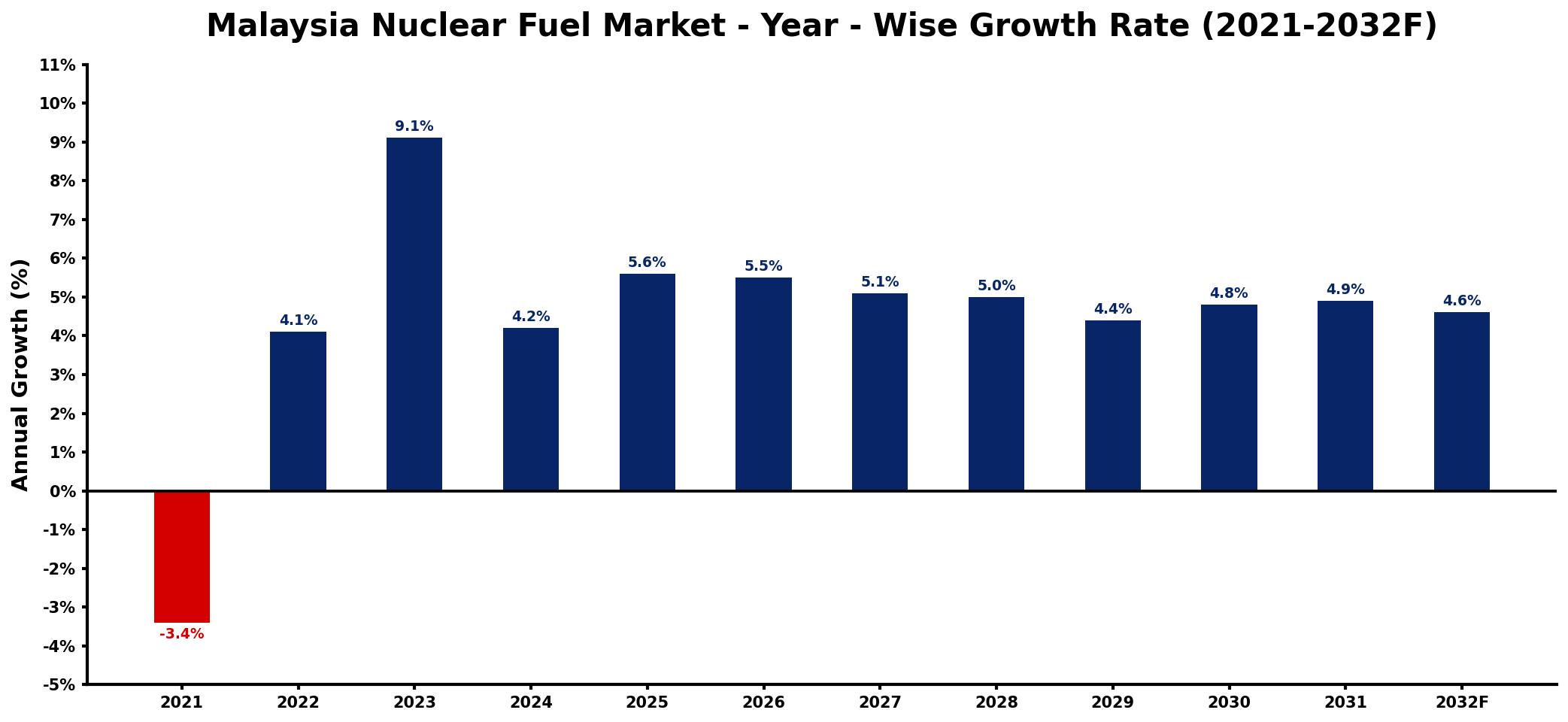
The table below presents the year‑wise growth rates along with the key drivers influencing the market
| Year | Growth Rate | Major Drivers |
| 2021 | -3.4% | decreased investments in energy sector |
| 2022 | 4.1% | increased renewable energy adoption |
| 2023 | 9.1% | growing energy security initiatives |
| 2024 | 4.2% | expansion of energy infrastructure projects |
| 2025 | 5.6% | rising demand for clean energy |
| 2026 | 5.5% | increased foreign investment projects |
| 2027 | 5.1% | growth in energy efficiency technologies |
| 2028 | 5.0% | expanding healthcare application demand |
| 2029 | 4.4% | advancements in energy storage solutions |
| 2030 | 4.8% | rising public awareness initiatives |
| 2031 | 4.9% | increased government energy policies |
| 2032 | 4.6% | growing partnerships with private sector |
Note: Market size estimations and growth projections presented in this report are based on 6Wresearch's proprietary forecasting methodology, utilizing the latest available industry data, government publications, and primary research inputs.
Malaysia Nuclear Fuel Market Synopsis
The strongest force currently shaping the Malaysia Nuclear Fuel Market is the government's consideration of nuclear energy as a strategic alternative to diversify energy sources. While no operational nuclear power plants exist as of now, the ongoing discussions signal a potential shift in the countrys energy policy, focusing on integrating nuclear fuel into the energy mix.
As Malaysia grapples with rising energy demands and environmental concerns, the nuclear fuel market finds itself at a pivotal juncture. The need for reliable energy sources, coupled with a global shift towards decarbonization, positions nuclear energy as an appealing solution, leading to increased interest from stakeholders and potential investors.
Malaysia Nuclear Fuel Market Key Takeaways
- The market is on the brink of significant growth driven by potential policy changes and energy diversification efforts.
- Heightened interest from both public and private sectors suggests a burgeoning ecosystem for nuclear fuel research and development.
- The Malaysian government is increasingly acknowledging the role of nuclear energy in achieving sustainability goals.
- Emerging trends indicate a future where nuclear power could contribute meaningfully to the countrys energy infrastructure.
- Investment in nuclear fuel technologies is poised to rise as Malaysia explores its nuclear energy options.
Evaluation of Restraints in Malaysia Nuclear Fuel Market
The Malaysia Nuclear Fuel Market faces significant constraints primarily due to the absence of existing nuclear power plants and a well-defined nuclear program. Public apprehension surrounding nuclear energy, driven by safety concerns and environmental implications, adds another layer of complexity. Additionally, the Malaysian government has historically focused on alternative energy sources such as natural gas and renewables, limiting the development of nuclear infrastructure. This cautious stance presents a barrier to establishing a robust domestic nuclear fuel market.
Malaysia Nuclear Fuel Market Trends
Current trends indicate a rising interest in nuclear energy as part of a larger push for energy security and sustainability. Technological advancements in nuclear reactor designs and safety protocols are also gaining traction, further enhancing the feasibility of nuclear fuel in Malaysia. Furthermore, as climate change pressures escalate, a growing number of stakeholders advocate for nuclear energy as a low-carbon solution to meet future energy demands.
Malaysia Nuclear Fuel Market Opportunities
Opportunities within the Malaysia Nuclear Fuel Market are becoming increasingly apparent. The countrys strategic geographic location in Southeast Asia presents potential for regional partnerships and collaboration in nuclear technology. Furthermore, as global supply chains evolve, Malaysia could emerge as a critical player in the nuclear fuel supply chain, particularly for nations looking to diversify energy sources. Investments in education and public awareness initiatives may also pave the way for a more supportive environment for nuclear energy.
Government Initiatives in the Malaysia Nuclear Fuel Market
Government initiatives aimed at evaluating nuclear energy's potential role in the national energy landscape are crucial to the Malaysia Nuclear Fuel Market. Recent studies and exploratory projects underscore a commitment to understanding the implications of adopting nuclear power. Furthermore, potential public spending on research and development in this sector, combined with international collaborations, may foster a more conducive atmosphere for nuclear energy exploration.
Future Insights of the Malaysia Nuclear Fuel Market
Looking ahead to 2026-2032, the Malaysia Nuclear Fuel Market is poised for a gradual transformation, contingent upon favorable government policies and public perception. As energy demands rise, and the discourse on climate change intensifies, Malaysia may increasingly turn to nuclear energy as part of its overarching strategy to ensure energy security. The market could witness the establishment of foundational infrastructure, potentially setting the stage for operational nuclear power plants within the coming decade.
Malaysia Nuclear Fuel Market Latest Developments (2025 - 2026)
Recent developments indicate a growing momentum in the evaluation of nuclear energy initiatives within Malaysia. Government agencies have begun releasing comprehensive reports detailing feasibility studies and potential regulatory frameworks for nuclear power integration. Additionally, partnerships with international bodies focused on nuclear research suggest a proactive approach to understanding and adopting nuclear technology in Malaysia's future energy portfolio.
Malaysia Nuclear Fuel Market - Key Attractiveness of the Report
- 10 Years of Market Numbers
- Historical Data Starting from 2022 to 2025
- Base Year: 2025
- Forecast Data until 2032
- Key Performance Indicators Impacting the Market
- Major Upcoming Developments and Projects
Key Highlights of the Report:
- Malaysia Nuclear Fuel Market Outlook
- Market Size of Malaysia Nuclear Fuel Market, 2025
- Forecast of Malaysia Nuclear Fuel Market, 2032
- Historical Data and Forecast of Malaysia Nuclear Fuel Revenues & Volume for the Period 2022-2032F
- Malaysia Nuclear Fuel Market Trend Evolution
- Malaysia Nuclear Fuel Market Drivers and Challenges
- Malaysia Nuclear Fuel Price Trends
- Malaysia Nuclear Fuel Porter's Five Forces
- Malaysia Nuclear Fuel Industry Life Cycle
- Historical Data and Forecast of Malaysia Nuclear Fuel Market Revenues & Volume By Fuel Type for the Period 2022-2032F
- Historical Data and Forecast of Malaysia Nuclear Fuel Market Revenues & Volume By Uranium Fuel for the Period 2022-2032F
- Historical Data and Forecast of Malaysia Nuclear Fuel Market Revenues & Volume By Mixed Oxidenuclear Fuel for the Period 2022-2032F
- Historical Data and Forecast of Malaysia Nuclear Fuel Market Revenues & Volume By Reactor Type for the Period 2022-2032F
- Historical Data and Forecast of Malaysia Nuclear Fuel Market Revenues & Volume By Boiling Water Reactor for the Period 2022-2032F
- Historical Data and Forecast of Malaysia Nuclear Fuel Market Revenues & Volume By Pressurized Water Reactor for the Period 2022-2032F
- Malaysia Nuclear Fuel Import Export Trade Statistics
- Market Opportunity Assessment By Fuel Type
- Market Opportunity Assessment By Reactor Type
- Malaysia Nuclear Fuel Top Companies Market Share
- Malaysia Nuclear Fuel Competitive Benchmarking By Technical and Operational Parameters
- Malaysia Nuclear Fuel Company Profiles
- Malaysia Nuclear Fuel Key Strategic Recommendations






































