Malaysia Online Grocery Market Size, Share & Growth Rate
The Malaysia Online Grocery Market was estimated at USD 156 Million in 2025 and is projected to reach USD 201 Million by 2032, growing at a CAGR of 3.7% from 2026 to 2032. This growth is driven primarily by a shift in consumer behavior towards the convenience of e-commerce, with more Malaysians embracing online platforms for their shopping needs. Additionally, increasing disposable incomes and improved internet connectivity are enhancing access to online grocery services, paving the way for sustained expansion in this sector.
Malaysia Online Grocery Market Year-wise Growth Rate and Key Drivers
This graph highlights how the Malaysia Online Grocery Market has steadily grown over the years, supported by major growth factors.
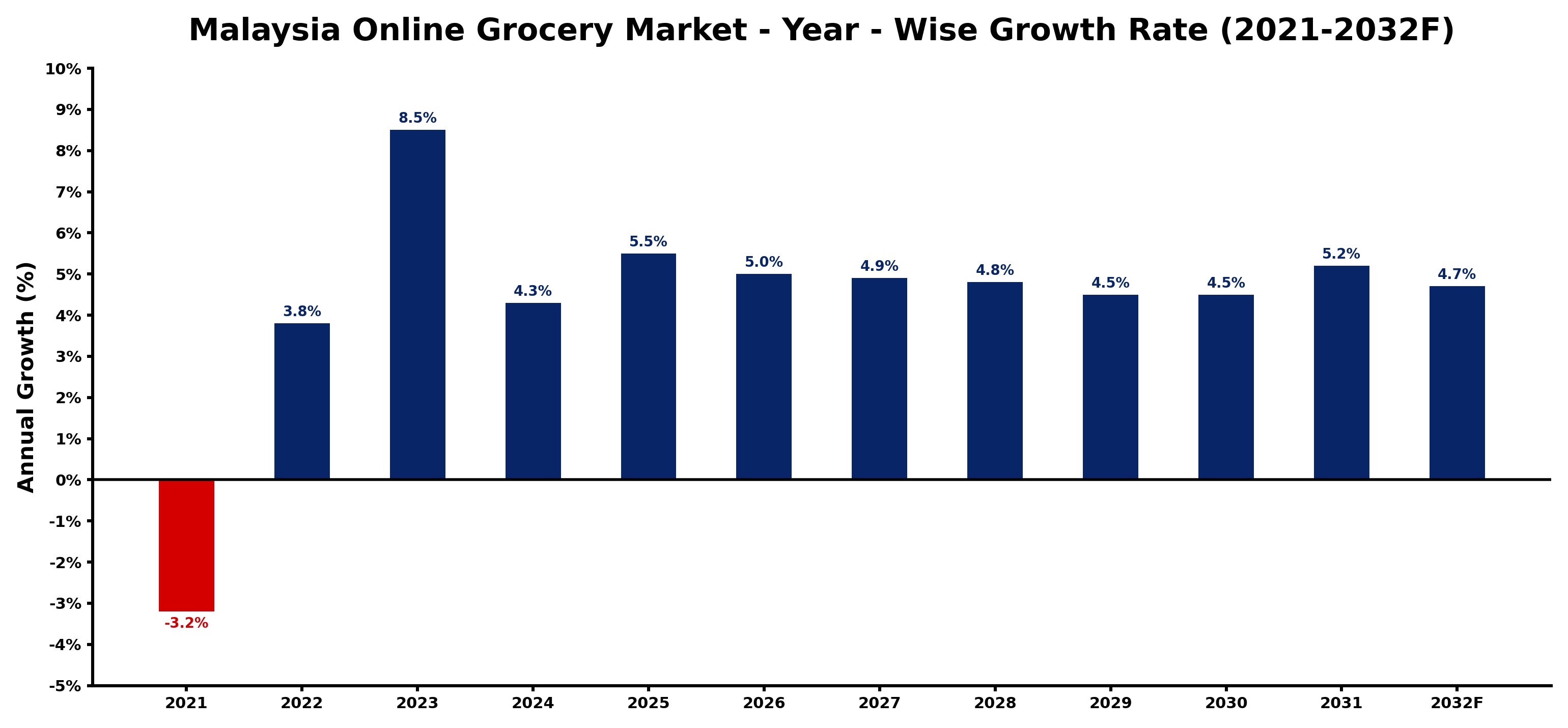
The table below presents the year‑wise growth rates along with the key drivers influencing the market
| Year | Growth Rate | Major Drivers |
| 2021 | -3.2% | Consumer spending decreased significantly |
| 2022 | 3.8% | E-commerce adoption accelerated rapidly |
| 2023 | 8.5% | Mobile shopping convenience enhanced sales |
| 2024 | 4.3% | Subscription services attracted new customers |
| 2025 | 5.5% | Local sourcing gained consumer interest |
| 2026 | 5.0% | Sustainability initiatives drove brand loyalty |
| 2027 | 4.9% | Digital payment options expanded accessibility |
| 2028 | 4.8% | Health-conscious products gained popularity |
| 2029 | 4.5% | Personalized shopping experiences increased engagement |
| 2030 | 4.5% | Delivery speed improvements enhanced satisfaction |
| 2031 | 5.2% | Loyalty programs encouraged repeat purchases |
| 2032 | 4.7% | Innovative marketing strategies attracted attention |
Note - Market size estimations and growth projections presented in this report are based on 6Wresearch's advanced forecasting approach, validated with industry datasets as of June 2026.
Malaysia Online Grocery Market Synopsis
The demand for online grocery shopping in Malaysia is witnessing unprecedented growth, fueled by a rising preference for convenience and efficiency among consumers. As busy lifestyles become the norm, shoppers are increasingly drawn to digital platforms that offer time-saving solutions and a diverse range of products.
In the wake of the Covid-19 pandemic, there has been a notable acceleration in the adoption of online grocery services, with many consumers now considering these platforms a staple rather than an alternative. This paradigm shift presents a unique opportunity for growth in Malaysia's online grocery market.
Malaysia Online Grocery Market Key Takeaways
- The market is projected to grow significantly as consumer behaviors continue to evolve.
- Enhanced internet infrastructure and mobile penetration are contributing to market expansion.
- Convenience and product variety are pivotal factors driving consumer choice in grocery shopping.
- The market is responding dynamically to lifestyle changes, particularly post-Covid-19.
- Emerging technology in logistics is vital for addressing supply chain challenges.
Evaluation of Restraints in Malaysia Online Grocery Market
Despite its promising trajectory, the Malaysia online grocery market faces several challenges. A significant barrier lies in convincing traditional shoppers to switch from brick-and-mortar stores to online platforms. This transition requires not only technological awareness but also a seamless shopping experience. Moreover, the logistics involved in maintaining a reliable supply chain—especially during unforeseen disruptions—remains a critical concern for market players aiming to meet growing consumer demands effectively.
Malaysia Online Grocery Market Trends
Several trends are shaping the future of the Malaysia Online Grocery Market. Firstly, the integration of artificial intelligence and machine learning into online shopping platforms is enhancing personalized consumer experiences. Additionally, there's a noticeable trend towards sustainability, with consumers increasingly favoring eco-friendly packaging and local sourcing. As delivery services advance, the demand for rapid fulfillment is also rising, pushing businesses to innovate in logistics and distribution.
Malaysia Online Grocery Market Opportunities
The landscape presents multiple opportunities for growth, particularly in expanding product offerings to include organic and specialty items that cater to health-conscious consumers. Additionally, partnerships with local farmers and food producers can enhance product diversity and foster a sense of community. Investing in mobile-first strategies will also be crucial, as more consumers prefer using mobile applications for their grocery needs.
Government Initiatives in the Malaysia Online Grocery Market
The Malaysian government has been proactive in supporting the e-commerce sector through various initiatives aimed at enhancing digital infrastructure and accessibility. Programs aimed at improving internet connectivity in rural areas are vital for ensuring that the benefits of online grocery shopping extend beyond urban centers. Moreover, public spending focused on digital literacy and e-payment systems is fostering a favorable environment for the growth of online grocery services.
Future Insights of the Malaysia Online Grocery Market
Looking ahead to 2026-2032, the Malaysia Online Grocery Market is poised for sustained growth driven by continuous consumer engagement and technological advancements. As more Malaysians become comfortable with digital transactions, the market will likely see increased innovation in service delivery, including subscription models and enhanced customer service. The intersection of technology and consumer behavior will redefine how groceries are purchased, positioning the market for exciting developments in the coming years.
Malaysia Online Grocery Market Latest Developments (May 2025 - June 2026)
Recent industry developments indicate a surge in investment towards improving digital platforms for a more user-friendly shopping experience. Companies are increasingly integrating advanced data analytics to understand consumer preferences better and tailor their offerings accordingly. Furthermore, collaborations between online platforms and local suppliers are becoming more common, enhancing the variety and freshness of products available online.
Malaysia Online Grocery Market - Key Attractiveness of the Report
- 10 Years of Market Numbers
- Historical Data Starting from 2022 to 2025
- Base Year: 2025
- Forecast Data until 2032
- Key Performance Indicators Impacting the Market
- Major Upcoming Developments and Projects
Key Highlights of the Report:
- Malaysia Online Grocery Market Outlook
- Market Size of Malaysia Online Grocery Market, 2025
- Forecast of Malaysia Online Grocery Market, 2032
- Historical Data and Forecast of Malaysia Online Grocery Revenues & Volume for the Period 2022-2032F
- Malaysia Online Grocery Market Trend Evolution
- Malaysia Online Grocery Market Drivers and Challenges
- Malaysia Online Grocery Price Trends
- Malaysia Online Grocery Porter's Five Forces
- Malaysia Online Grocery Industry Life Cycle
- Historical Data and Forecast of Malaysia Online Grocery Market Revenues & Volume By Product Type for the Period 2022-2032F
- Historical Data and Forecast of Malaysia Online Grocery Market Revenues & Volume By Food Grains for the Period 2022-2032F
- Historical Data and Forecast of Malaysia Online Grocery Market Revenues & Volume By Bread, Bakery and Dairy Products for the Period 2022-2032F
- Historical Data and Forecast of Malaysia Online Grocery Market Revenues & Volume By Fruits and Vegetables for the Period 2022-2032F
- Historical Data and Forecast of Malaysia Online Grocery Market Revenues & Volume By Personal Care for the Period 2022-2032F
- Historical Data and Forecast of Malaysia Online Grocery Market Revenues & Volume By Dry and Baking Products for the Period 2022-2032F
- Historical Data and Forecast of Malaysia Online Grocery Market Revenues & Volume By Household Products for the Period 2022-2032F
- Historical Data and Forecast of Malaysia Online Grocery Market Revenues & Volume By Meat and Meat Products for the Period 2022-2032F
- Historical Data and Forecast of Malaysia Food Grains Online Grocery Market Revenues & Volume By Others for the Period 2022-2032F
- Historical Data and Forecast of Malaysia Online Grocery Market Revenues & Volume By Platform for the Period 2022-2032F
- Historical Data and Forecast of Malaysia Online Grocery Market Revenues & Volume By App-based for the Period 2022-2032F
- Historical Data and Forecast of Malaysia Online Grocery Market Revenues & Volume By Web-based for the Period 2022-2032F
- Malaysia Online Grocery Import Export Trade Statistics
- Market Opportunity Assessment By Product Type
- Market Opportunity Assessment By Platform
- Malaysia Online Grocery Top Companies Market Share
- Malaysia Online Grocery Competitive Benchmarking By Technical and Operational Parameters
- Malaysia Online Grocery Company Profiles
- Malaysia Online Grocery Key Strategic Recommendations






































