Malaysia Optical Instrument And Lens Market Size, Share & Growth Rate
The Malaysia Optical Instrument And Lens Market was estimated at USD 285 Million in 2025 and is projected to reach USD 370 Million by 2032, growing at a CAGR of 3.8% from 2026 to 2032. This growth trajectory is largely driven by a heightened awareness of eye health among the Malaysian population, which is increasingly seeking corrective eyewear. Additionally, the rise in the aging demographic, coupled with a growing dependence on digital devices, is significantly contributing to the demand for advanced optical products.
Malaysia Optical Instrument And Lens Market Year-wise Growth Rate and Key Drivers
This graph highlights how the Malaysia Optical Instrument And Lens Market has steadily grown over the years, supported by major growth factors.
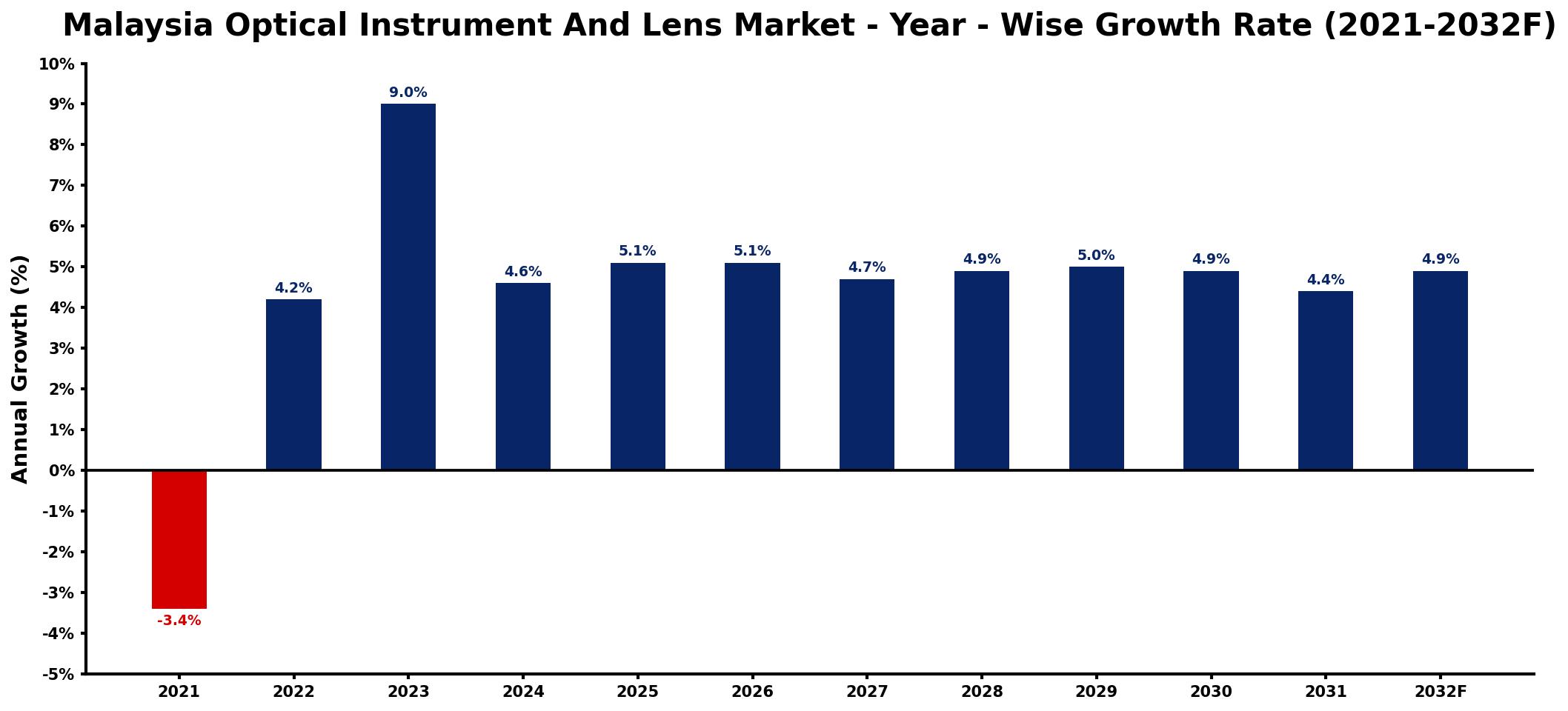
The table below presents the year‑wise growth rates along with the key drivers influencing the market
| Year | Growth Rate | Major Drivers |
| 2021 | -3.4% | decreased consumer spending on technology |
| 2022 | 4.2% | rising demand for personal eyewear |
| 2023 | 9.0% | increased investments in healthcare technology |
| 2024 | 4.6% | growing interest in digital devices |
| 2025 | 5.1% | expansion of online retail channels |
| 2026 | 5.1% | enhanced manufacturing capabilities emerging |
| 2027 | 4.7% | growing awareness of eye health |
| 2028 | 4.9% | increased adoption of smart eyewear |
| 2029 | 5.0% | rising popularity of telemedicine solutions |
| 2030 | 4.9% | expanding market for luxury eyewear |
| 2031 | 4.4% | increased focus on sustainability trends |
| 2032 | 4.9% | growing demand for innovative designs |
Note: Market size estimations and growth projections presented in this report are based on 6Wresearch's proprietary forecasting methodology, utilizing the latest available industry data, government publications, and primary research inputs.
Malaysia Optical Instrument And Lens Market Synopsis
The Malaysian market for optical instruments and lenses is poised for growth, propelled by technological advancements in lens design and materials. Consumers are now more informed and proactive about eye health, leading to a surge in the adoption of prescription glasses and contact lenses.
Furthermore, as digital devices become ubiquitous, issues like digital eye strain have emerged, further stimulating the market. Government initiatives promoting eye care and affordable eyewear also play a crucial role in enhancing market reach and accessibility.
Malaysia Optical Instrument And Lens Market Key Takeaways
- Steady market growth driven by increasing consumer awareness of eye health.
- Technological innovations in lens materials and designs are transforming the landscape.
- The aging population is a significant contributor to the demand for optical products.
- Government initiatives are enhancing accessibility to eye care solutions.
- The pandemic-induced recovery phase presents fresh opportunities for growth in optical sales.
Evaluation of Restraints in Malaysia Optical Instrument And Lens Market
While the Malaysia Optical Instrument and Lens Market shows promise, it faces certain restraints. The rapid evolution of digital technology poses challenges as new devices integrate optical components, resulting in stiff competition for traditional optical products. Counterfeit products undermine consumer trust, complicating market dynamics. Economic fluctuations can also affect consumer spending, particularly for high-end optical instruments, necessitating continual innovation and investment in research and development to maintain product quality and relevance.
Malaysia Optical Instrument And Lens Market Trends
Emerging trends shaping the Malaysia Optical Instrument and Lens Market include the growing shift towards personalized eyewear solutions, driven by advancements in 3D printing technology. There is also an increasing focus on blue-light-blocking lenses as awareness of digital eye strain grows. Furthermore, smart eyewear solutions are gaining traction, with technological integration becoming a key feature that consumers seek in optical products.
Malaysia Optical Instrument And Lens Market Opportunities
Significant growth opportunities exist in the Malaysia Optical Instrument and Lens Market, particularly in the realm of digital marketing strategies that cater to tech-savvy consumers. Investing in innovative eyewear solutions, such as anti-fog and anti-reflective coatings, can meet the evolving needs of users. Furthermore, expanding distribution channels, including online platforms, can enhance market reach and cater to a broader audience.
Government Initiatives in the Malaysia Optical Instrument And Lens Market
The Malaysian government has been proactive in promoting eye health through various initiatives aimed at increasing awareness and accessibility. Public health campaigns focused on regular eye examinations and affordable eyewear options are integral to these efforts. Additionally, partnerships with healthcare providers aim to ensure that eye care services reach underserved populations, thus enhancing the overall market landscape.
Future Insights of the Malaysia Optical Instrument And Lens Market
Looking ahead to 2026-2032, the Malaysia Optical Instrument and Lens Market is expected to evolve significantly, driven by technological advancements and consumer demand. The integration of artificial intelligence in optical solutions is likely to become more prevalent, enhancing user experience. Furthermore, as healthcare awareness continues to grow, investments in optical research and product development will be crucial for meeting the diverse needs of an increasingly discerning consumer base.
Malaysia Optical Instrument And Lens Market Latest Developments (2025 - 2026)
Recent industry developments indicate a surge in partnerships between optical manufacturers and tech companies aimed at creating smarter eyewear solutions. Additionally, there is a noticeable push towards sustainability in production processes, with companies increasingly adopting eco-friendly materials. The market has also seen a rise in promotional campaigns targeting younger consumers, encouraging earlier adoption of eye care products and services.
Malaysia Optical Instrument And Lens Market - Key Attractiveness of the Report
- 10 Years of Market Numbers
- Historical Data Starting from 2022 to 2025
- Base Year: 2025
- Forecast Data until 2032
- Key Performance Indicators Impacting the Market
- Major Upcoming Developments and Projects
Key Highlights of the Report:
- Malaysia Optical Instrument And Lens Market Outlook
- Market Size of Malaysia Optical Instrument And Lens Market, 2025
- Forecast of Malaysia Optical Instrument And Lens Market, 2032
- Historical Data and Forecast of Malaysia Optical Instrument And Lens Revenues & Volume for the Period 2022-2032F
- Malaysia Optical Instrument And Lens Market Trend Evolution
- Malaysia Optical Instrument And Lens Market Drivers and Challenges
- Malaysia Optical Instrument And Lens Price Trends
- Malaysia Optical Instrument And Lens Porter's Five Forces
- Malaysia Optical Instrument And Lens Industry Life Cycle
- Historical Data and Forecast of Malaysia Optical Instrument And Lens Market Revenues & Volume By Product for the Period 2022-2032F
- Historical Data and Forecast of Malaysia Optical Instrument And Lens Market Revenues & Volume By Binoculars for the Period 2022-2032F
- Historical Data and Forecast of Malaysia Optical Instrument And Lens Market Revenues & Volume By Microscopes for the Period 2022-2032F
- Historical Data and Forecast of Malaysia Optical Instrument And Lens Market Revenues & Volume By Telescopes for the Period 2022-2032F
- Historical Data and Forecast of Malaysia Optical Instrument And Lens Market Revenues & Volume By Others for the Period 2022-2032F
- Historical Data and Forecast of Malaysia Optical Instrument And Lens Market Revenues & Volume By Category for the Period 2022-2032F
- Historical Data and Forecast of Malaysia Optical Instrument And Lens Market Revenues & Volume By Optical Instruments for the Period 2022-2032F
- Historical Data and Forecast of Malaysia Optical Instrument And Lens Market Revenues & Volume By Interchangeable Camera Lenses for the Period 2022-2032F
- Historical Data and Forecast of Malaysia Optical Instrument And Lens Market Revenues & Volume By Application for the Period 2022-2032F
- Historical Data and Forecast of Malaysia Optical Instrument And Lens Market Revenues & Volume By Medical for the Period 2022-2032F
- Historical Data and Forecast of Malaysia Optical Instrument And Lens Market Revenues & Volume By Astronomy for the Period 2022-2032F
- Historical Data and Forecast of Malaysia Optical Instrument And Lens Market Revenues & Volume By Commercial for the Period 2022-2032F
- Historical Data and Forecast of Malaysia Optical Instrument And Lens Market Revenues & Volume By Defense for the Period 2022-2032F
- Historical Data and Forecast of Malaysia Optical Instrument And Lens Market Revenues & Volume By Others for the Period 2022-2032F
- Malaysia Optical Instrument And Lens Import Export Trade Statistics
- Market Opportunity Assessment By Product
- Market Opportunity Assessment By Category
- Market Opportunity Assessment By Application
- Malaysia Optical Instrument And Lens Top Companies Market Share
- Malaysia Optical Instrument And Lens Competitive Benchmarking By Technical and Operational Parameters
- Malaysia Optical Instrument And Lens Company Profiles
- Malaysia Optical Instrument And Lens Key Strategic Recommendations






































