Malaysia Peer-to-peer (P2P) lending Market Size, Share & Growth Rate
The Malaysia Peer-to-peer (P2P) lending Market was estimated at USD 152 Million in 2025 and is projected to reach USD 197 Million by 2032, growing at a CAGR of 3.8% from 2026 to 2032. This growth trajectory is underpinned by rising digital adoption among consumers, who increasingly prefer online financing options, alongside government initiatives that bolster financial inclusion. Furthermore, as more individuals and small enterprises seek alternative funding avenues, the demand for P2P lending platforms continues to gain momentum.
Malaysia Peer-to-peer (P2P) lending Market Year-wise Growth Rate and Key Drivers
This graph highlights how the Malaysia Peer-to-peer (P2P) lending Market has steadily grown over the years, supported by major growth factors.
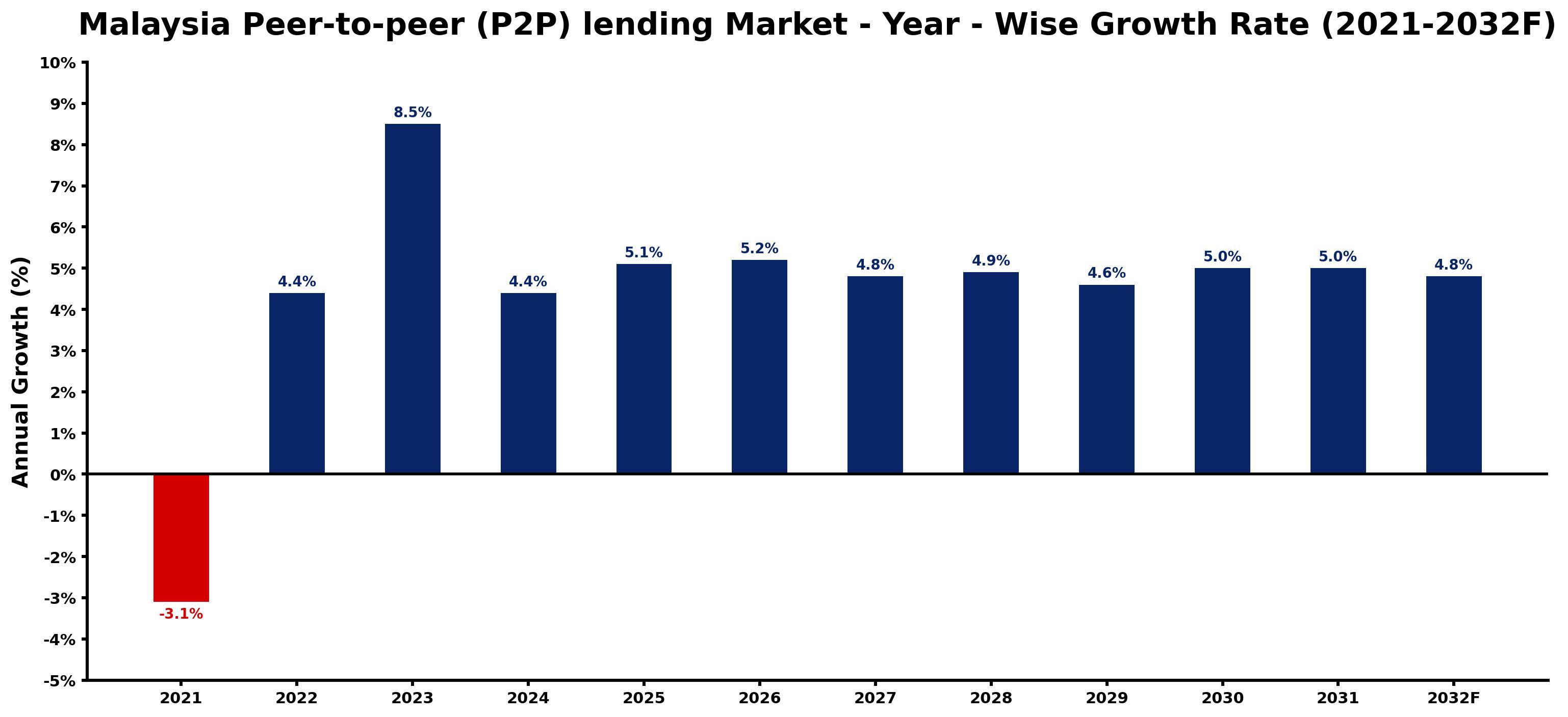
The table below presents the year‑wise growth rates along with the key drivers influencing the market
| Year | Growth Rate | Major Drivers |
| 2021 | -3.1% | Government infrastructure modernization initiatives |
| 2022 | 4.4% | Increasing industrial infrastructure investments |
| 2023 | 8.5% | Expansion of commercial construction activities |
| 2024 | 4.4% | Growing urbanization and commercial development |
| 2025 | 5.1% | Expansion of manufacturing activities |
| 2026 | 5.2% | Increasing industrial automation investments |
| 2027 | 4.8% | Rising electricity demand across industries |
| 2028 | 4.9% | Rising electricity demand across industries |
| 2029 | 4.6% | Rising electricity demand across industries |
| 2030 | 5.0% | Increasing industrial infrastructure investments |
| 2031 | 5.0% | Growing urbanization and commercial development |
| 2032 | 4.8% | Increasing industrial automation investments |
Note - Market size estimations and growth projections presented in this report are based on 6Wresearch’s advanced forecasting approach, validated with industry datasets as of June 2026.
Malaysia Peer-to-peer (P2P) lending Market Synopsis
The strongest force shaping the Malaysia Peer-to-peer (P2P) lending market is the push for financial inclusion, which has accelerated access to capital for traditionally underserved demographics. This is complemented by an influx of technology, enabling a seamless user experience for both borrowers and lenders alike.
With over 10 million borrowers and lenders in the ecosystem, platforms have diversified their offerings to include personal loans, business loans, and investment opportunities. Moreover, the inclusion of educational resources helps foster a more informed lending community, ultimately leading to sustainable market growth.
Malaysia Peer-to-peer (P2P) lending Market Key Takeaways
- The market is characterized by rapid growth driven by technological advancements and a rising emphasis on financial inclusion.
- Government support through tax incentives significantly boosts market development and attracts new players.
- Platforms are increasingly offering educational resources alongside traditional lending services, enhancing user experience.
- With a substantial user base exceeding 10 million, the market presents considerable growth potential for both lenders and borrowers.
- The projected market growth signifies a robust future, driven by evolving consumer preferences and emerging financial solutions.
Evaluation of Restraints in Malaysia Peer-to-peer (P2P) lending Market
Despite the optimistic growth outlook, the Malaysia P2P lending market faces certain restraints that could hinder its potential. A primary concern is the regulatory landscape, as evolving regulations can impose challenges on operational flexibility for P2P platforms. Additionally, consumer hesitance to adopt newer lending models due to perceived risks and a lack of awareness remains an obstacle. Such factors necessitate continuous efforts in consumer education and robust compliance frameworks to ensure the market's long-term sustainability.
Malaysia Peer-to-peer (P2P) lending Market Trends
Several current and emerging trends are shaping the demand and technological landscape in the Malaysia P2P lending market. The increasing integration of artificial intelligence and machine learning in credit scoring processes is enhancing the accuracy and efficiency of lending decisions. Furthermore, the growing popularity of mobile applications is facilitating instant access to loans, thereby catering to a tech-savvy clientele. Lastly, sustainability-focused lending initiatives are gaining traction, aligning financial practices with ethical investing principles.
Malaysia Peer-to-peer (P2P) lending Market Opportunities
The future is rife with genuine growth and investment opportunities within the Malaysia P2P lending market. As financial literacy improves, there exists a significant chance to tap into the unbanked segments of the population. Moreover, evolving consumer preferences towards responsible lending pave the way for platforms that incorporate social impact assessments. Developing robust partnerships with fintech firms could also enhance service offerings and user acquisition strategies, propelling market expansion.
Government Initiatives in the Malaysia Peer-to-peer (P2P) lending Market
The Malaysian government has actively supported the P2P lending sector through various policies aimed at fostering innovation and inclusivity. Initiatives include providing tax incentives for P2P operators, thus encouraging entrepreneurship and the establishment of new platforms. Additionally, regulatory frameworks have been adapted to ensure a balanced approach to consumer protection while enabling market growth, which further reinforces the government's commitment to enhancing the financial ecosystem.
Future Insights of the Malaysia Peer-to-peer (P2P) lending Market
Looking ahead to 2026-2032, the Malaysia P2P lending market is poised for substantial growth driven by continued technological advancement and increasing consumer engagement. As the market matures, platforms will likely expand their service offerings, catering to niche segments with tailored solutions. Furthermore, the ongoing emphasis on financial inclusion suggests a rising number of borrowers from diverse backgrounds, ultimately transforming the lending landscape in the country.
Malaysia Peer-to-peer (P2P) lending Market Latest Developments (May 2025 - June 2026)
Recent developments in the Malaysia P2P lending market indicate a growing focus on technological integration and enhanced user experiences. Platforms are increasingly exploring partnerships with tech firms to optimize their services through better data analytics and streamlined processes. Moreover, regulatory updates are anticipated as the government seeks to keep pace with industry growth while ensuring consumer protection. Overall, the sector is evolving rapidly, reflecting both local and global financial trends.
Malaysia Peer-to-peer (P2P) lending Market - Key Attractiveness of the Report
- 10 Years of Market Numbers
- Historical Data Starting from 2022 to 2025
- Base Year: 2025
- Forecast Data until 2032
- Key Performance Indicators Impacting the Market
- Major Upcoming Developments and Projects
Key Highlights of the Report:
- Malaysia Peer-to-peer (P2P) lending Market Outlook
- Market Size of Malaysia Peer-to-peer (P2P) lending Market, 2025
- Forecast of Malaysia Peer-to-peer (P2P) lending Market, 2032F
- Historical Data and Forecast of Malaysia Peer-to-peer (P2P) lending Revenues & Volume for the Period 2022-2032F
- Malaysia Peer-to-peer (P2P) lending Market Trend Evolution
- Malaysia Peer-to-peer (P2P) lending Market Drivers and Challenges
- Malaysia Peer-to-peer (P2P) lending Price Trends
- Malaysia Peer-to-peer (P2P) lending Porter's Five Forces
- Malaysia Peer-to-peer (P2P) lending Industry Life Cycle
- Historical Data and Forecast of Malaysia Peer-to-peer (P2P) lending Market Revenues & Volume By Business Model for the Period 2022-2032F
- Historical Data and Forecast of Malaysia Peer-to-peer (P2P) lending Market Revenues & Volume By Alternate Marketplace Lending for the Period 2022-2032F
- Historical Data and Forecast of Malaysia Peer-to-peer (P2P) lending Market Revenues & Volume By Traditional Lending for the Period 2022-2032F
- Historical Data and Forecast of Malaysia Peer-to-peer (P2P) lending Market Revenues & Volume By Type for the Period 2022-2032F
- Historical Data and Forecast of Malaysia Peer-to-peer (P2P) lending Market Revenues & Volume By Consumer Lending for the Period 2022-2032F
- Historical Data and Forecast of Malaysia Peer-to-peer (P2P) lending Market Revenues & Volume By Business Lending for the Period 2022-2032F
- Historical Data and Forecast of Malaysia Peer-to-peer (P2P) lending Market Revenues & Volume By End User for the Period 2022-2032F
- Historical Data and Forecast of Malaysia Peer-to-peer (P2P) lending Market Revenues & Volume By Consumer Credit Loans for the Period 2022-2032F
- Historical Data and Forecast of Malaysia Peer-to-peer (P2P) lending Market Revenues & Volume By Small Business Loans for the Period 2022-2032F
- Historical Data and Forecast of Malaysia Peer-to-peer (P2P) lending Market Revenues & Volume By Student Loans for the Period 2022-2032F
- Historical Data and Forecast of Malaysia Peer-to-peer (P2P) lending Market Revenues & Volume By Real Estate Loans for the Period 2022-2032F
- Malaysia Peer-to-peer (P2P) lending Import Export Trade Statistics
- Market Opportunity Assessment By Business Model
- Market Opportunity Assessment By Type
- Market Opportunity Assessment By End User
- Malaysia Peer-to-peer (P2P) lending Top Companies Market Share
- Malaysia Peer-to-peer (P2P) lending Competitive Benchmarking By Technical and Operational Parameters
- Malaysia Peer-to-peer (P2P) lending Company Profiles
- Malaysia Peer-to-peer (P2P) lending Key Strategic Recommendations






































