Malaysia Pneumatic Valves Market Summary
The malaysia pneumatic valves market was estimated at USD 363 Million in 2025 and is projected to reach USD 470 Million by 2032, growing at a CAGR of 5.6% from 2026 to 2032.
Malaysia Pneumatic Valves Market Year-wise Growth Rate and Key Drivers
This graph highlights how the Malaysia Pneumatic Valves Market has steadily grown over the past five years, supported by major growth factors.
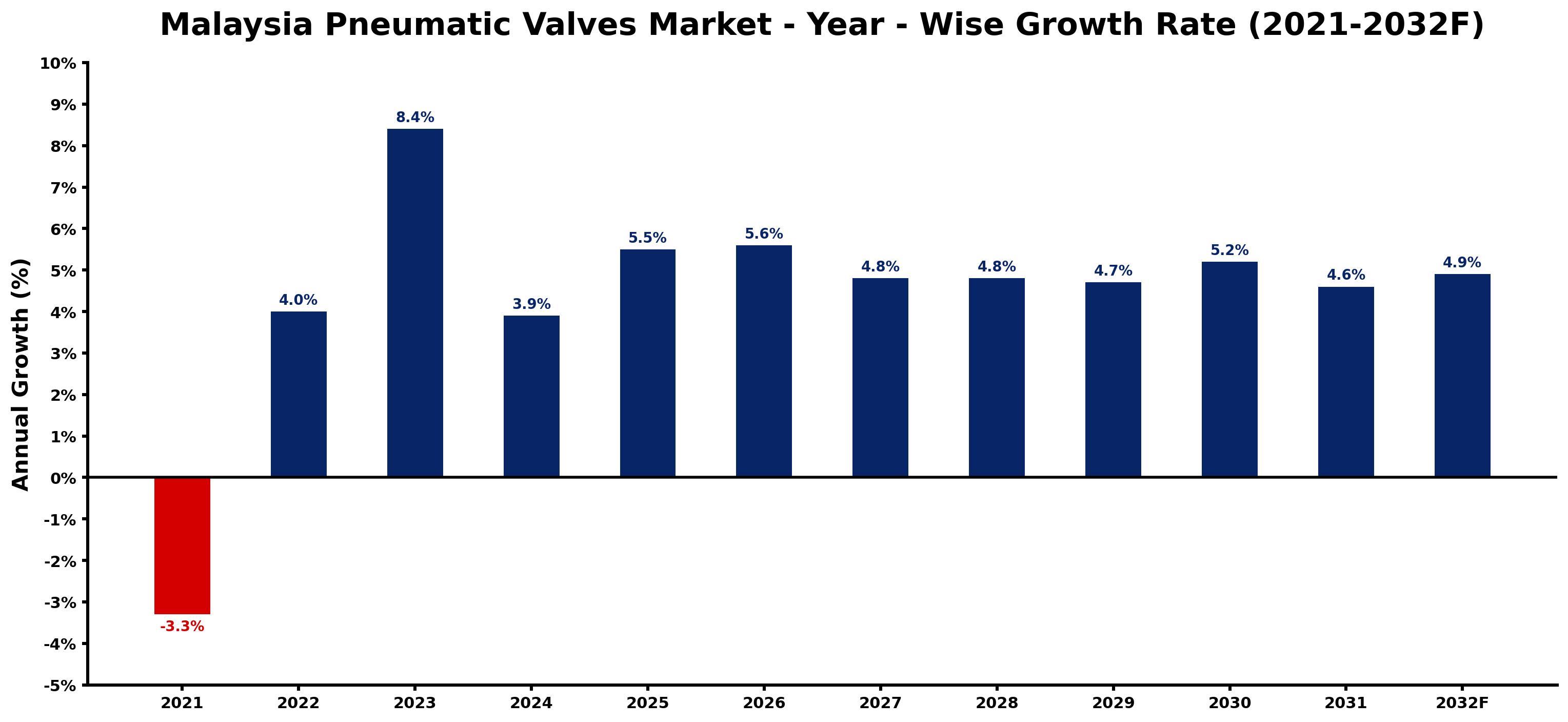
The table below presents the year wise growth rates along with the key drivers influencing the market
| Year | Growth Rate | Major Drivers |
| 2021 | -3.3% | Supply chain disruptions due to pandemicrelated restrictions hindered manufacturing capacity and led to increased delivery times. |
| 2022 | 4.0% | Local manufacturing plants increasingly utilize pneumatic systems for operational efficiency gains. |
| 2023 | 8.4% | Investment in renewable energy projects expands demand for pneumatic valves in Malaysia. |
| 2024 | 3.9% | The construction industry drives the need for reliable valve solutions in commercial projects. |
| 2025 | 5.5% | Emerging smart factory trends integrate pneumatic technologies for improved automation processes. |
| 2026 | 5.6% | The agriculture sector explores automation, creating a niche for pneumatic control systems. |
| 2027 | 4.8% | Increased manufacturing output leads to higher demand for specialized pneumatic solutions. |
| 2028 | 4.8% | Major pipeline projects in oil and gas boost the valve market's growth potential. |
| 2029 | 4.7% | Technological upgrades across industries stimulate interest in advanced pneumatic valve features. |
| 2030 | 5.2% | Urbanization trends necessitate effective fluid control in expanded transportation networks. |
| 2031 | 4.6% | Collaborations between local firms and global suppliers enhance product offerings in Malaysia. |
| 2032 | 4.9% | Sustainability goals push innovation in pneumatic valves, focusing on energy-efficient designs. |
Note - Market size estimations and growth projections presented in this report are based on 6Wresearch's advanced forecasting approach, validated with industry datasets as of June 2026.
Malaysia Pneumatic Valves Market Synopsis
The Malaysia Pneumatic Valves Market is projected to reach 5.6% and witness significant growth during the forecast period (2026-2032). The anticipated growth, estimated at a compound annual growth rate (CAGR) of around 4.9%, is primarily driven by an increase in industrial and manufacturing activities. These sectors have a rising demand for pneumatically operated control valves, essential for efficient operations across various applications such as food and beverages, chemicals, and oil and gas. The ongoing infrastructure development initiatives further bolster this demand, suggesting a vibrant future for the Malaysia pneumatic valves market.
Malaysia Pneumatic Valves Market Growth Drivers
The growth of the Malaysia pneumatic valves market is significantly influenced by a variety of factors:
- The expansion of the manufacturing industry in Malaysia has increased the need for automated systems, which rely heavily on pneumatic technologies for efficiency and precision.
- Industrial automation trends are driving the adoption of pneumatic valves, as they provide reliable control in processes that require high speed and accuracy.
- The food and beverage sector is evolving to meet new safety and hygiene regulations, leading to a rising preference for pneumatic systems that ensure contamination-free operations.
- Investment in infrastructure projects, both public and private, is enhancing the demand for pneumatic valves to support construction and operational processes in utilities and services.
- Technological advancements in valve designs are also contributing to market growth, as newer models offer improved performance and energy efficiency, enhancing their appeal to end-users.
Malaysia Pneumatic Valves Market Trends and Opportunities
The Malaysia pneumatic valves market is characterized by several emerging trends and opportunities that could shape its future landscape:
- A shift towards smart manufacturing solutions is fostering the development of intelligent pneumatic systems that integrate with IoT technologies for enhanced monitoring and control.
- Green manufacturing practices are prompting industries to seek more energy-efficient pneumatic valves, opening avenues for innovation in environmentally friendly designs.
- As Malaysia strengthens its position as a manufacturing hub in Southeast Asia, the demand for high-quality pneumatic components is likely to rise, creating opportunities for new entrants and existing manufacturers.
- The growing emphasis on maintenance and service support is leading to increased demand for aftermarket products and services, positioning service providers as key players in the market.
- Collaborations and partnerships between technology providers and industry stakeholders could spur the development of innovative pneumatic solutions tailored to meet specific sector needs.
Malaysia Pneumatic Valves Market Challenges and Restraints
Despite the promising prospects of the Malaysia pneumatic valves market, several challenges may hinder its growth:
- The high cost of pneumatic control systems can deter small to medium-sized enterprises from investing in necessary technologies, thereby limiting market penetration.
- Fluctuations in raw material prices can impact the production costs of pneumatic valves, causing potential supply chain disruptions and pricing volatility.
- A lack of skilled workforce experienced in pneumatic technology can delay the implementation of advanced pneumatic solutions in various industries.
- The advent of alternative technologies that offer similar functionalities may pose competition to pneumatic systems, potentially restraining market share.
- Regulatory challenges, including compliance with safety standards and environmental regulations, can complicate the market landscape, requiring manufacturers to adapt continuously.
Malaysia Pneumatic Valves Market Government Investment and Initiatives
Government investment and initiatives play a crucial role in shaping the Malaysia pneumatic valves market. The Malaysian government has set forth several development plans aimed at boosting industrial growth, which includes public spending on infrastructure projects. These initiatives are focused on enhancing the overall efficiency and productivity of the manufacturing sector. Furthermore, there are incentives in place to encourage the adoption of automation technologies, including pneumatic systems, that align with national policies promoting industrial transformation and sustainability. Collaborative efforts between governmental bodies and private sectors are expected to drive innovation and technological advancements within the market context.
Malaysia Pneumatic Valves Market Latest Developments (May 2025 - June 2026)
Recent developments in the Malaysia pneumatic valves market reflect a dynamic industry landscape. There has been a marked focus on adopting advanced manufacturing techniques that enhance operational efficiency and reduce costs. Companies are increasingly prioritizing R&D to develop next-generation pneumatic valves that are not only more efficient but also environmentally sustainable. Additionally, partnerships among various stakeholders in the supply chain are fostering collaborative innovations aimed at meeting specific industry demands. There is also a growing trend towards the integration of digital technologies, such as IoT, to enhance valve performance monitoring and control capabilities in real-time.
Malaysia Pneumatic Valves Market - Key Attractiveness of the Report
- 10 Years of Market Numbers
- Historical Data Starting from 2022 to 2025
- Base Year: 2025
- Forecast Data until 2032
- Key Performance Indicators Impacting the Market
- Major Upcoming Developments and Projects
Key Highlights of the Report:
- Malaysia Pneumatic Valves Market Outlook
- Market Size of Malaysia Pneumatic Valves Market, 2025
- Forecast of Malaysia Pneumatic Valves Market, 2032F
- Historical Data and Forecast of Malaysia Pneumatic Valves Revenues & Volume for the Period 2022-2032F
- Malaysia Pneumatic Valves Market Trend Evolution
- Malaysia Pneumatic Valves Market Drivers and Challenges
- Malaysia Pneumatic Valves Price Trends
- Malaysia Pneumatic Valves Porter's Five Forces
- Malaysia Pneumatic Valves Industry Life Cycle
- Historical Data and Forecast of Malaysia Pneumatic Valves Market Revenues & Volume By Product Type for the Period 2022-2032F
- Historical Data and Forecast of Malaysia Pneumatic Valves Market Revenues & Volume By Sliding shaft for the Period 2022-2032F
- Historical Data and Forecast of Malaysia Pneumatic Valves Market Revenues & Volume By Rotating shaft for the Period 2022-2032F
- Historical Data and Forecast of Malaysia Pneumatic Valves Market Revenues & Volume By End-Users for the Period 2022-2032F
- Historical Data and Forecast of Malaysia Pneumatic Valves Market Revenues & Volume By Chemicals and petrochemicals for the Period 2022-2032F
- Historical Data and Forecast of Malaysia Pneumatic Valves Market Revenues & Volume By Power generation and management for the Period 2022-2032F
- Historical Data and Forecast of Malaysia Pneumatic Valves Market Revenues & Volume By Mining for the Period 2022-2032F
- Historical Data and Forecast of Malaysia Pneumatic Valves Market Revenues & Volume By Water and wastewater management? for the Period 2022-2032F
- Malaysia Pneumatic Valves Import Export Trade Statistics
- Market Opportunity Assessment By Product Type
- Market Opportunity Assessment By End-Users
- Malaysia Pneumatic Valves Top Companies Market Share
- Malaysia Pneumatic Valves Competitive Benchmarking By Technical and Operational Parameters
- Malaysia Pneumatic Valves Company Profiles
- Malaysia Pneumatic Valves Key Strategic Recommendations






































