Malaysia Polymer Clay Market Size, Share & Growth Rate
The Malaysia Polymer Clay Market was estimated at USD 440 Million in 2025 and is projected to reach USD 572 Million by 2032, growing at a CAGR of 3.8% from 2026 to 2032. This trajectory is being propelled by the growing interest in DIY crafts and the increasing accessibility of polymer clay in art supply stores across the country. Additionally, innovation in product offerings, including new colors and formulations, is further stimulating consumer engagement in the crafting community.
Malaysia Polymer Clay Market Year-wise Growth Rate and Key Drivers
This graph highlights how the Malaysia Polymer Clay Market has steadily grown over the years, supported by major growth factors.
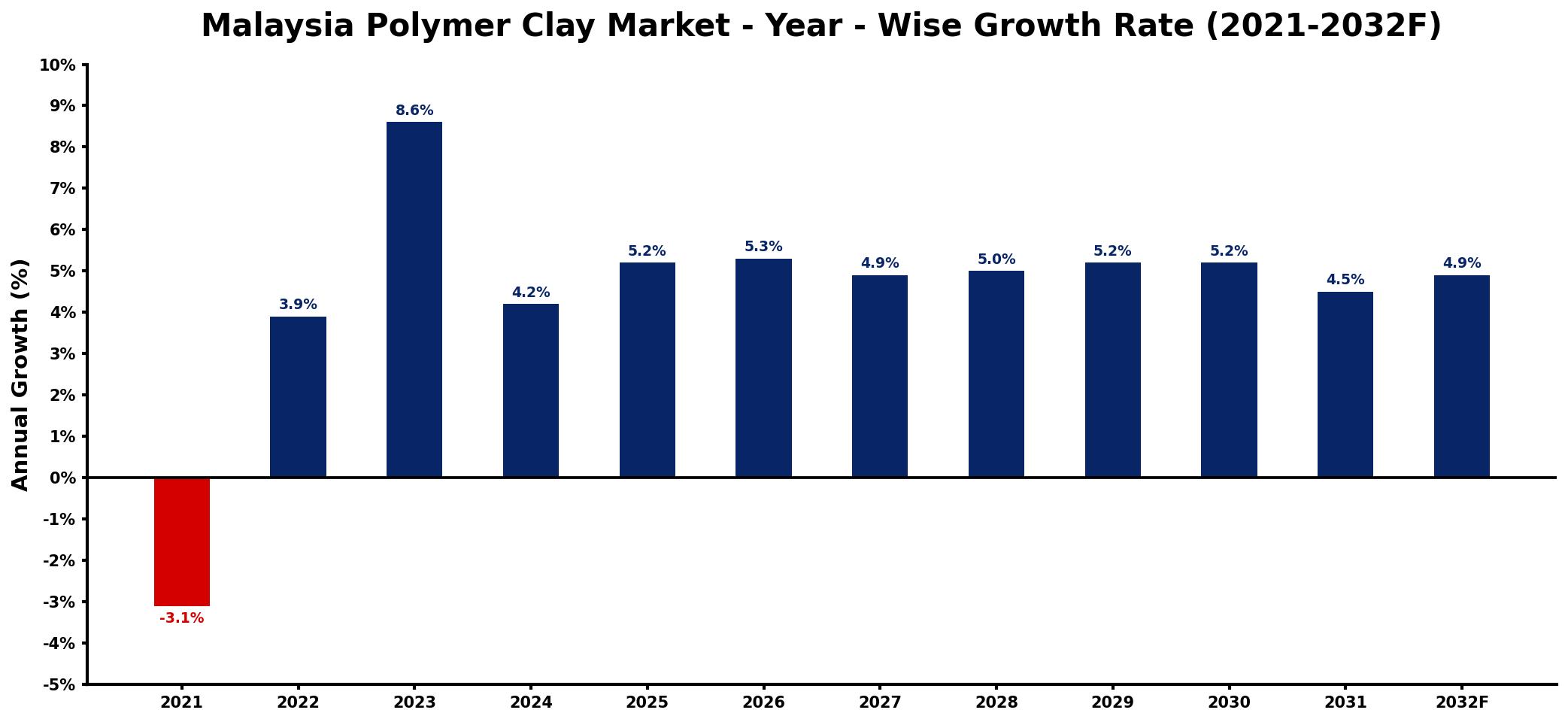
The table below presents the year‑wise growth rates along with the key drivers influencing the market
| Year | Growth Rate | Major Drivers |
| 2021 | -3.1% | decreased consumer spending on crafts |
| 2022 | 3.9% | growing interest in DIY projects |
| 2023 | 8.6% | expansion of online retail platforms |
| 2024 | 4.2% | rise in educational workshops offered |
| 2025 | 5.2% | increase in art therapy programs |
| 2026 | 5.3% | growing popularity of handmade goods |
| 2027 | 4.9% | surge in social media influencers |
| 2028 | 5.0% | enhanced distribution network strategies |
| 2029 | 5.2% | growth in eco-friendly materials usage |
| 2030 | 5.2% | increased investment in creative industries |
| 2031 | 4.5% | development of new hobbyist communities |
| 2032 | 4.9% | expanding industrial usage applications |
Note: Market size estimations and growth projections presented in this report are based on 6Wresearch's proprietary forecasting methodology, utilizing the latest available industry data, government publications, and primary research inputs.
Malaysia Polymer Clay Market Synopsis
The demand for polymer clay in Malaysia is significantly influenced by the rise of online marketplaces and local crafting workshops. As more individuals turn to creative hobbies, the need for versatile, easy-to-use crafting materials like polymer clay has become apparent, facilitating a growing community of artisans and crafters.
Furthermore, the intricate designs achievable with polymer clay have led to its popularity in jewelry making and decorative arts. This trend showcases the material's adaptability, attracting both novices and experienced artisans eager to explore their creative potential.
Malaysia Polymer Clay Market Key Takeaways
- The market is benefiting from a burgeoning DIY culture among consumers.
- Innovations in product variations are crucial to keeping consumer interest alive.
- Accessibility of polymer clay in local and online stores contributes to its increasing popularity.
- Competitive pressure from alternative materials underscores the importance of differentiation.
- Hobbyist communities are becoming significant drivers of market demand.
Evaluation of Restraints in Malaysia Polymer Clay Market
The polymer clay market in Malaysia faces several restraints that could hinder its growth potential. One notable challenge is the intense competition from alternative modeling materials, such as air-dry clay and epoxy resin, which can easily attract consumers looking for different crafting experiences. Additionally, fluctuations in the prices of key raw materials like PVC and plasticizers are causing production cost concerns, making it essential for manufacturers to find innovative solutions and maintain pricing strategies that cater to both profitability and consumer demand. This balancing act of maintaining quality while mitigating costs adds another layer of complexity to market operations.
Malaysia Polymer Clay Market Trends
Several trends are currently shaping the Malaysian polymer clay market. A notable shift is the integration of eco-friendly practices within the industry, as consumers increasingly favor sustainable products. Manufacturers are beginning to introduce environmentally conscious formulations, which could lead to greater appeal among eco-aware crafters. Additionally, the rise of social media platforms has resulted in increased visibility for polymer clay artistry, encouraging more individuals to engage with and share their creations. Online tutorials and crafting videos are serving to inspire a new generation of creators, broadening the market's reach.
Malaysia Polymer Clay Market Opportunities
The Malaysian polymer clay market presents numerous growth and investment opportunities. Companies can explore collaborations with local artisans and influencers to create unique product lines or limited-edition collections that resonate with target demographics. Furthermore, tapping into educational institutions by offering workshops and crafting events could significantly expand the consumer base and foster a love for polymer clay from a young age. Innovations in product development, focusing on specialty clays with unique properties or textures, also provide avenues for differentiation in a competitive landscape.
Government Initiatives in the Malaysia Polymer Clay Market
The Malaysian government has implemented several initiatives aimed at promoting local craftsmanship and the arts, which indirectly support the polymer clay market. Various programs encourage creative industries through grants and subsidies, allowing artists and craft businesses to flourish. Additionally, public spending on arts education and local craftsmanship showcases an effort to foster innovation and community engagement within the sector, contributing to a more robust environment for businesses involved in crafting and art supplies.
Future Insights of the Malaysia Polymer Clay Market
Looking ahead to 2026-2032, the Malaysian polymer clay market is poised for steady growth, driven by the continued popularity of DIY culture and artistic expression. As more individuals embrace crafting as a leisure activity, the demand for versatile and high-quality materials like polymer clay is expected to rise. Innovations in product offerings and a focus on sustainable practices will likely play a crucial role in capturing the interest of environmentally conscious consumers. Furthermore, the emergence of e-commerce will provide enhanced access to these products, further stimulating market expansion.
Malaysia Polymer Clay Market Latest Developments (2025 - 2026)
Recent developments in the Malaysian polymer clay market have seen an increased focus on community-driven events that promote crafting. Workshops and craft fairs have gained popularity as platforms for consumers to engage with polymer clay, fostering a deeper connection with the product. Moreover, the introduction of innovative color palettes and formulations designed for specific crafting needs has garnered attention, allowing crafters to experiment with new artistic styles and techniques.
Malaysia Polymer Clay Market - Key Attractiveness of the Report
- 10 Years of Market Numbers
- Historical Data Starting from 2022 to 2025
- Base Year: 2025
- Forecast Data until 2032
- Key Performance Indicators Impacting the Market
- Major Upcoming Developments and Projects
Key Highlights of the Report:
- Malaysia Polymer Clay Market Outlook
- Market Size of Malaysia Polymer Clay Market, 2025
- Forecast of Malaysia Polymer Clay Market, 2032
- Historical Data and Forecast of Malaysia Polymer Clay Revenues & Volume for the Period 2022-2032F
- Malaysia Polymer Clay Market Trend Evolution
- Malaysia Polymer Clay Market Drivers and Challenges
- Malaysia Polymer Clay Price Trends
- Malaysia Polymer Clay Porter's Five Forces
- Malaysia Polymer Clay Industry Life Cycle
- Historical Data and Forecast of Malaysia Polymer Clay Market Revenues & Volume By Product Form for the Period 2022-2032F
- Historical Data and Forecast of Malaysia Polymer Clay Market Revenues & Volume By Solid for the Period 2022-2032F
- Historical Data and Forecast of Malaysia Polymer Clay Market Revenues & Volume By Liquid for the Period 2022-2032F
- Historical Data and Forecast of Malaysia Polymer Clay Market Revenues & Volume By Application for the Period 2022-2032F
- Historical Data and Forecast of Malaysia Polymer Clay Market Revenues & Volume By Jewelry Making for the Period 2022-2032F
- Historical Data and Forecast of Malaysia Polymer Clay Market Revenues & Volume By Manufacturing of Toys and Novelty Items for the Period 2022-2032F
- Historical Data and Forecast of Malaysia Polymer Clay Market Revenues & Volume By Arts and Sculpture Making for the Period 2022-2032F
- Historical Data and Forecast of Malaysia Polymer Clay Market Revenues & Volume By Crockery and Ceramic Products for the Period 2022-2032F
- Historical Data and Forecast of Malaysia Polymer Clay Market Revenues & Volume By Others for the Period 2022-2032F
- Historical Data and Forecast of Malaysia Polymer Clay Market Revenues & Volume By End Use for the Period 2022-2032F
- Historical Data and Forecast of Malaysia Polymer Clay Market Revenues & Volume By Residential for the Period 2022-2032F
- Historical Data and Forecast of Malaysia Polymer Clay Market Revenues & Volume By Commercial for the Period 2022-2032F
- Historical Data and Forecast of Malaysia Polymer Clay Market Revenues & Volume By Industrial for the Period 2022-2032F
- Malaysia Polymer Clay Import Export Trade Statistics
- Market Opportunity Assessment By Product Form
- Market Opportunity Assessment By Application
- Market Opportunity Assessment By End Use
- Malaysia Polymer Clay Top Companies Market Share
- Malaysia Polymer Clay Competitive Benchmarking By Technical and Operational Parameters
- Malaysia Polymer Clay Company Profiles
- Malaysia Polymer Clay Key Strategic Recommendations






































