Malaysia Processed Food Market Growth Rate
According to 6Wresearch internal database and industry insights, the Malaysia Processed Food Market is projected to grow at a compound annual growth rate (CAGR) of 6.4% during the forecast period (2026-2032).
Malaysia Processed Food Market Year-wise Growth Rate and Key Drivers
This graph highlights how the Malaysia Processed Food Market has steadily grown over the past five years, supported by major growth factors.
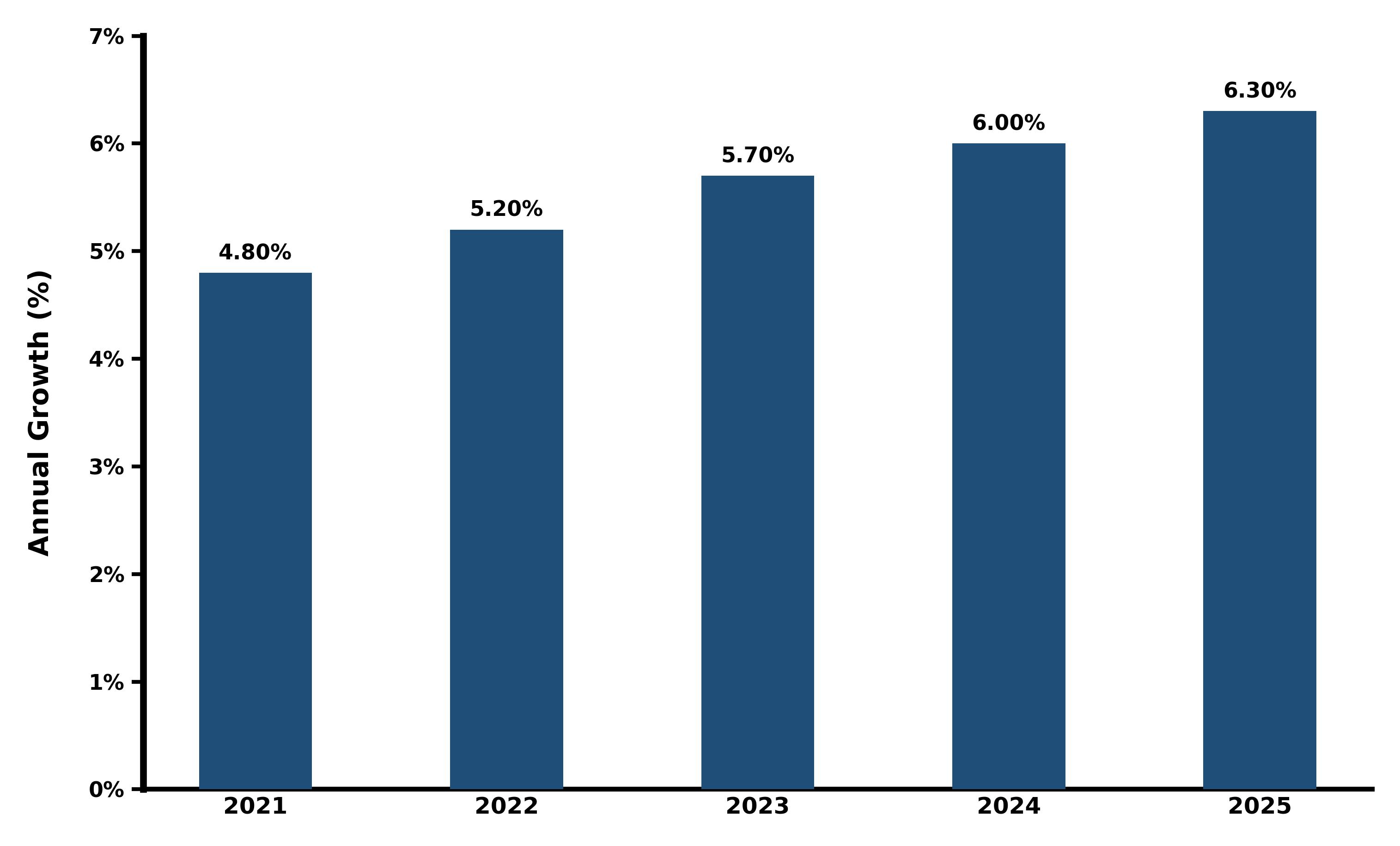
The table below presents the year‑wise growth rates along with the key drivers influencing the market
| Years | Est. Annual Growth in % | Growth Drivers |
| 2021 | 4.8% | Rising demand for convenience and ready-to-eat foods in urban areas. |
| 2022 | 5.2% | Growth in disposable income and increasing consumer spending on processed food products. |
| 2023 | 5.7% | Expansion of e-commerce platforms and online food delivery services. |
| 2024 | 6% | Increasing preference for plant-based, fortified, and health-focused processed foods. |
| 2025 | 6.3% | Technological advancements in food processing, packaging, and product innovation. |
Topics Covered in the Malaysia Processed Food Market Report
The Malaysia Processed Food Market report thoroughly covers the market by process types, product types, and application segments. The report provides an unbiased and detailed analysis of ongoing market trends, opportunities/high growth areas, and market drivers, which helps stakeholders devise and align their strategies according to current and future market dynamics.
Malaysia Processed Food Market Highlights
| Report Name | Malaysia Processed Food Market |
| Forecast Period | 2026-2032 |
| CAGR | 6.4% |
| Growing Sector | Innovation & Convenience Foods |
Malaysia Processed Food Market Synopsis
The Malaysia Processed Food Market shows continuous development as urbanization and increasing disposable income and consumer demand for convenient ready-to-eat meals gets high. The government establishes regulatory frameworks which include food safety requirements and labeling standards and halal certification procedures to create product trust that helps businesses expand their market reach. The development of new technologies for packaging and preservation and quality control systems. The export market for Malaysian products expands through regional trade agreements and the country's position as a global leader in halal food production.
Evaluation of Growth Drivers in the Malaysia Processed Food Market
Below mentioned are some growth drivers and their impact on market dynamics:
| Drivers | Primary Segments Affected | Why It Matters |
| Urbanisation & Busy Lifestyles | All Segments | Increases demand for convenient and ready-to-eat processed foods. |
| Health & Wellness Trends | Product Type (Plant-Based, Low-Preservative, Fortified) | Drives demand for nutritious and clean-label products. |
| E-commerce Expansion | Distribution Channels | There is growing demand among consumers for online retail platforms. |
| Government Support & Halal Certification | Export & Process | The government strengthens trust, quality standards, and global market access. |
| Technology & Packaging Innovation | Process Segments | Makes the shelf-life increased, product quality higher, and appeals more consumer. |
The Malaysia Processed Food Market is projected to grow significantly, at a CAGR of 6.4% during the forecast period of 2026-2032. Urbanization and the demands of modern life led to increased need for ready-to-eat products which drive the Malaysia Processed Food Market. The consumer market for plant-based foods which contain nutritional supplements and have minimal artificial additives continues to grow as people now prioritize their health and well-being. The growth of e-commerce websites enables city and suburban customers to access products with greater ease. Government support, including strict food safety standards and halal certification, strengthens market trust and export potential. Technological advancements in processing, packaging, and preservation enable product improvements which extend shelf life and boost market appeal for domestic and international markets.
Evaluation of Challenges in the Malaysia Processed Food Market
Below mentioned are some challenges and their influence on market dynamics:
| Challenges | Primary Segments Affected | Why It Matters |
| High Raw Material Costs | All Segments | Puts pressure on pricing and profit margins. |
| Regulatory Compliance | Process & Export | Increases operational complexity and costs. |
| Competition from Fresh Foods | Application Segments | Reduces demand for highly processed products. |
| Consumer Health Awareness | Product Type | Limits demand for foods with preservatives or additives. |
| Technology Adoption Barriers | SMEs & Small Manufacturers | Restricts production efficiency and competitiveness. |
Malaysia Processed Food Market Challenges
Several challenges faced by this Malaysia Processed Food Industry are rising costs of raw materials and various types of preservatives. In addition to this, operation expenses for manufacturing this product require high-quality equipment. Moreover, the high cost of operating technologies is a key barrier for small entrants in the market. Generating trust from people is also difficult for usage of this product, as people are getting conscious of their eating habits. Following government regulations is also a key challenge for small businesses, as the government is strict regarding product quality and its usage.
Malaysia Processed Food Market Trends
Some major trends contributing to the Malaysia Processed Food Market growth are:
- Health-Conscious Food Products: There is more demand among consumers for low-preservative, plant-based, and fortified processed foods that are good for health.
- Rise of Convenient & Ready-to-Eat Foods: There is growing demand among consumers for quick-to-prepare meals, frozen products, and instant foods due to changes in lifestyle and eating habits of consumers.
- E-commerce & Online Retail Expansion: The online retail platforms are encouraging the market expansion by providing ease of accessibility and wide range product offerings.
Investment Opportunities in the Malaysia Processed Food Market
Here are some investment opportunities in the Malaysia Processed Food Industry:
- Functional & Health-Focused Products: Investors can develop fortified, organic, and plant-based products catering to the growing health-conscious consumer segment.
- E-commerce & Direct-to-Consumer Platforms: The increased partnerships with online retail platforms will encourage the market expansion and will be really beneficial for long term market growth.
- Product Innovation & Diversification: Creating ready-to-eat meals, ethnic cuisines, snacks, and premium offerings can capture niche markets and evolving consumer preferences.
Top Leading Players in the Malaysia Processed Food Market
Here are some top companies contributing to Malaysia Processed Food Market share:
1. Nestlé Malaysia
| Company Name | Nestlé Malaysia |
| Headquarters | Kuala Lumpur, Malaysia |
| Established | 1912 |
| Website | Click Here |
Nestlé Malaysia is a major processed food and beverage company, offering a wide range of products from dairy to ready-to-eat meals. The company emphasizes product innovation, quality standards, and health-focused offerings, strengthening its leadership in Malaysia.
2. Fraser & Neave Holdings (F&N)
| Company Name | Fraser & Neave Holdings (F&N) |
| Headquarters | Petaling Jaya, Malaysia |
| Established | 1883 |
| Website | Click Here |
F&N is a leading food and beverage company in Malaysia, with strong presence in dairy, carbonated drinks, and processed food products. Its focus on brand recognition, distribution network, and product diversification helps maintain market dominance.
3. Dutch Lady Milk Industries
| Company Name | Dutch Lady Milk Industries |
| Headquarters | Petaling Jaya, Malaysia |
| Established | 1963 |
| Website | Click Here |
Dutch Lady specializes in dairy products including milk, yogurt, and powdered milk. The company is recognized for its high-quality standards, nutritional innovation, and commitment to healthy lifestyles among Malaysian consumers.
4. Fonterra
| Company Name | Fonterra |
| Headquarters | Auckland, New Zealand (operates in Malaysia) |
| Established | 2001 |
| Website | Click Here |
Fonterra is a global dairy cooperative with a strong presence in Malaysia. It supplies milk, dairy ingredients, and nutrition products, focusing on innovation, food safety, and partnerships with local manufacturers.
5. Unilever Malaysia
| Company Name | Unilever Malaysia |
| Headquarters | Petaling Jaya, Malaysia |
| Established | 1930 |
| Website | Click Here |
Unilever Malaysia offers processed foods, spreads, and frozen products, leveraging its strong global brand and local adaptation. The company emphasizes sustainable sourcing, product innovation, and health-conscious options to capture growing consumer demand.
Government Regulations in the Malaysia Processed Food Market
According to Malaysian government data, the Malaysian processed food market is regulated under strict government guidelines. These guidelines include strict rules for product labelling and packaging. As Malaysia, a country predominantly Muslim, requires halal certification for its products. Halal certification promotes that the processed foods meet the dietary requirements of the Muslim population, thereby enhancing consumer trust and marketability. Government control on exports helps small manufacturers to establish themselves in the market. The Malaysian health ministry further incorporates the usage of high-quality preservatives and packaging to protect consumers' health.
Future Insights of the Malaysia Processed Food Market
The processed food market in Malaysia is ready to grow substantially. These markets propelled based on changing consumer tastes and technological advancements. Trends include the greater demand for healthful and organic products as consumers are becoming increasingly aware of health issues and made more informed choices. Urbanization and busy lifestyles led to increased demand for easy-to-eat food (i.e. convenient ready-to-eat meals and grab-and-go) and make it more appealing to consumers. Technologies such as automation and AI-enabled analytics will increase efficiency of food and beverage producers by increasing productivity and by offering personalized products.
Market Segmentation Analysis
The report offers a comprehensive study of the subsequent market segments and their leading categories.
Highly Processed to Dominate the Market – By Process
According to Guneet Kaur, Senior Research Analyst at 6Wresearch, the highly processed segment dominates the market due to growing consumer preference for ready-to-eat and convenience foods. These products offer with extended shelf-life and easy preparation, making them highly favored in urban lifestyles and retail channels.
Plant-Based to Dominate the Market – By Product Type
The plant-based segment is leading the market. As health-conscious consumers increasingly seek alternatives to animal-based products. Also, its versatility across snacks, meals, and beverages, coupled with clean-label and nutritional benefits, drives the market demand. Retailers and e-commerce platforms extensively promote these products to meet wellness trends.
Instant Noodles to Dominate the Market – By Application
Instant noodles is leading the market. This is mainly due to their convenience and quick preparation. And them being popular among busy professionals and urban households, this segment benefits from constant product innovation, flavor variety, and strong retail presence across supermarkets and online grocery channels.
Key attractiveness of the report
- 10 Years Market Numbers.
- Historical Data Starting from 2022 to 2025.
- Base Year: 2025
- Forecast Data until 2032.
- Key Performance Indicators Impacting the Market.
- Major Upcoming Developments and Projects.
Key Highlights of the Report:
- Malaysia Processed Food Market Outlook
- Market Size of Malaysia Processed Food Market, 2025
- Forecast of Malaysia Processed Food Market, 2032
- Historical Data and Forecast of Malaysia Processed Food Revenues & Volume for the Period 2022 - 2032
- Malaysia Processed Food Market Trend Evolution
- Malaysia Processed Food Market Drivers and Challenges
- Malaysia Processed Food Price Trends
- Malaysia Processed Food Porter's Five Forces
- Malaysia Processed Food Industry Life Cycle
- Historical Data and Forecast of Malaysia Processed Food Market Revenues & Volume By Process for the Period 2022 - 2032
- Historical Data and Forecast of Malaysia Processed Food Market Revenues & Volume By Minimally for the Period 2022 - 2032
- Historical Data and Forecast of Malaysia Processed Food Market Revenues & Volume By Highly for the Period 2022 - 2032
- Historical Data and Forecast of Malaysia Processed Food Market Revenues & Volume By Product type for the Period 2022 - 2032
- Historical Data and Forecast of Malaysia Processed Food Market Revenues & Volume By Plant based for the Period 2022 - 2032
- Historical Data and Forecast of Malaysia Processed Food Market Revenues & Volume By Fruits for the Period 2022 - 2032
- Historical Data and Forecast of Malaysia Processed Food Market Revenues & Volume By Vegetables for the Period 2022 - 2032
- Historical Data and Forecast of Malaysia Processed Food Market Revenues & Volume By Legumes for the Period 2022 - 2032
- Historical Data and Forecast of Malaysia Processed Food Market Revenues & Volume By Extracted foods for the Period 2022 - 2032
- Historical Data and Forecast of Malaysia Processed Food Market Revenues & Volume By Others for the Period 2022 - 2032
- Historical Data and Forecast of Malaysia Processed Food Market Revenues & Volume By Animal based for the Period 2022 - 2032
- Historical Data and Forecast of Malaysia Processed Food Market Revenues & Volume By Milk for the Period 2022 - 2032
- Historical Data and Forecast of Malaysia Processed Food Market Revenues & Volume By Application for the Period 2022 - 2032
- Historical Data and Forecast of Malaysia Processed Food Market Revenues & Volume By Baked foods for the Period 2022 - 2032
- Historical Data and Forecast of Malaysia Processed Food Market Revenues & Volume By Baby food for the Period 2022 - 2032
- Historical Data and Forecast of Malaysia Processed Food Market Revenues & Volume By Breakfast Cereal for the Period 2022 - 2032
- Historical Data and Forecast of Malaysia Processed Food Market Revenues & Volume By Biscuits for the Period 2022 - 2032
- Historical Data and Forecast of Malaysia Processed Food Market Revenues & Volume By Cheese for the Period 2022 - 2032
- Historical Data and Forecast of Malaysia Processed Food Market Revenues & Volume By Chocolate confectionary for the Period 2022 - 2032
- Historical Data and Forecast of Malaysia Processed Food Market Revenues & Volume By Ice creams for the Period 2022 - 2032
- Historical Data and Forecast of Malaysia Processed Food Market Revenues & Volume By Instant Noodles for the Period 2022 - 2032
- Malaysia Processed Food Import Export Trade Statistics
- Market Opportunity Assessment By Process
- Market Opportunity Assessment By Product type
- Market Opportunity Assessment By Application
- Malaysia Processed Food Top Companies Market Share
- Malaysia Processed Food Competitive Benchmarking By Technical and Operational Parameters
- Malaysia Processed Food Company Profiles
- Malaysia Processed Food Key Strategic Recommendations
Market Covered
The report offers a comprehensive study of the subsequent market segments:
By Process
- Minimally
- Highly
By Product Type
- Plant Based
- Fruits
- Vegetables
- Legumes
- Extracted Foods
- Others
- Animal Based
- Milk
By Application
- Baked Foods
- Baby Food
- Breakfast Cereal
- Biscuits
- Cheese
- Chocolate Confectionary
- Ice Creams
- Instant Noodles






































