Malaysia Radar Systems Market Size, Share & Growth Rate
The Malaysia Radar Systems Market was estimated at USD 345 Million in 2025 and is projected to reach USD 448 Million by 2032, growing at a CAGR of 3.8% from 2026 to 2032. This growth trajectory is significantly driven by heightened investments in national defense and aviation infrastructure. The governments commitment to enhancing air traffic management and surveillance capabilities is positioning radar systems as essential tools in both security and operational contexts.
Malaysia Radar Systems Market Year-wise Growth Rate and Key Drivers
This graph highlights how the Malaysia Radar Systems Market has steadily grown over the years, supported by major growth factors.
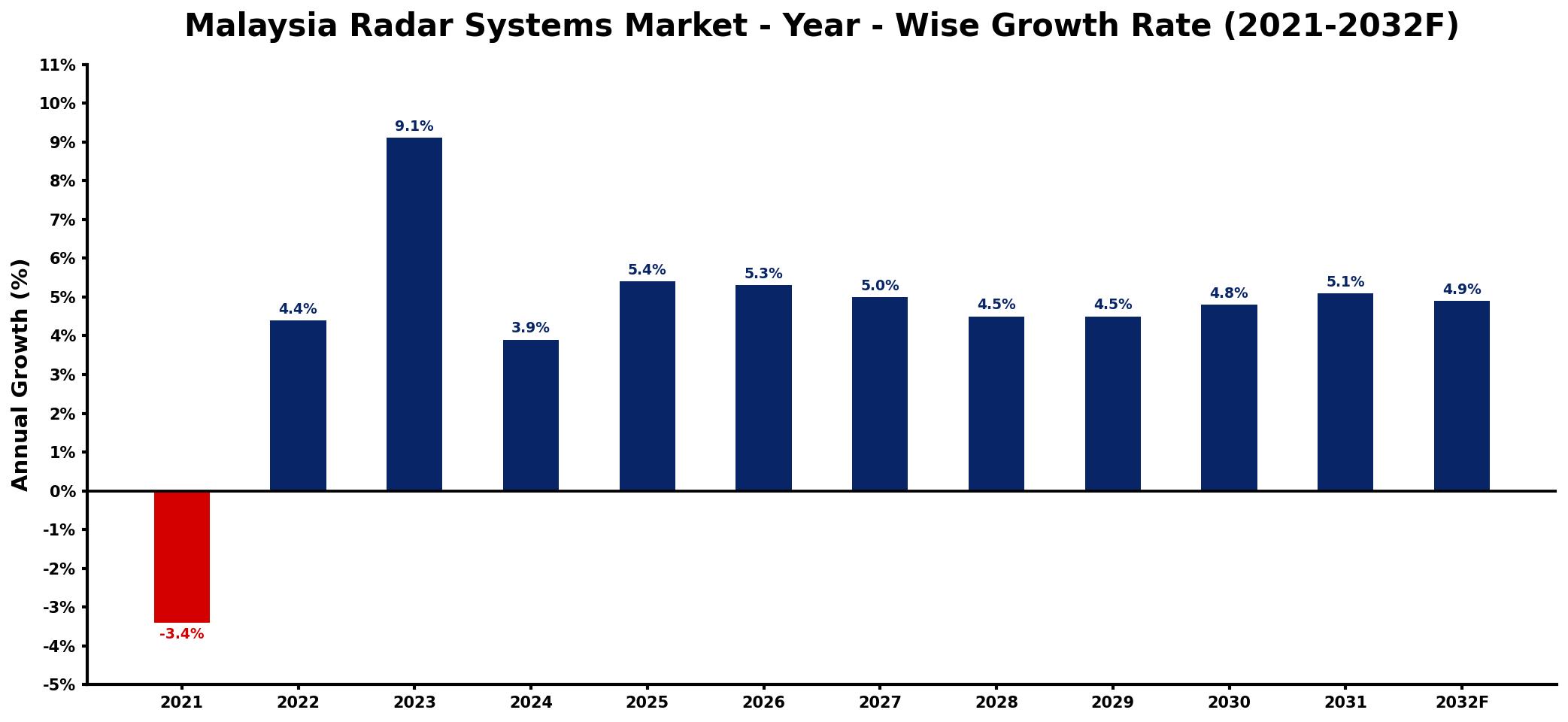
The table below presents the year‑wise growth rates along with the key drivers influencing the market
| Year | Growth Rate | Major Drivers |
| 2021 | -3.4% | decreased military spending on technology |
| 2022 | 4.4% | improved processing technologies adoption |
| 2023 | 9.1% | expansion of surveillance capabilities |
| 2024 | 3.9% | growing demand for air traffic |
| 2025 | 5.4% | rising investments in coastal security |
| 2026 | 5.3% | enhanced public safety initiatives |
| 2027 | 5.0% | boost in maritime security projects |
| 2028 | 4.5% | growing interest in environmental monitoring |
| 2029 | 4.5% | increased research funding for innovations |
| 2030 | 4.8% | growing automotive sector requirements |
| 2031 | 5.1% | rising demand for disaster management |
| 2032 | 4.9% | growing focus on urban development |
Note: Market size estimations and growth projections presented in this report are based on 6Wresearch's proprietary forecasting methodology, utilizing the latest available industry data, government publications, and primary research inputs.
Malaysia Radar Systems Market Synopsis
The most significant force shaping the Malaysia Radar Systems Market currently is the escalating demand for advanced radar technologies in defense and aviation sectors. As national security concerns intensify, investments in sophisticated surveillance and navigation systems are expected to rise, further propelling market growth.
Moreover, the maritime and meteorological sectors are also contributing to the market's expansion, as they increasingly rely on radar systems for accurate weather forecasting and effective vessel tracking. This multifaceted demand underscores the importance of radar systems in ensuring safety and efficiency across various domains.
Malaysia Radar Systems Market Key Takeaways
- The radar systems market in Malaysia is on an upward trajectory due to increased defense expenditures.
- Advancements in radar technology are enabling new applications across different sectors.
- Growing safety and security concerns are driving the need for enhanced surveillance systems.
- COVID-19's impact varied across sectors, maintaining stability in defense while challenging aviation.
- The expanding transportation sector further fuels demand for radar technologies.
Evaluation of Restraints in Malaysia Radar Systems Market
Despite the promising outlook for the Malaysia Radar Systems Market, several factors act as restraints. Key among these are budget constraints faced by defense and civil sectors, which can limit procurement capabilities. Furthermore, rapid advancements in radar technology necessitate continual investment, which can be challenging in the face of fluctuating economic conditions. These restraints, if not addressed, could hinder the potential growth of the market.
Malaysia Radar Systems Market Trends
The market is witnessing several transformative trends, including the integration of artificial intelligence and machine learning into radar systems, enhancing their capabilities for data analysis and real-time decision-making. Additionally, theres a growing emphasis on miniaturization and the development of multifunctional radar systems that cater to multiple applications. These trends reflect a significant shift towards more efficient and versatile radar solutions in Malaysia.
Malaysia Radar Systems Market Opportunities
Genuine growth opportunities within the Malaysia Radar Systems Market lie in the ongoing modernization of military capabilities and the advancement of smart city initiatives. The governments focus on enhancing infrastructure and urban safety creates a fertile ground for radar technologies. Moreover, as the maritime sector expands, opportunities for radar solutions in vessel tracking and port management are expected to increase significantly.
Government Initiatives in the Malaysia Radar Systems Market
The Malaysian government is actively investing in radar technology as part of its broader defense strategy and national security framework. Initiatives aimed at upgrading air traffic management systems and enhancing maritime surveillance capabilities are central to these efforts. Moreover, public spending on research and development in radar technology underscores the commitment to fostering innovation in the sector, enabling local manufacturers and suppliers to compete effectively on a global scale.
Future Insights of the Malaysia Radar Systems Market
Looking ahead to the period from 2026 to 2032, the Malaysia Radar Systems Market is expected to continue its upward trend, driven by both technological advancements and increasing security demands. As the government continues to prioritize defense and infrastructure, radar systems will increasingly be integrated into diverse applications, enhancing their strategic importance across the board. The focus on enhancing operational capabilities in defense, transportation, and civil applications promises a robust market landscape.
Malaysia Radar Systems Market Latest Developments (2025 - 2026)
In recent months, industry players have been ramping up efforts to develop next-generation radar solutions that leverage cutting-edge technologies such as AI and enhanced data analytics. Collaborations between public and private sectors have intensified, aiming to address specific national security needs and improve operational efficiency in aviation and maritime domains. This collaborative spirit is likely to yield significant advancements in radar capabilities and market offerings.
Malaysia Radar Systems Market - Key Attractiveness of the Report
- 10 Years of Market Numbers
- Historical Data Starting from 2022 to 2025
- Base Year: 2025
- Forecast Data until 2032
- Key Performance Indicators Impacting the Market
- Major Upcoming Developments and Projects
Key Highlights of the Report:
- Malaysia Radar Systems Market Outlook
- Market Size of Malaysia Radar Systems Market, 2025
- Forecast of Malaysia Radar Systems Market, 2032
- Historical Data and Forecast of Malaysia Radar Systems Revenues & Volume for the Period 2022-2032F
- Malaysia Radar Systems Market Trend Evolution
- Malaysia Radar Systems Market Drivers and Challenges
- Malaysia Radar Systems Price Trends
- Malaysia Radar Systems Porter's Five Forces
- Malaysia Radar Systems Industry Life Cycle
- Historical Data and Forecast of Malaysia Radar Systems Market Revenues & Volume By Type for the Period 2022-2032F
- Historical Data and Forecast of Malaysia Radar Systems Market Revenues & Volume By Continuous Wave RADAR Systems for the Period 2022-2032F
- Historical Data and Forecast of Malaysia Radar Systems Market Revenues & Volume By Pulsated Wave RADAR Systems for the Period 2022-2032F
- Historical Data and Forecast of Malaysia Radar Systems Market Revenues & Volume By Application for the Period 2022-2032F
- Historical Data and Forecast of Malaysia Radar Systems Market Revenues & Volume By Airborne for the Period 2022-2032F
- Historical Data and Forecast of Malaysia Radar Systems Market Revenues & Volume By Land-based for the Period 2022-2032F
- Historical Data and Forecast of Malaysia Radar Systems Market Revenues & Volume By Naval for the Period 2022-2032F
- Historical Data and Forecast of Malaysia Radar Systems Market Revenues & Volume By End-user Industry for the Period 2022-2032F
- Historical Data and Forecast of Malaysia Radar Systems Market Revenues & Volume By Aviation for the Period 2022-2032F
- Historical Data and Forecast of Malaysia Radar Systems Market Revenues & Volume By Maritime Applications for the Period 2022-2032F
- Historical Data and Forecast of Malaysia Radar Systems Market Revenues & Volume By Automotive for the Period 2022-2032F
- Historical Data and Forecast of Malaysia Radar Systems Market Revenues & Volume By Military & Defense for the Period 2022-2032F
- Malaysia Radar Systems Import Export Trade Statistics
- Market Opportunity Assessment By Type
- Market Opportunity Assessment By Application
- Market Opportunity Assessment By End-user Industry
- Malaysia Radar Systems Top Companies Market Share
- Malaysia Radar Systems Competitive Benchmarking By Technical and Operational Parameters
- Malaysia Radar Systems Company Profiles
- Malaysia Radar Systems Key Strategic Recommendations






































