Malaysia Refrigeration and Heating Equipment Market Summary
The malaysia refrigeration and heating equipment market was estimated at USD 438 Million in 2025 and is projected to reach USD 571 Million by 2032, growing at a CAGR of 5.5% from 2026 to 2032.
Malaysia Refrigeration and Heating Equipment Market Year-wise Growth Rate and Key Drivers
This graph highlights how the Malaysia Refrigeration and Heating Equipment Market has steadily grown over the past five years, supported by major growth factors.
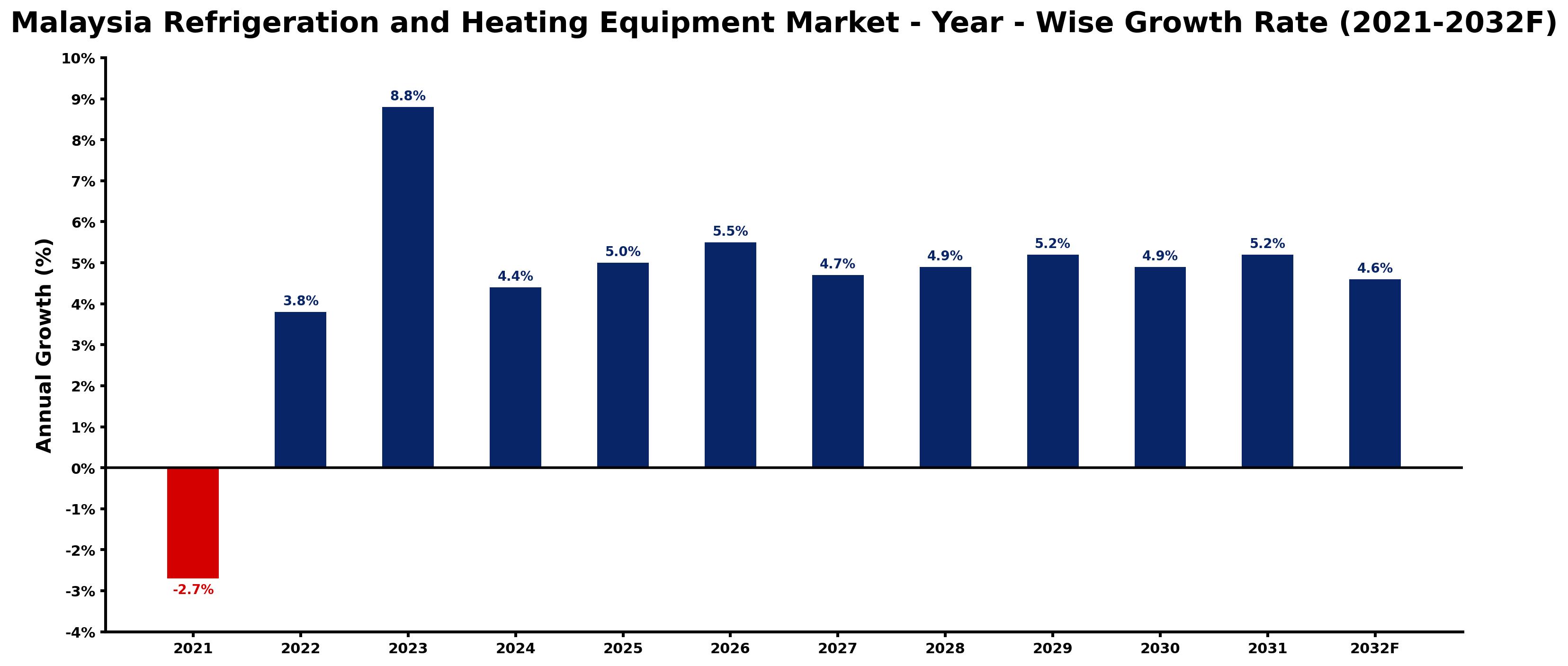
The table below presents the year wise growth rates along with the key drivers influencing the market
| Year | Growth Rate | Major Drivers |
| 2021 | -2.7% | Pandemicrelated disruptions severely hampered construction activities, leading to decreased demand for refrigeration and heating equipment. |
| 2022 | 3.8% | Manufacturers increasingly focused on energy-efficient products to meet local standards. |
| 2023 | 8.8% | Investment in smart home technology reshaped consumer expectations for HVAC systems. |
| 2024 | 4.4% | Urbanization trends influenced residential market demands for reliable cooling solutions. |
| 2025 | 5.0% | Climate change concerns accelerated the shift towards sustainable refrigeration methods. |
| 2026 | 5.5% | Construction activity surged as commercial projects increased demand for heating equipment. |
| 2027 | 4.7% | Local manufacturers began adopting innovative technologies to improve product efficiency. |
| 2028 | 4.9% | Growing awareness of indoor air quality propelled the demand for advanced HVAC systems. |
| 2029 | 5.2% | E-commerce platforms expanded, creating new distribution channels for refrigeration equipment. |
| 2030 | 4.9% | Government policies began emphasizing green technologies, impacting industry investment decisions. |
| 2031 | 5.2% | Consumer preference shifted towards integrated systems combining heating and cooling functionalities. |
| 2032 | 4.6% | Market consolidation increased as large players sought to enhance competitive advantages. |
Note - Market size estimations and growth projections presented in this report are based on 6Wresearch's advanced forecasting approach, validated with industry datasets as of June 2026.
Malaysia Refrigeration and Heating Equipment Market Synopsis
The Malaysia Refrigeration and Heating Equipment Market is projected to reach 5.5% and witness significant growth during the forecast period (2026-2032). This market is expected to grow at a compounded annual growth rate (CAGR) of 9.7%, driven by several key factors that influence both demand and innovation in the sector.
Malaysia Refrigeration and Heating Equipment Market Growth Drivers
Several compelling drivers are propelling the Malaysia Refrigeration and Heating Equipment Market forward. The following factors are particularly influential:
- The increasing emphasis on energy efficiency has led both consumers and industries to seek refrigeration and heating solutions that minimize energy consumption while maximizing output, contributing positively to market expansion.
- The burgeoning trend of supermarkets and hypermarkets has created a robust demand for advanced refrigeration systems to ensure food safety and quality, further accelerating market growth.
- Investments in the food processing industry are rising, encouraging the adoption of modern refrigeration technologies that support extensive supply chains and logistics.
- The hospitality sector in Malaysia is expanding rapidly, leading to enhanced demand for heating and cooling solutions that meet the needs of hotels, restaurants, and other service establishments.
- Technological advancements, particularly in air conditioning and heat pump technologies, present new growth avenues by offering innovative solutions tailored to the evolving market landscape.
Malaysia Refrigeration and Heating Equipment Market Trends and Opportunities
The Malaysia Refrigeration and Heating Equipment Market is witnessing a series of trends that are reshaping its future. These trends include:
- Adoption of smart and connected devices that enhance operational efficiency and enable remote monitoring, aligning with the digital transformation trends across many industries.
- A growing focus on sustainable technologies that not only reduce greenhouse gas emissions but also comply with stricter environmental regulations.
- Increased consumer preferences for products that demonstrate lower environmental impact, such as refrigerants with zero ozone depletion potential.
- Significant investments in research and development are leading to innovative solutions, such as modular refrigeration systems that offer flexibility and energy savings.
- The introduction of government incentives to support the adoption of eco-friendly technologies is expected to stimulate market growth further, encouraging innovation and investment.
Malaysia Refrigeration and Heating Equipment Market Challenges and Restraints
While the market shows promise, it also faces certain challenges that could hinder growth. These challenges include:
- High initial investment costs associated with the implementation of advanced refrigeration and heating systems can deter small businesses and startups from adopting modern solutions.
- The fluctuating prices of raw materials and components may impact the cost structures for manufacturers, affecting pricing strategies and market competitiveness.
- Environmental regulations may impose restrictions that require manufacturers to adapt quickly, which could result in increased operational costs.
- There exists a skill gap in the workforce which may limit the effective implementation and maintenance of advanced heating and refrigeration technologies.
- Seasonal variations in demand can lead to inconsistencies in revenue, creating challenges in inventory management and production planning.
Malaysia Refrigeration and Heating Equipment Market Government Investment and Initiatives
The Malaysian government has implemented various initiatives to support the refrigeration and heating equipment sector. These initiatives include significant public investments aimed at promoting energy efficiency and sustainability. Additionally, there is a strong push for the adoption of green building concepts, which align with global efforts to reduce carbon footprints. Programs encouraging the use of energy-efficient technologies in commercial buildings are also part of the government's agenda, fostering a favorable environment for market growth. Furthermore, collaboration with international bodies to develop and implement best practices in refrigeration technologies contributes to the enhancement of industry standards.
Malaysia Refrigeration and Heating Equipment Market Latest Developments (May 2025 - June 2026)
Recent developments within the Malaysia Refrigeration and Heating Equipment Market from May 2025 to June 2026 reflect a dynamic industry responding to both challenges and opportunities. The sector has seen a marked increase in investments towards innovative refrigeration technologies that focus on sustainability and energy efficiency. Furthermore, companies have been actively engaging in research collaborations to enhance product offerings. An uptick in government initiatives aimed at green technology adoption has also significantly influenced the market landscape. Additionally, there have been advancements in regulatory frameworks that encourage the integration of environmentally friendly refrigerants in both the residential and commercial segments.
Malaysia Refrigeration and Heating Equipment Market - Key Attractiveness of the Report
- 10 Years of Market Numbers
- Historical Data Starting from 2022 to 2025
- Base Year: 2025
- Forecast Data until 2032
- Key Performance Indicators Impacting the Market
- Major Upcoming Developments and Projects
Key Highlights of the Report:
- Malaysia Refrigeration and Heating Equipment Market Outlook
- Market Size of Malaysia Refrigeration and Heating Equipment Market, 2025
- Forecast of Malaysia Refrigeration and Heating Equipment Market, 2032
- Historical Data and Forecast of Malaysia Refrigeration and Heating Equipment Revenues & Volume for the Period 2022-2032F
- Malaysia Refrigeration and Heating Equipment Market Trend Evolution
- Malaysia Refrigeration and Heating Equipment Market Drivers and Challenges
- Malaysia Refrigeration and Heating Equipment Price Trends
- Malaysia Refrigeration and Heating Equipment Porter's Five Forces
- Malaysia Refrigeration and Heating Equipment Industry Life Cycle
- Historical Data and Forecast of Malaysia Refrigeration and Heating Equipment Market Revenues & Volume By Heating equipments for the Period 2022-2032F
- Historical Data and Forecast of Malaysia Refrigeration and Heating Equipment Market Revenues & Volume By Heating Pumps for the Period 2022-2032F
- Historical Data and Forecast of Malaysia Refrigeration and Heating Equipment Market Revenues & Volume By Furnaces for the Period 2022-2032F
- Historical Data and Forecast of Malaysia Refrigeration and Heating Equipment Market Revenues & Volume By Boilers for the Period 2022-2032F
- Historical Data and Forecast of Malaysia Refrigeration and Heating Equipment Market Revenues & Volume By Space heaters for the Period 2022-2032F
- Historical Data and Forecast of Malaysia Refrigeration and Heating Equipment Market Revenues & Volume By Unitary heaters for the Period 2022-2032F
- Historical Data and Forecast of Malaysia Refrigeration and Heating Equipment Market Revenues & Volume By Others for the Period 2022-2032F
- Historical Data and Forecast of Malaysia Refrigeration and Heating Equipment Market Revenues & Volume By Cooling Equipments for the Period 2022-2032F
- Historical Data and Forecast of Malaysia Refrigeration and Heating Equipment Market Revenues & Volume By Cooling towers for the Period 2022-2032F
- Historical Data and Forecast of Malaysia Refrigeration and Heating Equipment Market Revenues & Volume By Chillers for the Period 2022-2032F
- Historical Data and Forecast of Malaysia Refrigeration and Heating Equipment Market Revenues & Volume By Coolers for the Period 2022-2032F
- Historical Data and Forecast of Malaysia Refrigeration and Heating Equipment Market Revenues & Volume By Air conditioners for the Period 2022-2032F
- Historical Data and Forecast of Malaysia Refrigeration and Heating Equipment Market Revenues & Volume By Others for the Period 2022-2032F
- Historical Data and Forecast of Malaysia Refrigeration and Heating Equipment Market Revenues & Volume By General Components for the Period 2022-2032F
- Historical Data and Forecast of Malaysia Refrigeration and Heating Equipment Market Revenues & Volume By Condensers for the Period 2022-2032F
- Historical Data and Forecast of Malaysia Refrigeration and Heating Equipment Market Revenues & Volume By Compressors for the Period 2022-2032F
- Historical Data and Forecast of Malaysia Refrigeration and Heating Equipment Market Revenues & Volume By Radiators for the Period 2022-2032F
- Historical Data and Forecast of Malaysia Refrigeration and Heating Equipment Market Revenues & Volume By Sensors for the Period 2022-2032F
- Historical Data and Forecast of Malaysia Refrigeration and Heating Equipment Market Revenues & Volume By Transducers for the Period 2022-2032F
- Historical Data and Forecast of Malaysia Refrigeration and Heating Equipment Market Revenues & Volume By Others for the Period 2022-2032F
- Historical Data and Forecast of Malaysia Refrigeration and Heating Equipment Market Revenues & Volume By End-User Industries for the Period 2022-2032F
- Historical Data and Forecast of Malaysia Refrigeration and Heating Equipment Market Revenues & Volume By Residential for the Period 2022-2032F
- Historical Data and Forecast of Malaysia Refrigeration and Heating Equipment Market Revenues & Volume By Commercial for the Period 2022-2032F
- Historical Data and Forecast of Malaysia Refrigeration and Heating Equipment Market Revenues & Volume By Healthcare Industry for the Period 2022-2032F
- Historical Data and Forecast of Malaysia Refrigeration and Heating Equipment Market Revenues & Volume By Educational and government institutions for the Period 2022-2032F
- Historical Data and Forecast of Malaysia Refrigeration and Heating Equipment Market Revenues & Volume By Others for the Period 2022-2032F
- Malaysia Refrigeration and Heating Equipment Import Export Trade Statistics
- Market Opportunity Assessment By Heating equipments
- Market Opportunity Assessment By Cooling Equipments
- Market Opportunity Assessment By General Components
- Market Opportunity Assessment By End-User Industries
- Malaysia Refrigeration and Heating Equipment Top Companies Market Share
- Malaysia Refrigeration and Heating Equipment Competitive Benchmarking By Technical and Operational Parameters
- Malaysia Refrigeration and Heating Equipment Company Profiles
- Malaysia Refrigeration and Heating Equipment Key Strategic Recommendations






































