Malaysia Renewable Chemicals Market Size, Share & Growth Rate
The Malaysia Renewable Chemicals Market was estimated at USD 199 Million in 2025 and is projected to reach USD 260 Million by 2032, growing at a CAGR of 3.9% from 2026 to 2032. This growth is driven by a pronounced shift towards sustainable materials, alongside a burgeoning demand for bio-based alternatives across multiple industries, including agriculture and manufacturing. With Malaysias rich agricultural resources and an increasingly eco-conscious consumer base, the market is set to flourish in alignment with global sustainability trends.
Malaysia Renewable Chemicals Market Year-wise Growth Rate and Key Drivers
This graph highlights how the Malaysia Renewable Chemicals Market has steadily grown over the years, supported by major growth factors.
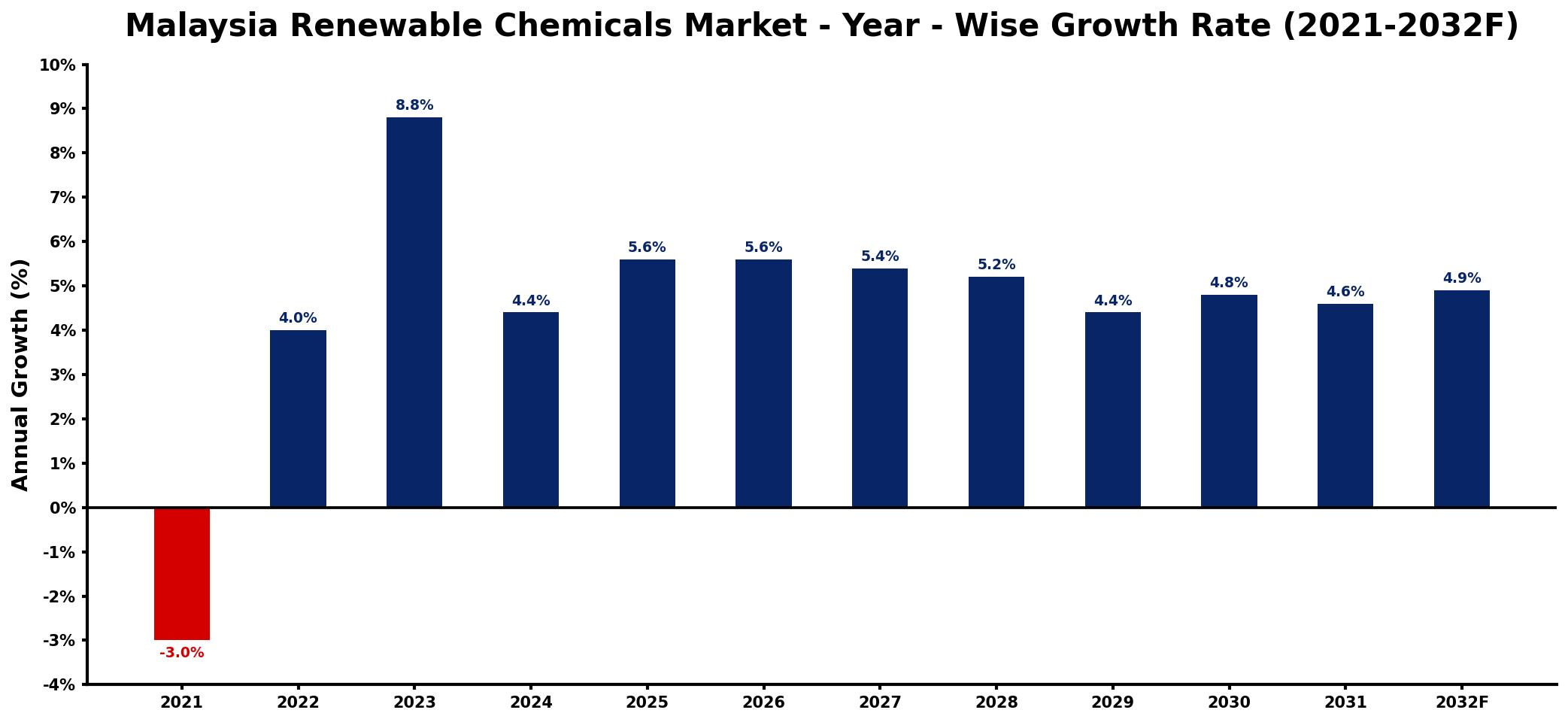
The table below presents the year‑wise growth rates along with the key drivers influencing the market
| Year | Growth Rate | Major Drivers |
| 2021 | -3.0% | decreased consumer interest in sustainability |
| 2022 | 4.0% | increased investment in green technologies |
| 2023 | 8.8% | growing demand for eco-friendly products |
| 2024 | 4.4% | expansion of sustainable manufacturing practices |
| 2025 | 5.6% | rising consumer awareness on sustainability |
| 2026 | 5.6% | enhanced government support for innovation |
| 2027 | 5.4% | broadened application in packaging solutions |
| 2028 | 5.2% | improved supply chain sustainability initiatives |
| 2029 | 4.4% | growing partnerships in circular economy |
| 2030 | 4.8% | improved processing technologies adoption |
| 2031 | 4.6% | growing automotive sector requirements |
| 2032 | 4.9% | rising demand for sustainable alternatives |
Note: Market size estimations and growth projections presented in this report are based on 6Wresearch's proprietary forecasting methodology, utilizing the latest available industry data, government publications, and primary research inputs.
Malaysia Renewable Chemicals Market Synopsis
The renewable chemicals market in Malaysia is at a critical juncture, moving from early momentum to significant potential for expansion. Government initiatives and a rising public awareness regarding the environmental impacts of conventional chemicals are shaping this landscape, positioning renewable chemicals as a viable alternative.
As the market transitions, a strong focus on biomass-derived products is expected to stimulate applications across various sectors, such as agriculture and food processing. The synergy of government support and the private sector's innovations marks a transformative phase that will likely redefine Malaysia's chemical industry in the years to come.
Malaysia Renewable Chemicals Market Key Takeaways
- The market is projected to grow from USD 199 Million in 2025 to USD 260 Million by 2032.
- Government initiatives are essential in fostering sustainable practices within the chemical industry.
- Increasing consumer awareness about environmental conservation is driving demand.
- Collaboration among various stakeholders is crucial to overcoming market entry barriers.
- Technological advancements in renewable feedstock processing enhance production efficiency.
Evaluation of Restraints in Malaysia Renewable Chemicals Market
Despite the promising outlook, the Malaysia Renewable Chemicals Market faces several constraints that could impede its growth. One notable challenge is the high research and development costs associated with developing new bio-based products. Additionally, the markets acceptance is hindered by the entrenched presence of conventional chemicals, which remain more cost-effective for manufacturers. The sector also grapples with competition from established chemical products, underscoring the need for comprehensive strategies to elevate market penetration and consumer trust in renewable alternatives.
Malaysia Renewable Chemicals Market Trends
A prominent trend shaping the Malaysia Renewable Chemicals Market is the increasing integration of sustainability across product life cycles. Companies are increasingly adopting circular economy principles, focusing on minimizing waste and maximizing resource efficiency. Furthermore, advancements in biotechnological processes are enhancing the yield and quality of renewable chemicals, making them more competitive with traditional options. There is also a noticeable rise in partnerships between research institutions and industry players aimed at accelerating innovation in renewable chemical applications.
Malaysia Renewable Chemicals Market Opportunities
Opportunities for growth in the Malaysia Renewable Chemicals Market are abundant, particularly in sectors like agriculture, packaging, and personal care products. With Malaysia's vast agricultural base, there is significant potential for leveraging local biomass resources for chemical production. Moreover, as industries worldwide pivot towards sustainable practices, the demand for renewable chemicals from Malaysian producers is expected to surge. Investing in technology and innovation to develop new, eco-friendly products can further enhance market competitiveness and align with global sustainability goals.
Government Initiatives in the Malaysia Renewable Chemicals Market
The Malaysian government has recognized the importance of the renewable chemicals sector as part of its broader environmental and economic strategy. Initiatives aimed at promoting sustainable practices include grants and funding for research in bio-based product development, as well as policies designed to support the adoption of renewable technologies in various industries. Public spending on infrastructure that encourages waste reduction and resource efficiency is also critical in facilitating growth in this burgeoning market.
Future Insights of the Malaysia Renewable Chemicals Market
Looking forward to the period between 2026 and 2032, the Malaysia Renewable Chemicals Market is anticipated to evolve dynamically. Continued government support and an increasing emphasis on sustainability by consumers and businesses will likely drive innovation and investment in this space. As more companies begin to align their practices with circular economy principles, we expect to see heightened collaboration across sectors. This collaborative approach will pave the way for advancements in production technologies and improved market acceptance of renewable chemical solutions.
Malaysia Renewable Chemicals Market Latest Developments (2025 - 2026)
Recent developments in the Malaysia Renewable Chemicals Market have illustrated a marked shift towards sustainable practices. Industry stakeholders are reporting increased partnerships aimed at advancing research in renewable materials. Additionally, several initiatives have emerged focusing on improving the supply chain for biomass resources, thereby enhancing production efficiency. The engagement of both government and private entities in fostering innovation is indicative of a commitment to growing this sector sustainably in the coming years.
Malaysia Renewable Chemicals Market - Key Attractiveness of the Report
- 10 Years of Market Numbers
- Historical Data Starting from 2022 to 2025
- Base Year: 2025
- Forecast Data until 2032
- Key Performance Indicators Impacting the Market
- Major Upcoming Developments and Projects
Key Highlights of the Report:
- Malaysia Renewable Chemicals Market Outlook
- Market Size of Malaysia Renewable Chemicals Market, 2025
- Forecast of Malaysia Renewable Chemicals Market, 2032
- Historical Data and Forecast of Malaysia Renewable Chemicals Revenues & Volume for the Period 2022-2032F
- Malaysia Renewable Chemicals Market Trend Evolution
- Malaysia Renewable Chemicals Market Drivers and Challenges
- Malaysia Renewable Chemicals Price Trends
- Malaysia Renewable Chemicals Porter's Five Forces
- Malaysia Renewable Chemicals Industry Life Cycle
- Historical Data and Forecast of Malaysia Renewable Chemicals Market Revenues & Volume By Product Type for the Period 2022-2032F
- Historical Data and Forecast of Malaysia Renewable Chemicals Market Revenues & Volume By Alcohols for the Period 2022-2032F
- Historical Data and Forecast of Malaysia Renewable Chemicals Market Revenues & Volume By Organic Acids for the Period 2022-2032F
- Historical Data and Forecast of Malaysia Renewable Chemicals Market Revenues & Volume By Ketones for the Period 2022-2032F
- Historical Data and Forecast of Malaysia Renewable Chemicals Market Revenues & Volume By Platform Chemicals for the Period 2022-2032F
- Historical Data and Forecast of Malaysia Renewable Chemicals Market Revenues & Volume By Biopolymers for the Period 2022-2032F
- Historical Data and Forecast of Malaysia Renewable Chemicals Market Revenues & Volume By Others for the Period 2022-2032F
- Historical Data and Forecast of Malaysia Renewable Chemicals Market Revenues & Volume By Applications for the Period 2022-2032F
- Historical Data and Forecast of Malaysia Renewable Chemicals Market Revenues & Volume By Transportation for the Period 2022-2032F
- Historical Data and Forecast of Malaysia Renewable Chemicals Market Revenues & Volume By Textiles for the Period 2022-2032F
- Historical Data and Forecast of Malaysia Renewable Chemicals Market Revenues & Volume By Food safety for the Period 2022-2032F
- Historical Data and Forecast of Malaysia Renewable Chemicals Market Revenues & Volume By Environment for the Period 2022-2032F
- Historical Data and Forecast of Malaysia Renewable Chemicals Market Revenues & Volume By Communication for the Period 2022-2032F
- Historical Data and Forecast of Malaysia Renewable Chemicals Market Revenues & Volume By Housing for the Period 2022-2032F
- Historical Data and Forecast of Malaysia Renewable Chemicals Market Revenues & Volume By Recreation for the Period 2022-2032F
- Historical Data and Forecast of Malaysia Renewable Chemicals Market Revenues & Volume By Other Applications for the Period 2022-2032F
- Malaysia Renewable Chemicals Import Export Trade Statistics
- Market Opportunity Assessment By Product Type
- Market Opportunity Assessment By Applications
- Malaysia Renewable Chemicals Top Companies Market Share
- Malaysia Renewable Chemicals Competitive Benchmarking By Technical and Operational Parameters
- Malaysia Renewable Chemicals Company Profiles
- Malaysia Renewable Chemicals Key Strategic Recommendations






































