Malaysia Residential Boiler Market Size, Share & Growth Rate
The Malaysia Residential Boiler Market was estimated at USD 164 Million in 2025 and is projected to reach USD 214 Million by 2032, growing at a CAGR of 3.9% from 2026 to 2032. This trajectory can be attributed to the growing demand for energy-efficient heating solutions as urbanization accelerates and lifestyles change. Additionally, the expanding middle-class population and government incentives for adopting sustainable technologies are further fueling this growth.
Malaysia Residential Boiler Market Year-wise Growth Rate and Key Drivers
This graph highlights how the Malaysia Residential Boiler Market has steadily grown over the years, supported by major growth factors.
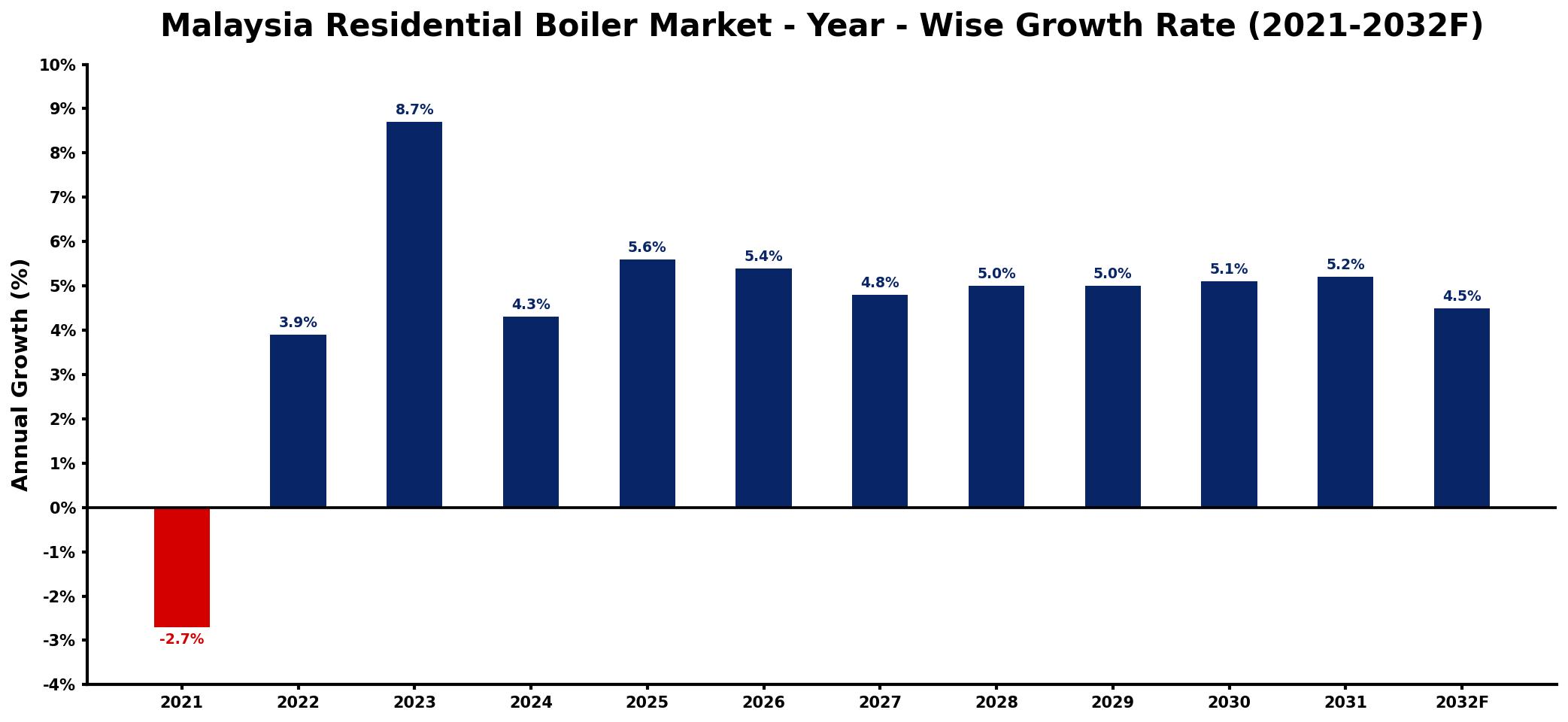
The table below presents the year‑wise growth rates along with the key drivers influencing the market
| Year | Growth Rate | Major Drivers |
| 2021 | -2.7% | decreased consumer spending on infrastructure |
| 2022 | 3.9% | increased investment in energy efficiency |
| 2023 | 8.7% | growing environmental sustainability initiatives |
| 2024 | 4.3% | expansion of housing construction projects |
| 2025 | 5.6% | rising demand for smart technologies |
| 2026 | 5.4% | enhanced government energy policies |
| 2027 | 4.8% | growing awareness of energy costs |
| 2028 | 5.0% | increased focus on renewable energy |
| 2029 | 5.0% | expanding healthcare application demand |
| 2030 | 5.1% | strengthening international trade flows |
| 2031 | 5.2% | growing interest in modernization upgrades |
| 2032 | 4.5% | improved processing technologies adoption |
Note: Market size estimations and growth projections presented in this report are based on 6Wresearch's proprietary forecasting methodology, utilizing the latest available industry data, government publications, and primary research inputs.
Malaysia Residential Boiler Market Synopsis
The current driving force in the Malaysia Residential Boiler Market is the increasing emphasis on energy efficiency. As households seek to reduce energy consumption and lower utility costs, there is a significant shift towards eco-friendly boiler options that promise both sustainability and comfort.
Urbanization continues to reshape the landscape, leading to a heightened demand for reliable heating systems in residential sectors. Alongside this, the government is actively promoting the integration of energy-efficient technologies, thereby laying the foundation for robust market growth in the years to come.
Malaysia Residential Boiler Market Key Takeaways
- Steady growth driven by increasing urbanization and a focus on energy efficiency.
- Government incentives are fostering the adoption of eco-friendly boiler technologies.
- Market recovery is anticipated post-COVID-19, with a renewed interest in residential heating solutions.
- Fluctuating fuel prices pose a challenge to consistent growth in the sector.
- The rising middle class is contributing to the increasing demand for modern heating solutions.
Evaluation of Restraints in Malaysia Residential Boiler Market
While the market outlook remains positive, several factors may act as restraints on growth. Fluctuating fuel prices can impact consumer purchasing decisions, leading to uncertainty in investment in new boiler systems. Furthermore, the need for continuous technological advancements requires manufacturers to invest in research and development, which can strain resources. The integration of new technologies must be balanced with cost-effectiveness to appeal to budget-conscious consumers.
Malaysia Residential Boiler Market Trends
Emerging trends in the Malaysia Residential Boiler Market indicate a significant shift towards smart heating solutions. With the rise of IoT technology, homeowners are increasingly opting for smart boilers that offer enhanced efficiency and connectivity. Additionally, the demand for hybrid systems that utilize both gas and renewable energy sources is on the rise. As environmental consciousness grows, so too does the interest in sustainable boiler options that reduce carbon footprints while providing effective heating solutions.
Malaysia Residential Boiler Market Opportunities
Opportunities for growth in the Malaysia Residential Boiler Market lie primarily in the development of advanced and energy-efficient boiler technologies. With a focus on sustainability, manufacturers can invest in products that not only comply with environmental regulations but also meet the increasing consumer demand for greener solutions. Furthermore, as urban areas continue to expand, there is a significant opportunity for product offerings tailored to the specific needs of dense residential communities.
Government Initiatives in the Malaysia Residential Boiler Market
The Malaysian government is actively promoting energy efficiency and sustainability through various initiatives aimed at residential heating solutions. Incentive programs encourage homeowners to invest in energy-efficient appliances, contributing to the overall market growth. Additionally, public spending on infrastructure projects includes a focus on energy-efficient residential developments, further reinforcing the adoption of advanced heating technologies.
Future Insights of the Malaysia Residential Boiler Market
Looking ahead to 2026-2032, the Malaysia Residential Boiler Market is poised for continued growth driven by ongoing urbanization and technological advancements. The integration of renewable energy sources and government backing for eco-friendly products will likely dominate market strategies. As consumer awareness of energy efficiency increases, manufacturers who prioritize innovation and sustainability will thrive, positioning themselves favorably in this evolving landscape.
Malaysia Residential Boiler Market Latest Developments (2025 - 2026)
Recent developments in the Malaysia Residential Boiler Market reflect a shift towards advanced technologies and energy-efficient solutions. Industry stakeholders are increasingly focusing on product innovations that incorporate smart features and eco-friendly designs. Additionally, collaborations between manufacturers and technology firms are emerging, aimed at enhancing boiler efficiency and consumer experience. This direction indicates a clear commitment to sustainability and market adaptation.
Malaysia Residential Boiler Market - Key Attractiveness of the Report
- 10 Years of Market Numbers
- Historical Data Starting from 2022 to 2025
- Base Year: 2025
- Forecast Data until 2032
- Key Performance Indicators Impacting the Market
- Major Upcoming Developments and Projects
Key Highlights of the Report:
- Malaysia Residential Boiler Market Outlook
- Market Size of Malaysia Residential Boiler Market, 2025
- Forecast of Malaysia Residential Boiler Market, 2032
- Historical Data and Forecast of Malaysia Residential Boiler Revenues & Volume for the Period 2022-2032F
- Malaysia Residential Boiler Market Trend Evolution
- Malaysia Residential Boiler Market Drivers and Challenges
- Malaysia Residential Boiler Price Trends
- Malaysia Residential Boiler Porter's Five Forces
- Malaysia Residential Boiler Industry Life Cycle
- Historical Data and Forecast of Malaysia Residential Boiler Market Revenues & Volume By Type for the Period 2022-2032F
- Historical Data and Forecast of Malaysia Residential Boiler Market Revenues & Volume By Water Tube Boiler for the Period 2022-2032F
- Historical Data and Forecast of Malaysia Residential Boiler Market Revenues & Volume By Fire Tube Boiler for the Period 2022-2032F
- Historical Data and Forecast of Malaysia Residential Boiler Market Revenues & Volume By Electric Boiler for the Period 2022-2032F
- Historical Data and Forecast of Malaysia Residential Boiler Market Revenues & Volume By Fuel Type for the Period 2022-2032F
- Historical Data and Forecast of Malaysia Residential Boiler Market Revenues & Volume By Coal Fired for the Period 2022-2032F
- Historical Data and Forecast of Malaysia Residential Boiler Market Revenues & Volume By Oil Fired for the Period 2022-2032F
- Historical Data and Forecast of Malaysia Residential Boiler Market Revenues & Volume By Gas Fired for the Period 2022-2032F
- Historical Data and Forecast of Malaysia Residential Boiler Market Revenues & Volume By Others for the Period 2022-2032F
- Historical Data and Forecast of Malaysia Residential Boiler Market Revenues & Volume By Technology for the Period 2022-2032F
- Historical Data and Forecast of Malaysia Residential Boiler Market Revenues & Volume By Condensing for the Period 2022-2032F
- Historical Data and Forecast of Malaysia Residential Boiler Market Revenues & Volume By Non-condensing for the Period 2022-2032F
- Malaysia Residential Boiler Import Export Trade Statistics
- Market Opportunity Assessment By Type
- Market Opportunity Assessment By Fuel Type
- Market Opportunity Assessment By Technology
- Malaysia Residential Boiler Top Companies Market Share
- Malaysia Residential Boiler Competitive Benchmarking By Technical and Operational Parameters
- Malaysia Residential Boiler Company Profiles
- Malaysia Residential Boiler Key Strategic Recommendations






































