Malaysia Seafood Processing Market Size, Share & Growth Rate
The Malaysia Seafood Processing Market was estimated at USD 189 Million in 2025 and is projected to reach USD 247 Million by 2032, growing at a CAGR of 3.9% from 2026 to 2032. This growth trajectory is underpinned by the increasing consumer preference for convenience-driven, processed seafood products, alongside advancements in processing technologies. As domestic and international demand rises, the market is set to benefit significantly from Malaysia's rich marine resources and a robust export outlook.
Malaysia Seafood Processing Market Year-wise Growth Rate and Key Drivers
This graph highlights how the Malaysia Seafood Processing Market has steadily grown over the years, supported by major growth factors.
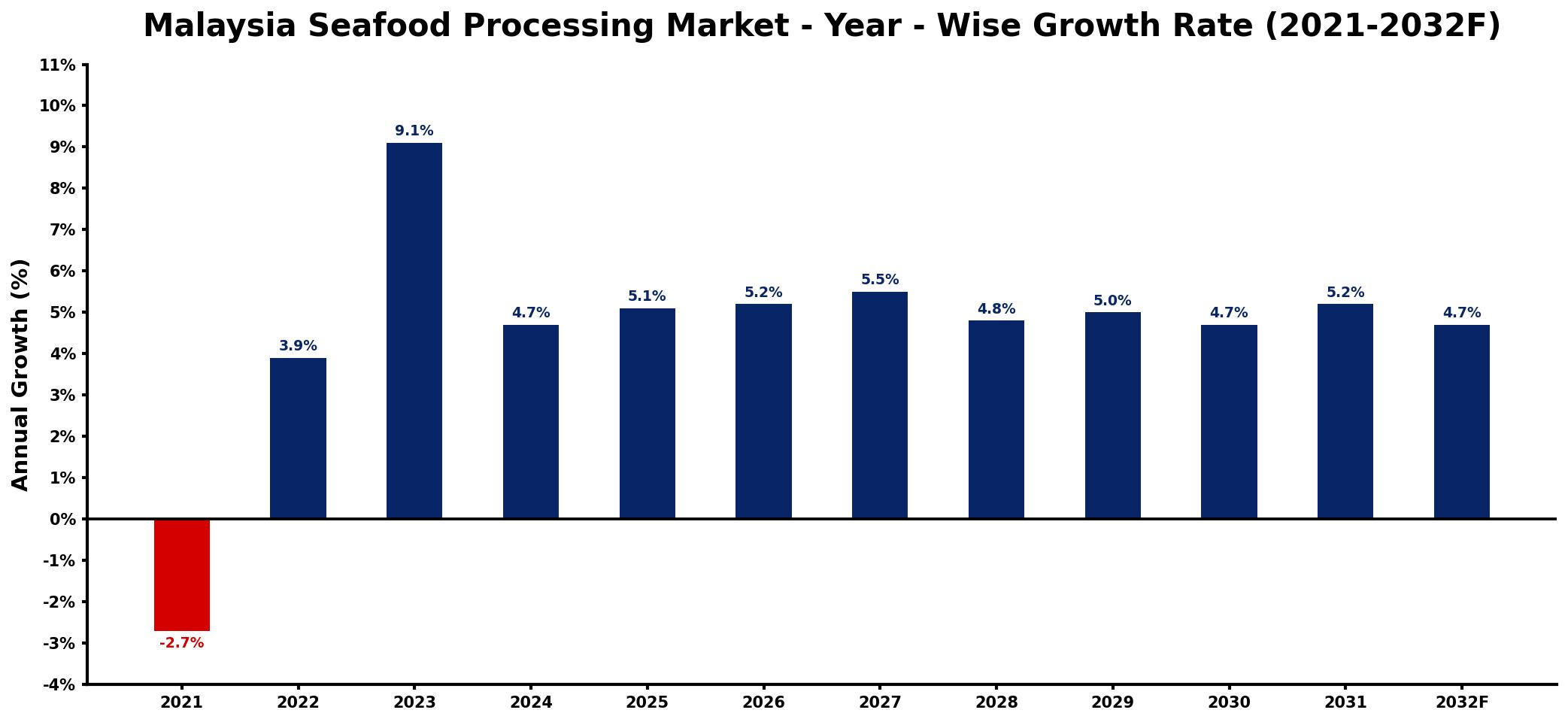
The table below presents the year‑wise growth rates along with the key drivers influencing the market
| Year | Growth Rate | Major Drivers |
| 2021 | -2.7% | decrease in consumer spending power |
| 2022 | 3.9% | rising demand for healthy options |
| 2023 | 9.1% | expansion of export markets |
| 2024 | 4.7% | increased investments in technology |
| 2025 | 5.1% | growing popularity of sustainability |
| 2026 | 5.2% | enhanced distribution network efficiency |
| 2027 | 5.5% | development of new product lines |
| 2028 | 4.8% | greater focus on food safety |
| 2029 | 5.0% | increased collaboration with suppliers |
| 2030 | 4.7% | improved raw material availability |
| 2031 | 5.2% | growing consumer awareness campaigns |
| 2032 | 4.7% | rising interest in premium offerings |
Note: Market size estimations and growth projections presented in this report are based on 6Wresearch's proprietary forecasting methodology, utilizing the latest available industry data, government publications, and primary research inputs.
Malaysia Seafood Processing Market Synopsis
In recent years, Malaysia's seafood processing industry has gained momentum, driven by the rising trend of home cooking and the demand for high-quality processed seafood. The market is at a pivotal point, transitioning towards greater innovation and value addition, setting the stage for sustainable growth in the coming years.
Looking ahead, the Malaysia Seafood Processing Market is expected to evolve significantly, capitalizing on technological advancements and changing consumer habits. With a diverse array of seafood species available locally, processors are well-positioned to introduce new and innovative products that cater to both domestic and international markets.
Malaysia Seafood Processing Market Key Takeaways
- The market is expected to witness a steady growth rate of 3.9% from 2026 to 2032.
- Innovative processing methods are becoming central to meeting consumer demand for quality and safety.
- The increase in home cooking trends during the pandemic is shaping consumer preferences.
- Malaysia's vast marine resources offer a competitive advantage for product diversification.
- Investment in technology will enhance product quality and operational efficiency across the sector.
Evaluation of Restraints in Malaysia Seafood Processing Market
Despite the promising growth prospects, the Malaysia Seafood Processing Market faces several constraints that could limit its potential. A critical challenge is sourcing raw materials in the face of fluctuating market demands. Additionally, strict adherence to quality and safety regulations poses ongoing pressures for processors, who must continually adapt to ensure compliance. Variations in consumer preferences and market dynamics further complicate the landscape, compelling stakeholders to be agile in their strategies.
Malaysia Seafood Processing Market Trends
Several key trends are currently shaping the Malaysia Seafood Processing Market. An emphasis on sustainability is emerging, with consumers increasingly preferring seafood sourced from responsible practices. Additionally, the rise of e-commerce platforms is facilitating greater accessibility to processed seafood products, particularly among urban dwellers. There is also a growing interest in value-added products, such as pre-marinated seafood and ready-to-cook options, which cater to the fast-paced lifestyles of modern consumers.
Malaysia Seafood Processing Market Opportunities
Opportunities for growth within the Malaysia Seafood Processing Market are abundant. The rising export demand for processed seafood products presents a significant avenue for expansion. Moreover, investment in innovative processing techniques can yield a diverse array of value-added products that appeal to both local and international markets. As health consciousness among consumers continues to rise, there is an opportunity to develop healthier, nutrient-rich options, further driving market growth.
Government Initiatives in the Malaysia Seafood Processing Market
The Malaysian government is actively promoting the seafood processing sector through various initiatives aimed at enhancing industry standards and increasing exports. Policies focusing on improving the supply chain, providing financial incentives for technology adoption, and supporting research and development are pivotal in driving growth. Additionally, government programs to promote sustainable fishing practices help ensure the long-term viability of marine resources, which is essential for the industry's success.
Future Insights of the Malaysia Seafood Processing Market
Looking toward 2026-2032, the Malaysia Seafood Processing Market is likely to undergo significant transformation. As processors embrace advanced technologies and innovative product offerings, the industry is poised for substantial growth. The trend of health-conscious eating will continue to influence consumer behavior, prompting the introduction of healthier alternatives. Additionally, as global demand for seafood products increases, Malaysia's strategic geographic location will play a vital role in positioning its seafood processing sector as a leader in the regional market.
Malaysia Seafood Processing Market Latest Developments (2025 - 2026)
Recent developments within the Malaysia Seafood Processing Market highlight a shift towards more sustainable practices. Companies are increasingly investing in state-of-the-art technologies to enhance processing efficiency and product quality. Furthermore, there is a marked increase in partnerships between local processors and international distributors, aimed at expanding market reach and improving competitiveness. The focus on consumer education regarding sustainable seafood is also gaining traction, which may foster greater trust and demand in the coming years.
Malaysia Seafood Processing Market - Key Attractiveness of the Report
- 10 Years of Market Numbers
- Historical Data Starting from 2022 to 2025
- Base Year: 2025
- Forecast Data until 2032
- Key Performance Indicators Impacting the Market
- Major Upcoming Developments and Projects
Key Highlights of the Report:
- Malaysia Seafood Processing Market Outlook
- Market Size of Malaysia Seafood Processing Market, 2025
- Forecast of Malaysia Seafood Processing Market, 2032
- Historical Data and Forecast of Malaysia Seafood Processing Revenues & Volume for the Period 2022-2032F
- Malaysia Seafood Processing Market Trend Evolution
- Malaysia Seafood Processing Market Drivers and Challenges
- Malaysia Seafood Processing Price Trends
- Malaysia Seafood Processing Porter's Five Forces
- Malaysia Seafood Processing Industry Life Cycle
- Historical Data and Forecast of Malaysia Seafood Processing Market Revenues & Volume By Equipment Type for the Period 2022-2032F
- Historical Data and Forecast of Malaysia Seafood Processing Market Revenues & Volume By Gutting Equipment for the Period 2022-2032F
- Historical Data and Forecast of Malaysia Seafood Processing Market Revenues & Volume By Sealing Equipment for the Period 2022-2032F
- Historical Data and Forecast of Malaysia Seafood Processing Market Revenues & Volume By Filleting Equipment for the Period 2022-2032F
- Historical Data and Forecast of Malaysia Seafood Processing Market Revenues & Volume By Deboning Equipment for the Period 2022-2032F
- Historical Data and Forecast of Malaysia Seafood Processing Market Revenues & Volume By other Equipment for the Period 2022-2032F
- Historical Data and Forecast of Malaysia Seafood Processing Market Revenues & Volume By Category for the Period 2022-2032F
- Historical Data and Forecast of Malaysia Seafood Processing Market Revenues & Volume By Single-Function Equipment for the Period 2022-2032F
- Historical Data and Forecast of Malaysia Seafood Processing Market Revenues & Volume By Multi-Function Equipment for the Period 2022-2032F
- Historical Data and Forecast of Malaysia Seafood Processing Market Revenues & Volume By Seafood Type for the Period 2022-2032F
- Historical Data and Forecast of Malaysia Seafood Processing Market Revenues & Volume By Fish for the Period 2022-2032F
- Historical Data and Forecast of Malaysia Seafood Processing Market Revenues & Volume By Crustaceans for the Period 2022-2032F
- Historical Data and Forecast of Malaysia Seafood Processing Market Revenues & Volume By Mollusks for the Period 2022-2032F
- Historical Data and Forecast of Malaysia Seafood Processing Market Revenues & Volume By others for the Period 2022-2032F
- Malaysia Seafood Processing Import Export Trade Statistics
- Market Opportunity Assessment By Equipment Type
- Market Opportunity Assessment By Category
- Market Opportunity Assessment By Seafood Type
- Malaysia Seafood Processing Top Companies Market Share
- Malaysia Seafood Processing Competitive Benchmarking By Technical and Operational Parameters
- Malaysia Seafood Processing Company Profiles
- Malaysia Seafood Processing Key Strategic Recommendations






































