Malaysia Semiconductor Foundry Market Size, Share & Growth Rate
The Malaysia Semiconductor Foundry Market was estimated at USD 475 Million in 2025 and is projected to reach USD 614 Million by 2032, growing at a CAGR of 3.7% from 2026 to 2032. This trajectory is driven by robust demand for advanced electronics, especially in smartphones and IoT devices, alongside Malaysia's strategic geographical advantages that bolster its appeal as a manufacturing hub. Government-backed initiatives and multinational investments further energize this burgeoning sector.
Malaysia Semiconductor Foundry Market Year-wise Growth Rate and Key Drivers
This graph highlights how the Malaysia Semiconductor Foundry Market has steadily grown over the years, supported by major growth factors.
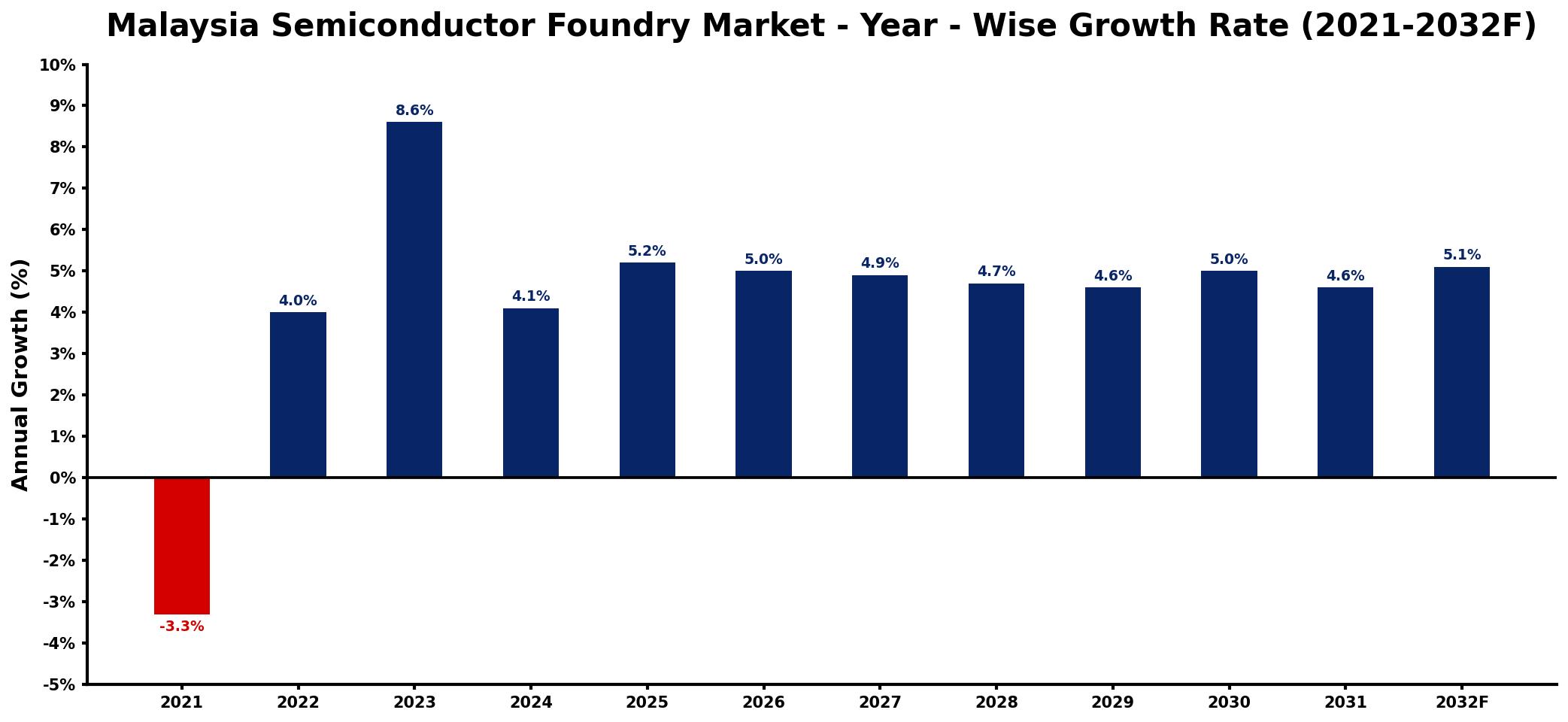
The table below presents the year‑wise growth rates along with the key drivers influencing the market
| Year | Growth Rate | Major Drivers |
| 2021 | -3.3% | decreased demand from automotive sector |
| 2022 | 4.0% | increased investment in technology infrastructure |
| 2023 | 8.6% | growing consumer electronics market demand |
| 2024 | 4.1% | expansion of renewable energy applications |
| 2025 | 5.2% | rise in artificial intelligence adoption |
| 2026 | 5.0% | enhanced telecommunications network investments |
| 2027 | 4.9% | boost in electric vehicle production |
| 2028 | 4.7% | increased demand for IoT devices |
| 2029 | 4.6% | growing healthcare technology applications |
| 2030 | 5.0% | growing regional consumption patterns |
| 2031 | 4.6% | increased focus on smart manufacturing |
| 2032 | 5.1% | growth in data center requirements |
Note: Market size estimations and growth projections presented in this report are based on 6Wresearch's proprietary forecasting methodology, utilizing the latest available industry data, government publications, and primary research inputs.
Malaysia Semiconductor Foundry Market Synopsis
The Malaysian semiconductor foundry market thrives within an established electronics manufacturing ecosystem, which is supported by a well-trained workforce and superior infrastructure. Local companies are increasingly tapping into the global supply chain, leveraging the countrys strengths in integrated circuit production.
Driven by significant demand from both domestic and international markets, Malaysia is rapidly becoming a pivotal player in semiconductor manufacturing. The governments commitment to advancing the industry, alongside investments from global tech firms, is fostering an environment ripe for innovation and growth.
Malaysia Semiconductor Foundry Market Key Takeaways
- The market is underpinned by increasing global demand for electronic devices.
- Malaysia's strategic location in the Asia-Pacific enhances its attractiveness for semiconductor production.
- Investment in R&D is crucial to maintaining competitiveness in the global landscape.
- Government initiatives are catalyzing growth in the semiconductor industry.
- Market players are adapting to technological changes to harness new opportunities.
Evaluation of Restraints in Malaysia Semiconductor Foundry Market
Despite the promising landscape, the Malaysia semiconductor foundry market faces certain restraints that could hinder its growth trajectory. One significant challenge is the need for continuous technological advancements, requiring substantial investment in research and development. Additionally, companies must navigate the complexities of global supply chain disruptions, which have been exacerbated by recent world events. To stay competitive, stakeholders must prioritize innovation and efficiency while addressing these external pressures.
Malaysia Semiconductor Foundry Market Trends
Several trends are currently shaping the Malaysia semiconductor foundry market. The rise of IoT devices is driving the need for smaller, more efficient semiconductors. Furthermore, advancements in chip design are prompting foundries to adopt cutting-edge manufacturing technologies such as advanced packaging and system-on-chip solutions. Increased focus on sustainability is also leading to the integration of eco-friendly practices within manufacturing processes, positioning companies as responsible market participants.
Malaysia Semiconductor Foundry Market Opportunities
Opportunities in the Malaysia semiconductor foundry market are ripe for the taking. With the relentless growth of electric vehicles and autonomous systems, there is an expanding demand for specialized chips. Moreover, tapping into the burgeoning 5G infrastructure can provide substantial new business avenues for local foundries. The ongoing globalization of supply chains presents openings for Malaysian companies to expand their reach and forge strategic partnerships with overseas firms, enhancing their competitive edge.
Government Initiatives in the Malaysia Semiconductor Foundry Market
The Malaysian government is actively supporting the semiconductor foundry sector through various initiatives aimed at fostering industry growth. Policies encouraging foreign direct investment, along with tax incentives and grants for research and development, are designed to attract multinational companies. Public spending on infrastructure improvements is also contributing to the sector's overall robustness, ensuring that Malaysia remains a key player in the global semiconductor landscape.
Future Insights of the Malaysia Semiconductor Foundry Market
Looking ahead to 2026-2032, the Malaysia semiconductor foundry market is positioned for steady growth as the demand for advanced electronics continues to surge. Innovations in semiconductor technology will likely redefine production processes, while ongoing government support will provide the framework necessary for sustainable expansion. As manufacturers increasingly prioritize agility and efficiency, Malaysian foundries are expected to play a pivotal role in the evolution of global supply chains.
Malaysia Semiconductor Foundry Market Latest Developments (2025 - 2026)
Recent developments within the Malaysian semiconductor foundry market reflect a commitment to innovation and adaptation. The industry is seeing an influx of partnerships aimed at advancing technology and improving manufacturing capabilities. Additionally, local foundries are responding to increased global demand with expanded production capacities, indicating a proactive approach to seizing market opportunities and enhancing their global footprint.
Malaysia Semiconductor Foundry Market - Key Attractiveness of the Report
- 10 Years of Market Numbers
- Historical Data Starting from 2022 to 2025
- Base Year: 2025
- Forecast Data until 2032
- Key Performance Indicators Impacting the Market
- Major Upcoming Developments and Projects
Key Highlights of the Report:
- Malaysia Semiconductor Foundry Market Outlook
- Market Size of Malaysia Semiconductor Foundry Market, 2025
- Forecast of Malaysia Semiconductor Foundry Market, 2032
- Historical Data and Forecast of Malaysia Semiconductor Foundry Revenues & Volume for the Period 2022-2032F
- Malaysia Semiconductor Foundry Market Trend Evolution
- Malaysia Semiconductor Foundry Market Drivers and Challenges
- Malaysia Semiconductor Foundry Price Trends
- Malaysia Semiconductor Foundry Porter's Five Forces
- Malaysia Semiconductor Foundry Industry Life Cycle
- Historical Data and Forecast of Malaysia Semiconductor Foundry Market Revenues & Volume By Technology Node for the Period 2022-2032F
- Historical Data and Forecast of Malaysia Semiconductor Foundry Market Revenues & Volume By 10/7/5 nm for the Period 2022-2032F
- Historical Data and Forecast of Malaysia Semiconductor Foundry Market Revenues & Volume By 16/14 nm for the Period 2022-2032F
- Historical Data and Forecast of Malaysia Semiconductor Foundry Market Revenues & Volume By 20 nm for the Period 2022-2032F
- Historical Data and Forecast of Malaysia Semiconductor Foundry Market Revenues & Volume By 28 nm for the Period 2022-2032F
- Historical Data and Forecast of Malaysia Semiconductor Foundry Market Revenues & Volume By 45/40 nm for the Period 2022-2032F
- Historical Data and Forecast of Malaysia Semiconductor Foundry Market Revenues & Volume By 65 nm for the Period 2022-2032F
- Historical Data and Forecast of Malaysia Semiconductor Foundry Market Revenues & Volume By Other for the Period 2022-2032F
- Historical Data and Forecast of Malaysia Semiconductor Foundry Market Revenues & Volume By Application for the Period 2022-2032F
- Historical Data and Forecast of Malaysia Semiconductor Foundry Market Revenues & Volume By Consumer Electronics and Communication for the Period 2022-2032F
- Historical Data and Forecast of Malaysia Semiconductor Foundry Market Revenues & Volume By Automotive for the Period 2022-2032F
- Historical Data and Forecast of Malaysia Semiconductor Foundry Market Revenues & Volume By Industrial for the Period 2022-2032F
- Historical Data and Forecast of Malaysia Semiconductor Foundry Market Revenues & Volume By HPC for the Period 2022-2032F
- Historical Data and Forecast of Malaysia Semiconductor Foundry Market Revenues & Volume By Other Applications for the Period 2022-2032F
- Malaysia Semiconductor Foundry Import Export Trade Statistics
- Market Opportunity Assessment By Technology Node
- Market Opportunity Assessment By Application
- Malaysia Semiconductor Foundry Top Companies Market Share
- Malaysia Semiconductor Foundry Competitive Benchmarking By Technical and Operational Parameters
- Malaysia Semiconductor Foundry Company Profiles
- Malaysia Semiconductor Foundry Key Strategic Recommendations






































