Malaysia Stainless Steel Wire Rods Market Size, Share & Growth Rate
The Malaysia Stainless Steel Wire Rods Market was estimated at USD 1012 Million in 2025 and is projected to reach USD 1518 Million by 2032, growing at a CAGR of 6.0% from 2026 to 2032. This upward trajectory is largely propelled by the rapid expansion of the construction and automotive industries, where stainless steels inherent properties, such as corrosion resistance and high tensile strength, are increasingly in demand. As urbanization continues to accelerate in Malaysia, the need for durable and reliable materials will further enhance the market's prospects.
Malaysia Stainless Steel Wire Rods Market Year-wise Growth Rate and Key Drivers
This graph highlights how the Malaysia Stainless Steel Wire Rods Market has steadily grown over the years, supported by major growth factors.
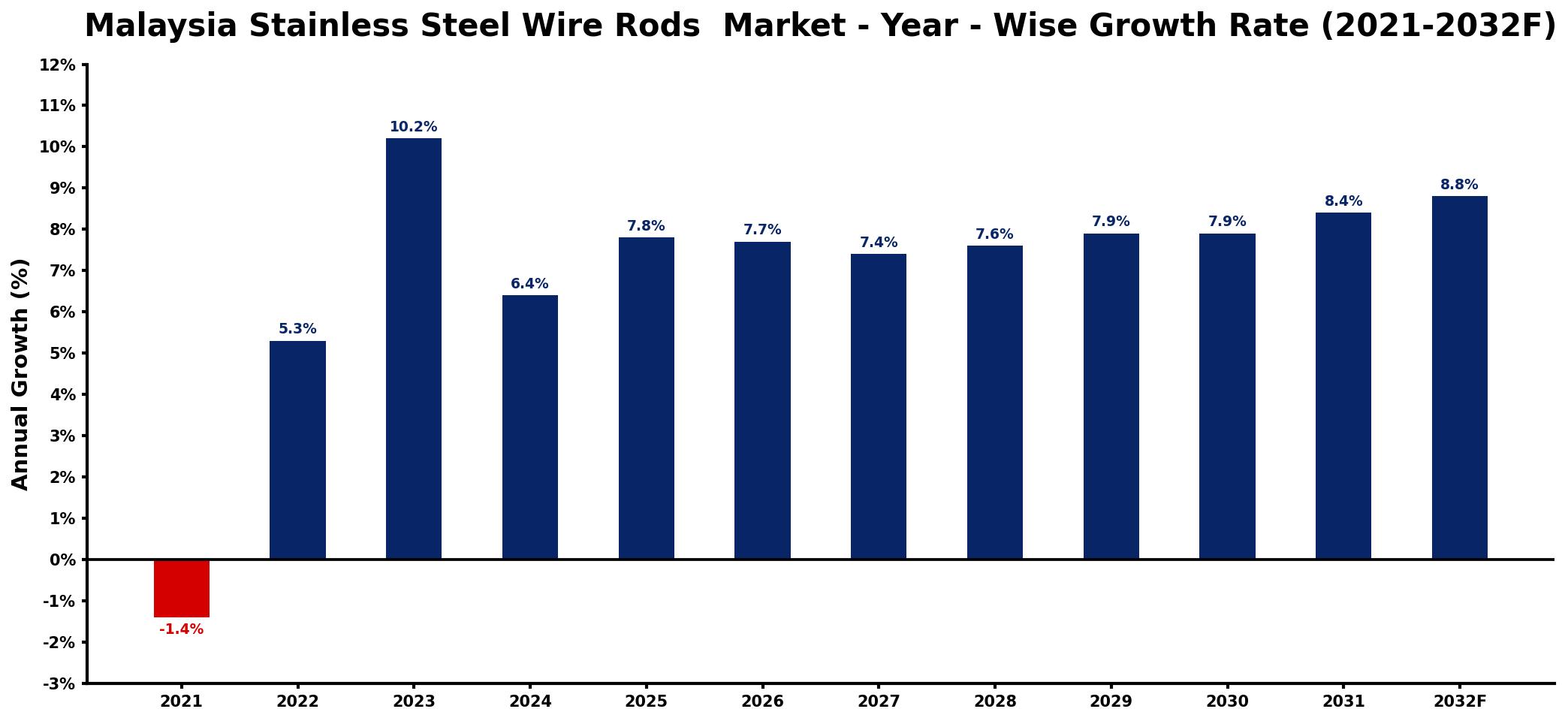
The table below presents the year‑wise growth rates along with the key drivers influencing the market
| Year | Growth Rate | Major Drivers |
| 2021 | -1.4% | decreased industrial construction activity |
| 2022 | 5.3% | rising demand from automotive sector |
| 2023 | 10.2% | expansion of renewable energy projects |
| 2024 | 6.4% | growth in infrastructure investments |
| 2025 | 7.8% | increased consumer electronics production |
| 2026 | 7.7% | surge in home renovation projects |
| 2027 | 7.4% | enhanced building regulations compliance |
| 2028 | 7.6% | booming telecommunication industry investments |
| 2029 | 7.9% | growing aerospace manufacturing demand |
| 2030 | 7.9% | increased energy efficiency initiatives |
| 2031 | 8.4% | expanding healthcare equipment requirements |
| 2032 | 8.8% | rising consumer awareness sustainability |
Note: Market size estimations and growth projections presented in this report are based on 6Wresearch's proprietary forecasting methodology, utilizing the latest available industry data, government publications, and primary research inputs.
Malaysia Stainless Steel Wire Rods Market Synopsis
The Malaysia stainless steel wire rods market has demonstrated significant momentum in recent years, particularly due to heightened activity in construction and manufacturing. As industries recover from the impacts of the COVID-19 pandemic, there is an observable shift towards investing in infrastructure projects, thereby increasing demand for stainless steel wire rods.
Moving forward, the market is expected to benefit from evolving consumer preferences towards sustainable and durable materials. With emerging technologies and innovations in production processes, companies are poised to adapt, further solidifying the role of stainless steel wire rods in Malaysia's industrial landscape.
Malaysia Stainless Steel Wire Rods Market Key Takeaways
- The market is poised for steady growth driven by increased consumption in construction and automotive sectors.
- Demand for corrosion-resistant materials positions stainless steel wire rods as a preferred choice across industries.
- The COVID-19 pandemic has impacted short-term trends, but recovery signals positive long-term growth.
- Investment in infrastructure and urbanization trends are significant contributors to market expansion.
- Technological advancements are shaping production efficiency, influencing market dynamics.
Evaluation of Restraints in Malaysia Stainless Steel Wire Rods Market
Despite the promising growth trajectory, the Malaysia stainless steel wire rods market faces certain constraints. Rising production costs, driven by fluctuations in raw material prices, can adversely affect profit margins for manufacturers. Additionally, the industry must navigate the complexities of global trade dynamics, which can lead to supply chain vulnerabilities. Moreover, there is an increasing need for effective recycling processes to align with sustainability initiatives, necessitating investments in infrastructure and technology that may not be immediately feasible for all stakeholders.
Malaysia Stainless Steel Wire Rods Market Trends
Current trends indicate a significant shift towards environmentally-friendly manufacturing practices in the stainless steel industry. Companies are increasingly focusing on product innovation, aiming to enhance the properties of stainless steel wire rods to meet specific industrial requirements. Furthermore, the automotive sector's growing preference for lightweight materials is reinforcing the demand for stainless steel wire rods, particularly in components requiring both strength and weight efficiency. These trends underline an evolution in how industries view material choices, with a clear tilt towards more sustainable options.
Malaysia Stainless Steel Wire Rods Market Opportunities
As the market evolves, various growth opportunities emerge. Investments in smart cities and infrastructure development offer a considerable avenue for increasing demand for stainless steel wire rods. Additionally, the automotive industry's ongoing transition towards electric vehicles (EVs) presents a new frontier for wire rod applications, where their lightweight and durable properties can be leveraged. Innovations in production techniques and potential partnerships among industry players can further create synergies that enhance market competitiveness.
Government Initiatives in the Malaysia Stainless Steel Wire Rods Market
The Malaysian government has initiated various policies aimed at fostering growth in the manufacturing sector, including stainless steel production. Efforts to enhance infrastructure, such as improving roads and public transport systems, have led to increased public spending in construction projects. Additionally, incentives for green manufacturing practices and sustainability initiatives are being introduced, promoting the use of corrosion-resistant materials like stainless steel in various applications. These initiatives collectively support the market's expansion and long-term viability.
Future Insights of the Malaysia Stainless Steel Wire Rods Market
Looking ahead to the 2026-2032 period, the Malaysia stainless steel wire rods market is set to embrace transformative changes. As construction and manufacturing sectors rebound robustly post-pandemic, they will continue to drive demand. Moreover, ongoing urbanization and modernization projects are expected to fuel consumption further. With technological advancements leading to improved production capabilities and cost efficiencies, manufacturers will likely be well-positioned to meet the evolving needs of various industries, reinforcing the market's growth potential.
Malaysia Stainless Steel Wire Rods Market Latest Developments (2025 - 2026)
In recent months, the Malaysian stainless steel wire rods market has witnessed notable developments aimed at enhancing production capabilities and sustainability. Industry players are increasingly exploring advanced manufacturing technologies to optimize processes, thereby reducing waste and improving material yields. Additionally, partnerships are being forged to strengthen supply chain dynamics, ensuring better access to raw materials and distribution networks. These collective efforts reflect a proactive approach to navigating challenges while positioning the market for robust growth.
Malaysia Stainless Steel Wire Rods Market - Key Attractiveness of the Report
- 10 Years of Market Numbers
- Historical Data Starting from 2022 to 2025
- Base Year: 2025
- Forecast Data until 2032
- Key Performance Indicators Impacting the Market
- Major Upcoming Developments and Projects
Key Highlights of the Report:
- Malaysia Stainless Steel Wire Rods Market Outlook
- Market Size of Malaysia Stainless Steel Wire Rods Market, 2025
- Forecast of Malaysia Stainless Steel Wire Rods Market, 2032
- Historical Data and Forecast of Malaysia Stainless Steel Wire Rods Revenues & Volume for the Period 2022-2032F
- Malaysia Stainless Steel Wire Rods Market Trend Evolution
- Malaysia Stainless Steel Wire Rods Market Drivers and Challenges
- Malaysia Stainless Steel Wire Rods Price Trends
- Malaysia Stainless Steel Wire Rods Porter's Five Forces
- Malaysia Stainless Steel Wire Rods Industry Life Cycle
- Historical Data and Forecast of Malaysia Stainless Steel Wire Rods Market Revenues & Volume By Types for the Period 2022-2032F
- Historical Data and Forecast of Malaysia Stainless Steel Wire Rods Market Revenues & Volume By 12mm for the Period 2022-2032F
- Historical Data and Forecast of Malaysia Stainless Steel Wire Rods Market Revenues & Volume By 10mm for the Period 2022-2032F
- Historical Data and Forecast of Malaysia Stainless Steel Wire Rods Market Revenues & Volume By 8mm for the Period 2022-2032F
- Historical Data and Forecast of Malaysia Stainless Steel Wire Rods Market Revenues & Volume By 6mm for the Period 2022-2032F
- Historical Data and Forecast of Malaysia Stainless Steel Wire Rods Market Revenues & Volume By Others for the Period 2022-2032F
- Historical Data and Forecast of Malaysia Stainless Steel Wire Rods Market Revenues & Volume By Applications for the Period 2022-2032F
- Historical Data and Forecast of Malaysia Stainless Steel Wire Rods Market Revenues & Volume By Steel Fasteners for the Period 2022-2032F
- Historical Data and Forecast of Malaysia Stainless Steel Wire Rods Market Revenues & Volume By Steel Wire for the Period 2022-2032F
- Historical Data and Forecast of Malaysia Stainless Steel Wire Rods Market Revenues & Volume By Steel Bright Bars for the Period 2022-2032F
- Historical Data and Forecast of Malaysia Stainless Steel Wire Rods Market Revenues & Volume By Others for the Period 2022-2032F
- Malaysia Stainless Steel Wire Rods Import Export Trade Statistics
- Market Opportunity Assessment By Types
- Market Opportunity Assessment By Applications
- Malaysia Stainless Steel Wire Rods Top Companies Market Share
- Malaysia Stainless Steel Wire Rods Competitive Benchmarking By Technical and Operational Parameters
- Malaysia Stainless Steel Wire Rods Company Profiles
- Malaysia Stainless Steel Wire Rods Key Strategic Recommendations






































