Malaysia Talc and Steatite Market Size, Share & Growth Rate
The Malaysia Talc and Steatite Market was estimated at USD 180 Million in 2025 and is projected to reach USD 234 Million by 2032, growing at a CAGR of 3.8% from 2026 to 2032. This upward trend is primarily driven by the expanding demand for talc and steatite in key industrial applications, particularly within the ceramics, plastics, and cosmetics sectors. The growth is further bolstered by ongoing industrialization efforts and the increasing consumption of consumer goods in Malaysia.
Malaysia Talc and Steatite Market Year-wise Growth Rate and Key Drivers
This graph highlights how the Malaysia Talc and Steatite Market has steadily grown over the years, supported by major growth factors.
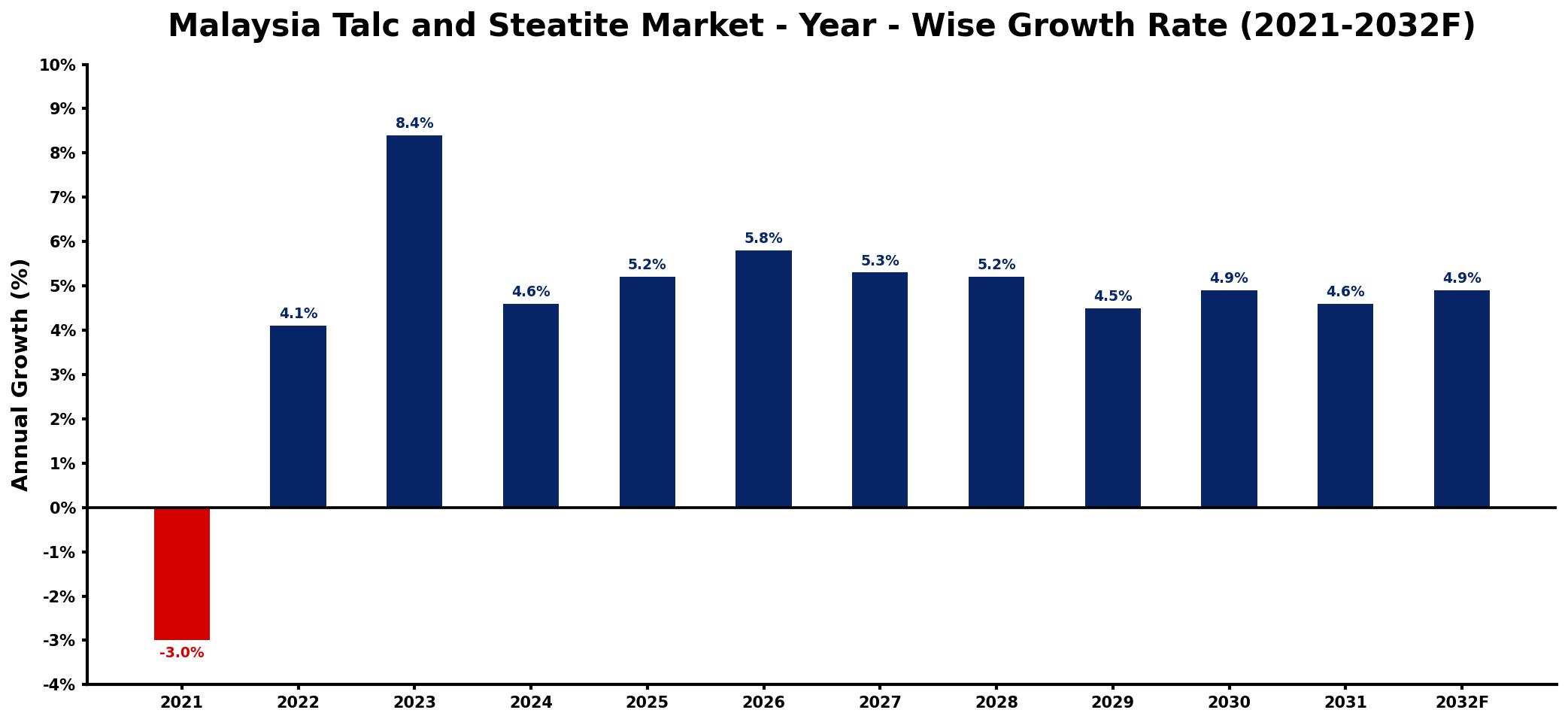
The table below presents the year‑wise growth rates along with the key drivers influencing the market
| Year | Growth Rate | Major Drivers |
| 2021 | -3.0% | Decreased industrial applications demand |
| 2022 | 4.1% | Rising consumer goods production levels |
| 2023 | 8.4% | Increased construction sector investment |
| 2024 | 4.6% | Growing demand from personal care |
| 2025 | 5.2% | Expansion in pharmaceutical manufacturing |
| 2026 | 5.8% | Higher utilization in food processing |
| 2027 | 5.3% | Developments in automotive industry usage |
| 2028 | 5.2% | Surge in paper production activities |
| 2029 | 4.5% | Boost in rubber industry requirements |
| 2030 | 4.9% | Strengthening demand from cosmetics |
| 2031 | 4.6% | Growth in electronics manufacturing sector |
| 2032 | 4.9% | Increased interest from agriculture applications |
Note: Market size estimations and growth projections presented in this report are based on 6Wresearch's proprietary forecasting methodology, utilizing the latest available industry data, government publications, and primary research inputs.
Malaysia Talc and Steatite Market Synopsis
The talc and steatite market in Malaysia benefits from the mineral's unique characteristics, such as high thermal stability and chemical inertness, making it an essential component in numerous manufacturing processes. With diverse applications spanning automotive components to pharmaceuticals, the market showcases a healthy demand trajectory.
Recent years have seen a marked increase in demand, particularly from the construction and automotive sectors. This trend is indicative of Malaysias ongoing infrastructure development and growth in manufacturing activities, which collectively enhance the markets prospects.
Malaysia Talc and Steatite Market Key Takeaways
- Market growth is driven by a range of applications across several industries, including cosmetics and ceramics.
- Key factors influencing demand include industrialization and the burgeoning construction sector.
- Innovative applications are being explored by industry players to enhance competitive positioning.
- Environmental concerns are shaping sourcing practices, prompting a shift towards more sustainable operations.
- The market is poised for stability despite challenges like raw material supply fluctuations.
Evaluation of Restraints in Malaysia Talc and Steatite Market
Despite the favorable growth outlook, the Malaysia talc and steatite market faces significant challenges that could impede progress. One of the primary concerns is the fluctuating availability of raw materials, which is often influenced by geopolitical dynamics and regulatory restrictions in mining. These factors can lead to price volatility, complicating procurement strategies for manufacturers. Additionally, as environmental awareness rises, there is growing scrutiny of mining practices, urging companies to adopt more responsible and sustainable sourcing methods. This balancing act of meeting demand while adhering to stricter regulations poses a significant challenge to industry stakeholders.
Malaysia Talc and Steatite Market Trends
Emerging trends in the Malaysia talc and steatite market highlight a noticeable shift toward sustainability. Companies are increasingly seeking eco-friendly alternatives and innovative applications of talc in various sectors, particularly in cosmetics, where natural and synthetic substitutes are gaining traction. Additionally, the ongoing advancements in manufacturing technologies are facilitating the integration of talc and steatite into novel products, enhancing their market appeal. Furthermore, the influence of digital transformation is beginning to reshape operational efficiencies within the industry.
Malaysia Talc and Steatite Market Opportunities
The Malaysia talc and steatite market presents numerous opportunities for growth and investment, particularly in high-demand sectors like construction and automotive manufacturing. The expansion of these industries is likely to sustain demand for talc-based products. Furthermore, as companies innovate in product development, there is an increasing potential to explore untapped markets and applications, creating avenues for new entrants and existing players alike to capture significant market share.
Government Initiatives in the Malaysia Talc and Steatite Market
The Malaysian government has implemented several initiatives aimed at enhancing the mining sector, including policies that promote sustainable practices and responsible sourcing of minerals. Investments in infrastructure development also serve to bolster the mining industry, providing improved access to key mining areas. Public spending directed toward enhancing industrial capabilities and supporting manufacturing sectors underscores the government's commitment to fostering a conducive environment for growth in the talc and steatite market.
Future Insights of the Malaysia Talc and Steatite Market
Looking ahead to 2026-2032, the Malaysia talc and steatite market is expected to maintain its upward trajectory, driven by continued industrialization and increased consumer demand for versatile applications. Innovations in product formulations and growing sustainability initiatives will likely play a pivotal role in shaping market dynamics. The interplay between technological advancements and evolving consumer preferences will be crucial in determining how effectively industry players can adapt and thrive in this evolving landscape.
Malaysia Talc and Steatite Market Latest Developments (2025 - 2026)
Recent developments in the Malaysian talc and steatite market reflect a commitment to sustainability and innovation. Companies are actively engaging in research and development to improve product quality and explore new applications, particularly in environmentally friendly formulations. This trend highlights the industry's responsiveness to changing consumer expectations and the regulatory landscape, positioning players for competitive advantage in an evolving marketplace.
Malaysia Talc and Steatite Market - Key Attractiveness of the Report
- 10 Years of Market Numbers
- Historical Data Starting from 2022 to 2025
- Base Year: 2025
- Forecast Data until 2032
- Key Performance Indicators Impacting the Market
- Major Upcoming Developments and Projects
Key Highlights of the Report:
- Malaysia Talc and Steatite Market Outlook
- Market Size of Malaysia Talc and Steatite Market, 2025
- Forecast of Malaysia Talc and Steatite Market, 2032
- Historical Data and Forecast of Malaysia Talc and Steatite Revenues & Volume for the Period 2022-2032F
- Malaysia Talc and Steatite Market Trend Evolution
- Malaysia Talc and Steatite Market Drivers and Challenges
- Malaysia Talc and Steatite Price Trends
- Malaysia Talc and Steatite Porter's Five Forces
- Malaysia Talc and Steatite Industry Life Cycle
- Historical Data and Forecast of Malaysia Talc and Steatite Market Revenues & Volume By Product Type for the Period 2022-2032F
- Historical Data and Forecast of Malaysia Talc and Steatite Market Revenues & Volume By Crushed for the Period 2022-2032F
- Historical Data and Forecast of Malaysia Talc and Steatite Market Revenues & Volume By Powdered for the Period 2022-2032F
- Malaysia Talc and Steatite Import Export Trade Statistics
- Market Opportunity Assessment By Product Type
- Malaysia Talc and Steatite Top Companies Market Share
- Malaysia Talc and Steatite Competitive Benchmarking By Technical and Operational Parameters
- Malaysia Talc and Steatite Company Profiles
- Malaysia Talc and Steatite Key Strategic Recommendations






































