Malaysia Toggle Clamps Market Size, Share & Growth Rate
The Malaysia Toggle Clamps Market was estimated at USD 429 Million in 2025 and is projected to reach USD 558 Million by 2032, growing at a CAGR of 3.8% from 2026 to 2032. The expansion of Malaysia's automotive manufacturing sector and the increasing shift towards industrial automation are key drivers of this upward trajectory. Coupled with the rising demand for efficient clamping solutions that reduce labor intensity, the market is poised for notable growth in the coming years.
Malaysia Toggle Clamps Market Year-wise Growth Rate and Key Drivers
This graph highlights how the Malaysia Toggle Clamps Market has steadily grown over the years, supported by major growth factors.
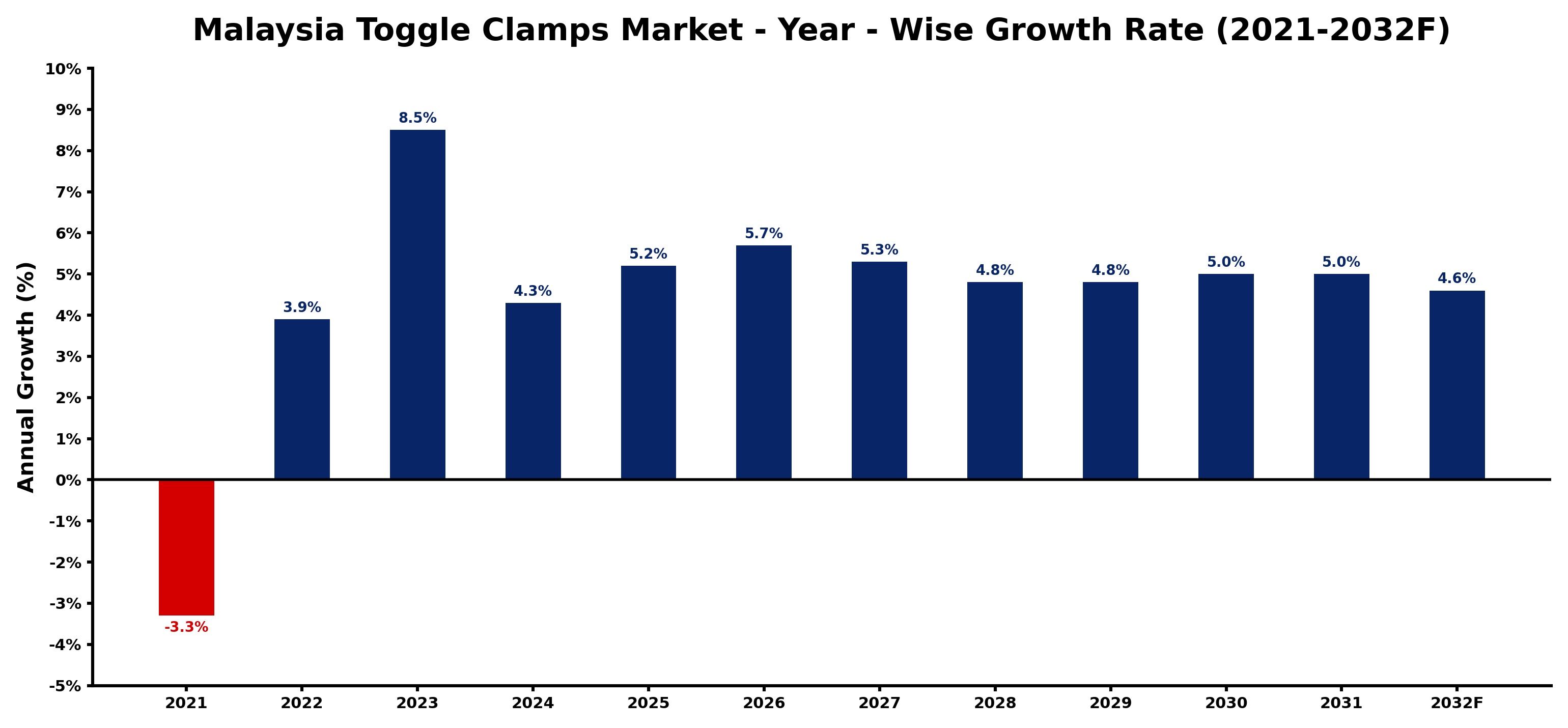
The table below presents the year‑wise growth rates along with the key drivers influencing the market
| Year | Growth Rate | Major Drivers |
| 2021 | -3.3% | Rising electricity demand across industries |
| 2022 | 3.9% | Rising electricity demand across industries |
| 2023 | 8.5% | Growing renewable energy integration projects |
| 2024 | 4.3% | Rapid growth in telecom and data center sectors |
| 2025 | 5.2% | Increasing industrial infrastructure investments |
| 2026 | 5.7% | Expansion of transportation and logistics networks |
| 2027 | 5.3% | Expansion of transportation and logistics networks |
| 2028 | 4.8% | Increasing industrial automation investments |
| 2029 | 4.8% | Rising electricity demand across industries |
| 2030 | 5.0% | Growing renewable energy integration projects |
| 2031 | 5.0% | Expansion of manufacturing activities |
| 2032 | 4.6% | Growing renewable energy integration projects |
Note - Market size estimations and growth projections presented in this report are based on 6Wresearch's advanced forecasting approach, validated with industry datasets as of June 2026.
Malaysia Toggle Clamps Market Synopsis
In recent years, the Malaysia toggle clamps market has emerged as a vital segment within the broader manufacturing landscape. The robust nature and reliability of toggle clamps make them a preferred choice for various applications, from general manufacturing to specific industry requirements.
As industries across Malaysia continue to evolve, the demand for toggle clamps is experiencing steady growth. This is largely attributed to the rising emphasis on automation, where the need for secure and efficient workholding solutions is paramount to optimizing production processes.
Malaysia Toggle Clamps Market Key Takeaways
- Significant growth projected driven by industrial automation and automotive sector expansion.
- Toggle clamps are essential for ensuring accuracy and safety in manufacturing operations.
- Increased demand for durable, reliable clamping solutions amidst fluctuating industrial activities.
- Competitive landscape necessitates innovation and focus on quality to withstand market challenges.
- Growing interest in cost-effective solutions over traditional labor-intensive practices.
Evaluation of Restraints in Malaysia Toggle Clamps Market
Despite promising growth, the Malaysia toggle clamps market faces several restraints. Fluctuations in the automotive, aerospace, and manufacturing sectors can create volatility in demand for toggle clamps, making it challenging for manufacturers to maintain consistent market share. Additionally, the availability and rising costs of raw materials needed for production can further strain supply chains. Competitively priced alternatives from overseas also compel local manufacturers to focus on quality and innovation to differentiate their offerings and sustain their market position.
Malaysia Toggle Clamps Market Trends
Currently, there is a noticeable trend towards integrating advanced materials and smart technologies into toggle clamp designs. Manufacturers are increasingly incorporating innovative features that enhance durability and user convenience. Additionally, a growing awareness of sustainability is prompting companies to explore eco-friendly materials and manufacturing practices, which could reshape product offerings in the near future.
Malaysia Toggle Clamps Market Opportunities
The Malaysian toggle clamps market presents significant opportunities for growth, especially in light of the country's industrial expansion initiatives. Investing in automation technologies and adapting clamp designs to specific industry needs, such as for the burgeoning automotive sector, can unlock new revenue streams. Moreover, exploring international markets for exports can further enhance growth potential, provided manufacturers focus on meeting diverse regulatory standards and consumer preferences.
Government Initiatives in the Malaysia Toggle Clamps Market
The Malaysian government has been proactive in fostering a conducive environment for manufacturing growth through various policies and initiatives. Investment incentives for the manufacturing sector, support for technology adoption, and infrastructure development programs are key areas of focus. Additionally, public spending on industrial projects is anticipated to drive demand for manufacturing tools, including toggle clamps, thus benefiting the market overall.
Future Insights of the Malaysia Toggle Clamps Market
Looking ahead to the period from 2026 to 2032, the Malaysia toggle clamps market is expected to experience steady growth fueled by ongoing industrial transformation. Emphasis on automation, coupled with enhancements in production efficiency, will keep demand robust. As manufacturers adapt to evolving technologies and client expectations, the market is likely to see innovations that redefine clamping solutions, positioning itself as a vital component of Malaysia's manufacturing future.
Malaysia Toggle Clamps Market Latest Developments (May 2025 - June 2026)
Recent developments in the Malaysia toggle clamps market have highlighted a shift towards more automated manufacturing practices, with an increasing number of companies investing in advanced clamping technologies. Industry players are prioritizing research and development to enhance product durability and functionality. The recent economic climate has also prompted manufacturers to explore strategic partnerships, further influencing the direction of the market.
Malaysia Toggle Clamps Market - Key Attractiveness of the Report
- 10 Years of Market Numbers
- Historical Data Starting from 2022 to 2025
- Base Year: 2025
- Forecast Data until 2032
- Key Performance Indicators Impacting the Market
- Major Upcoming Developments and Projects
Key Highlights of the Report:
- Malaysia Toggle Clamps Market Outlook
- Market Size of Malaysia Toggle Clamps Market, 2025
- Forecast of Malaysia Toggle Clamps Market, 2032
- Historical Data and Forecast of Malaysia Toggle Clamps Revenues & Volume for the Period 2022-2032F
- Malaysia Toggle Clamps Market Trend Evolution
- Malaysia Toggle Clamps Market Drivers and Challenges
- Malaysia Toggle Clamps Price Trends
- Malaysia Toggle Clamps Porter's Five Forces
- Malaysia Toggle Clamps Industry Life Cycle
- Historical Data and Forecast of Malaysia Toggle Clamps Market Revenues & Volume By Product Type for the Period 2022-2032F
- Historical Data and Forecast of Malaysia Toggle Clamps Market Revenues & Volume By Horizontal Toggle Clamps for the Period 2022-2032F
- Historical Data and Forecast of Malaysia Toggle Clamps Market Revenues & Volume By Vertical Toggle Clamps for the Period 2022-2032F
- Historical Data and Forecast of Malaysia Toggle Clamps Market Revenues & Volume By Application for the Period 2022-2032F
- Historical Data and Forecast of Malaysia Toggle Clamps Market Revenues & Volume By Assembly Technology for the Period 2022-2032F
- Historical Data and Forecast of Malaysia Toggle Clamps Market Revenues & Volume By Clamping Technology for the Period 2022-2032F
- Historical Data and Forecast of Malaysia Toggle Clamps Market Revenues & Volume By Tool Construction for the Period 2022-2032F
- Historical Data and Forecast of Malaysia Toggle Clamps Market Revenues & Volume By Fixture Construction for the Period 2022-2032F
- Malaysia Toggle Clamps Import Export Trade Statistics
- Market Opportunity Assessment By Product Type
- Market Opportunity Assessment By Application
- Malaysia Toggle Clamps Top Companies Market Share
- Malaysia Toggle Clamps Competitive Benchmarking By Technical and Operational Parameters
- Malaysia Toggle Clamps Company Profiles
- Malaysia Toggle Clamps Key Strategic Recommendations






































