Malaysia Toys and Hobby Goods Market Summary
The malaysia toys and hobby goods market was estimated at USD 231 Million in 2025 and is projected to reach USD 300 Million by 2032, growing at a CAGR of 5.0% from 2026 to 2032.
Malaysia Toys and Hobby Goods Market Year-wise Growth Rate and Key Drivers
This graph highlights how the Malaysia Toys and Hobby Goods Market has steadily grown over the past five years, supported by major growth factors.
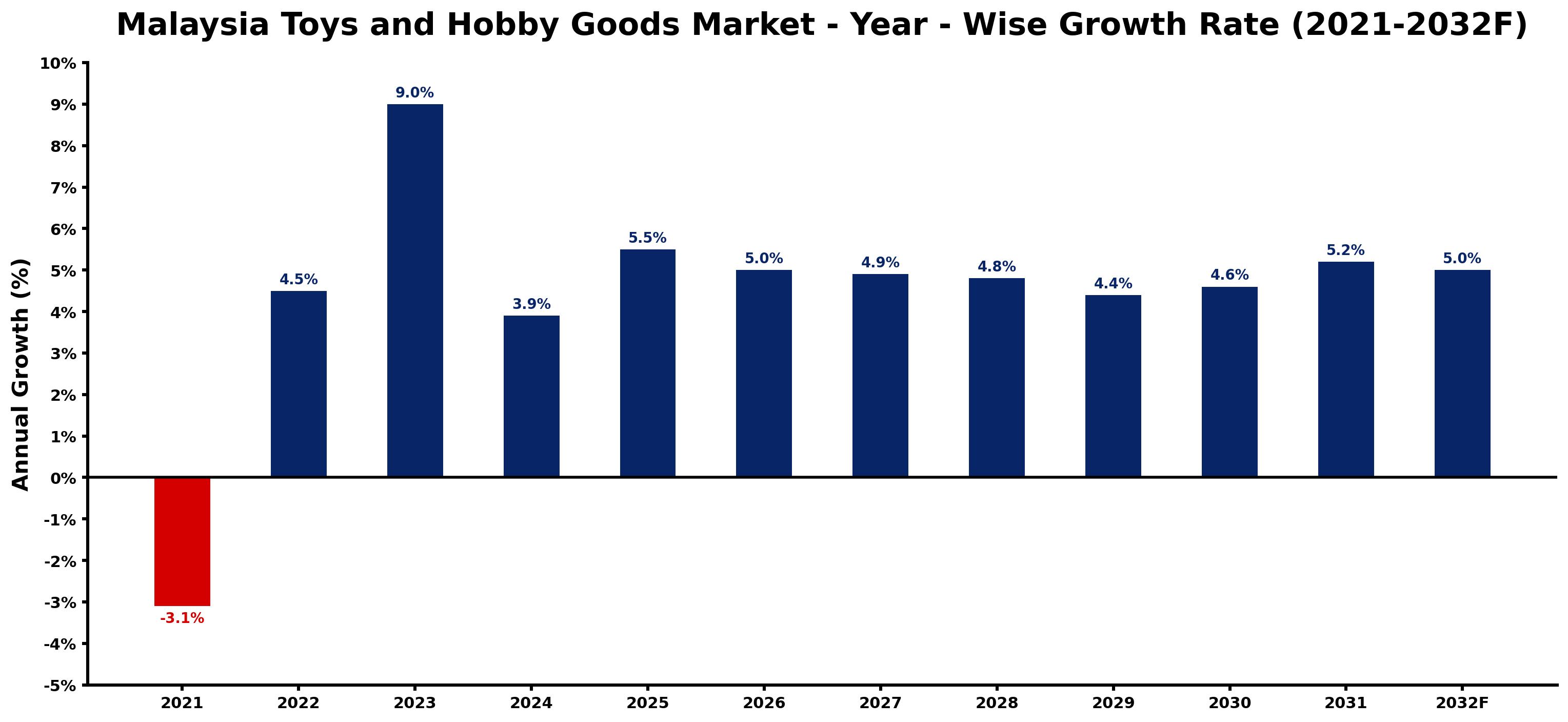
The table below presents the year wise growth rates along with the key drivers influencing the market
| Year | Growth Rate | Major Drivers |
| 2021 | -3.1% | Prolonged pandemicrelated restrictions limited retail operations, significantly curtailing toy sales and hobbyist engagement. |
| 2022 | 4.5% | Traditional toy sales saw a revival amid increased interest in nostalgic products. |
| 2023 | 9.0% | E-commerce platforms expanded, enhancing accessibility to diverse toy and hobby goods. |
| 2024 | 3.9% | Local manufacturers began prioritizing sustainable materials for toy production. |
| 2025 | 5.5% | Educational toys gained traction, responding to heightened awareness of developmental needs. |
| 2026 | 5.0% | Cross-promotional partnerships with popular media franchises attracted younger audiences. |
| 2027 | 4.9% | Increased disposable income fueled investments in premium hobby goods and collectibles. |
| 2028 | 4.8% | Community-driven events fostered engagement, boosting local toy markets and retailers. |
| 2029 | 4.4% | Technology integration in toys offered interactive experiences, appealing to tech-savvy children. |
| 2030 | 4.6% | Global supply chain stability improved, allowing for more competitive pricing strategies. |
| 2031 | 5.2% | Parenting trends emphasized educational value, steering purchases towards STEM-related toys. |
| 2032 | 5.0% | Cultural shifts led to greater acceptance of hobbies across diverse age demographics. |
Note - Market size estimations and growth projections presented in this report are based on 6Wresearch's advanced forecasting approach, validated with industry datasets as of June 2026.
Malaysia Toys and Hobby Goods Market Synopsis
The Malaysia Toys and Hobby Goods Market is projected to reach 5.0% and witness significant growth during the forecast period (2026-2032). Factors such as the increasing penetration of e-commerce platforms, escalating consumer spending on leisure activities, and the rising popularity of innovative toys are contributing to this expansion. Moreover, a shift among parents towards educational toys that facilitate learning through play is anticipated to further stimulate market growth. Positive government initiatives aimed at promoting DIY hobby kits among children are also expected to bolster the sector.
Malaysia Toys and Hobby Goods Market Growth Drivers
Several key drivers are fueling the growth of the Malaysia Toys and Hobby Goods Market. Firstly, the rapid adoption of e-commerce has transformed how consumers shop for toys and hobby goods, providing access to a wider range of products. This convenience encourages increased spending and market engagement. Secondly, as disposable incomes rise, consumers are allocating more funds towards leisure and recreational activities, including toys and hobbies.
- The increasing demand for educational and STEM-focused toys reflects a growing awareness of child development, driving parents to purchase products that enhance learning.
- Innovations in toy design, particularly through the integration of technology, have created a surge in interest for products that offer interactive experiences.
- Trends like augmented reality gaming have prompted manufacturers to explore new product categories that capture the interest of tech-savvy consumers.
- The rise in disposable income among the middle class is further propelling growth, as families are now willing to invest in higher-quality toys and hobby supplies.
- Increased marketing efforts and brand promotions via social media and digital platforms are also enhancing product visibility and driving sales.
Malaysia Toys and Hobby Goods Market Trends and Opportunities
Looking ahead, the Malaysia Toys and Hobby Goods Market is set to witness several transformative trends. One such trend is the transition towards sustainable and eco-friendly toys as consumers become more environmentally conscious. This trend represents an opportunity for manufacturers to innovate and offer products that align with changing consumer values. Additionally, the integration of augmented reality and virtual reality features into traditional toys presents an opportunity for enhanced user engagement.
- As digital gaming continues to grow, there is an opportunity for hybrid products that combine physical toys with digital experiences.
- Local toy manufacturers may benefit from a shift towards supporting homegrown brands, particularly as consumers seek unique and culturally relevant products.
- The focus on health and wellness is prompting the market for hobby goods to incorporate fitness-related activities, expanding the definition of hobbies to include well-being.
- Additionally, as parents look for ways to engage their children during vacations and leisure time, the demand for DIY hobby kits continues to rise, providing manufacturers with a lucrative avenue for growth.
- The ongoing digitization of retail landscapes is pushing towards an omnichannel approach, allowing brands to capture diverse consumer segments more effectively.
Malaysia Toys and Hobby Goods Market Challenges and Restraints
Despite promising growth prospects, the Malaysia Toys and Hobby Goods Market faces certain challenges. Economic uncertainties may lead to fluctuating consumer confidence, which can impact spending on non-essential items like toys. Additionally, the increasing prevalence of counterfeit products poses a significant threat, undermining brand integrity and consumer trust. Furthermore, rapid technological advancements necessitate constant innovation from manufacturers, which can strain resources.
- Market saturation in certain segments could limit growth potential, forcing brands to compete aggressively on price rather than value.
- The reliance on imports for certain toy categories could expose the market to external shocks such as shipping disruptions and trade tariffs.
- Moreover, changing demographics and consumer preferences require flexible strategies that may challenge traditional market players.
- Heightened regulation concerning toy safety standards necessitates ongoing compliance, which can incur additional costs for manufacturers.
- Variations in regional preferences may complicate marketing strategies, demanding localized approaches that can add layers of complexity to distribution.
Malaysia Toys and Hobby Goods Market Government Investment and Initiatives
The government of Malaysia is increasingly recognizing the importance of the toys and hobby goods sector in fostering creativity and innovation among children. To support this, various initiatives and public spending programs are being developed. These initiatives often include funding for educational toy companies and the promotion of local manufacturing capabilities.
- Government policies aimed at increasing exports of locally produced toys and hobby goods are being implemented, thus enhancing market competitiveness.
- Public awareness campaigns to encourage the purchase of educational and DIY hobby kits are also part of broader educational strategies.
- Incentives for research and development in the toy industry are being introduced to stimulate innovation and ensure that Malaysian products can compete globally.
- Collaborations between the government and local businesses aim to enhance the quality and safety standards of toys, ultimately ensuring consumer protection.
- Investment in digital infrastructure is being prioritized to support the e-commerce growth of toys and hobby goods, enabling better market access for consumers and manufacturers alike.
Malaysia Toys and Hobby Goods Market Latest Developments (May 2025 - June 2026)
In the period from May 2025 to June 2026, the Malaysia Toys and Hobby Goods Market has experienced notable developments reflecting the evolving landscape of consumer preferences. A marked increase in the launch of augmented reality-based toys is observed, catering to the tech-savvy generation. Additionally, many manufacturers are integrating educational aspects into their products, aligning with the ongoing trend of purposeful play.
- The expansion of online retail platforms has further accelerated, allowing consumers to easily access a broad range of toys and hobby goods.
- Environmental concerns are leading to the introduction of several lines of eco-friendly toys, responding to consumer demand for sustainable products.
- Collaborative initiatives between educational institutions and toy manufacturers to develop STEM-focused educational kits have gained traction.
- Overall industry sentiment indicates a strong push towards innovation and customer engagement, with many brands enhancing their digital marketing strategies.
- The presence of local toy fairs and exhibitions has increased, providing platforms for networking and showcasing new products to potential buyers.
Malaysia Toys and Hobby Goods Market - Key Attractiveness of the Report
- 10 Years of Market Numbers
- Historical Data Starting from 2022 to 2025
- Base Year: 2025
- Forecast Data until 2032
- Key Performance Indicators Impacting the Market
- Major Upcoming Developments and Projects
Key Highlights of the Report:
- Malaysia Toys and Hobby Goods Market Outlook
- Market Size of Malaysia Toys and Hobby Goods Market, 2025
- Forecast of Malaysia Toys and Hobby Goods Market, 2032
- Historical Data and Forecast of Malaysia Toys and Hobby Goods Revenues & Volume for the Period 2022-2032F
- Malaysia Toys and Hobby Goods Market Trend Evolution
- Malaysia Toys and Hobby Goods Market Drivers and Challenges
- Malaysia Toys and Hobby Goods Price Trends
- Malaysia Toys and Hobby Goods Porter's Five Forces
- Malaysia Toys and Hobby Goods Industry Life Cycle
- Historical Data and Forecast of Malaysia Toys and Hobby Goods Market Revenues & Volume By Type for the Period 2022-2032F
- Historical Data and Forecast of Malaysia Toys and Hobby Goods Market Revenues & Volume By Sports Toys for the Period 2022-2032F
- Historical Data and Forecast of Malaysia Toys and Hobby Goods Market Revenues & Volume By Intellectual Toys for the Period 2022-2032F
- Historical Data and Forecast of Malaysia Toys and Hobby Goods Market Revenues & Volume By Education Toys for the Period 2022-2032F
- Historical Data and Forecast of Malaysia Toys and Hobby Goods Market Revenues & Volume By Decorative Toys for the Period 2022-2032F
- Historical Data and Forecast of Malaysia Toys and Hobby Goods Market Revenues & Volume By Other for the Period 2022-2032F
- Historical Data and Forecast of Malaysia Toys and Hobby Goods Market Revenues & Volume By Application for the Period 2022-2032F
- Historical Data and Forecast of Malaysia Toys and Hobby Goods Market Revenues & Volume By Online Sales for the Period 2022-2032F
- Historical Data and Forecast of Malaysia Toys and Hobby Goods Market Revenues & Volume By Offline Sales for the Period 2022-2032F
- Historical Data and Forecast of Malaysia Toys and Hobby Goods Market Revenues & Volume By Others for the Period 2022-2032F
- Malaysia Toys and Hobby Goods Import Export Trade Statistics
- Market Opportunity Assessment By Type
- Market Opportunity Assessment By Application
- Malaysia Toys and Hobby Goods Top Companies Market Share
- Malaysia Toys and Hobby Goods Competitive Benchmarking By Technical and Operational Parameters
- Malaysia Toys and Hobby Goods Company Profiles
- Malaysia Toys and Hobby Goods Key Strategic Recommendations






































