Sri Lanka Toys and Hobby Goods Market Summary
The sri lanka toys and hobby goods market was estimated at USD 280 Million in 2025 and is projected to reach USD 396 Million by 2032, growing at a CAGR of 6.1% from 2026 to 2032.
Sri Lanka Toys and Hobby Goods Market Year-wise Growth Rate and Key Drivers
This graph highlights how the Sri Lanka Toys and Hobby Goods Market has steadily grown over the past five years, supported by major growth factors.
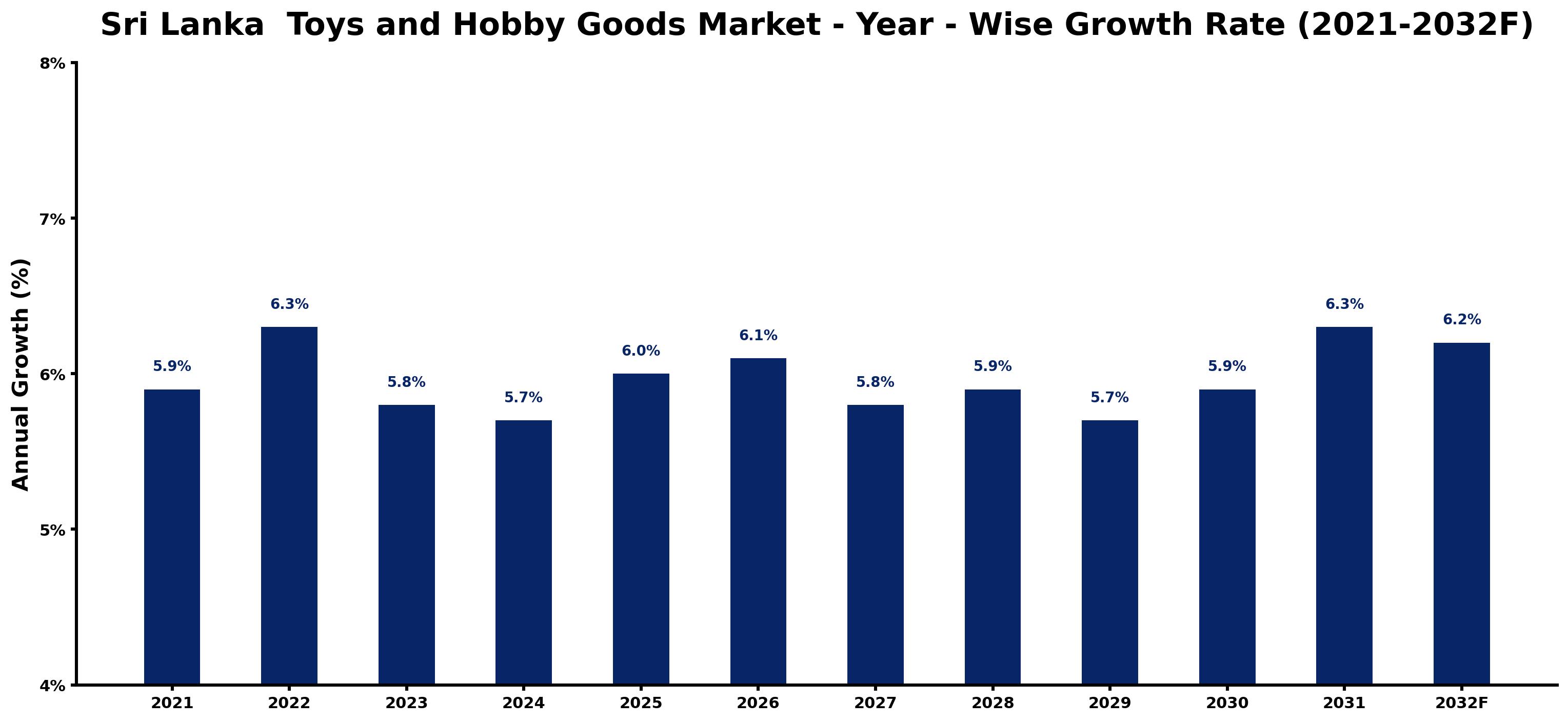
The table below presents the year wise growth rates along with the key drivers influencing the market
| Year | Growth Rate | Major Drivers |
| 2021 | 5.9% | Post-pandemic recovery saw families prioritizing indoor entertainment and hobbies. |
| 2022 | 6.3% | Online sales channels expanded, making toys more accessible to urban consumers. |
| 2023 | 5.8% | Increased consumer interest in eco-friendly and sustainable toy options emerged. |
| 2024 | 5.7% | Local manufacturers began producing educational toys, enhancing market competition. |
| 2025 | 6.0% | Investment in digital marketing strategies helped brands engage younger audiences effectively. |
| 2026 | 6.1% | Expanding middle-class income levels created disposable income for toy purchases. |
| 2027 | 5.8% | Collaborations between toy brands and popular local franchises captured children's attention. |
| 2028 | 5.9% | Technological integration in toys, such as AR features, appealed to tech-savvy children. |
| 2029 | 5.7% | Social media influencers significantly impacted toy trends among parents and children. |
| 2030 | 5.9% | Increased international tourism drove demand for local toy souvenirs and collectibles. |
| 2031 | 6.3% | Government policies promoting local crafts boosted traditional toy manufacturing sectors. |
| 2032 | 6.2% | Rising awareness of child development emphasized educational toys in consumer purchases. |
Note - Market size estimations and growth projections presented in this report are based on 6Wresearch's advanced forecasting approach, validated with industry datasets as of June 2026.
Sri Lanka Toys and Hobby Goods Market Synopsis
The Sri Lanka Toys and Hobby Goods Market is projected to reach 6.1% and witness significant growth during the forecast period (2026-2032). This growth trajectory is anticipated to be driven by several factors, including increasing urbanization, rising disposable incomes, evolving lifestyles, and the burgeoning influence of e-commerce in the region. The industry is poised for expansion as consumers gravitate towards modern and diverse play options, facilitated by innovative marketing efforts and promotional strategies.
Sri Lanka Toys and Hobby Goods Market Growth Drivers
The anticipated growth in the Sri Lanka Toys and Hobby Goods Market can be attributed to multiple interconnected drivers. Urbanization has heightened the demand for a variety of toys and hobby items, reflecting changing consumer preferences in metropolitan areas. The rise in disposable incomes enables families to allocate more resources towards children's entertainment and hobbies, further fueling market expansion. Additionally, lifestyle changes, characterized by increased spending on leisure activities, are shaping the purchasing decisions of consumers in Sri Lanka.
The growing popularity of e-commerce platforms in the country also plays a pivotal role in market growth. Consumers increasingly prefer the convenience of online shopping, which provides access to a wider selection of toys and hobby goods than traditional retail outlets. Moreover, leading companies are investing substantially in marketing initiatives and employing various promotional strategies, which not only enhance brand visibility but also stimulate consumer engagement with the product offerings.
Sri Lanka Toys and Hobby Goods Market Trends and Opportunities
Several key trends are shaping the dynamics of the Sri Lanka Toys and Hobby Goods Market in the forecast period. The emergence of eco-friendly and sustainable toys offers a significant opportunity as consumers become more environmentally conscious. This trend aligns with global movements towards sustainability, prompting manufacturers to innovate in line with consumer values.
The incorporation of technology into toys, such as interactive and educational products, is attracting the attention of modern parents who seek enriching experiences for their children. Furthermore, the popularity of DIY hobby kits that encourage creativity and skill development is gaining momentum, pushing the market towards diversification.
- Changes in family dynamics have led to increased investment in personalized and unique toys that cater to individual interests, enhancing emotional connections.
- Social media platforms are becoming critical in influencing consumer trends, enabling brands to engage with younger demographics through targeted marketing campaigns.
- The rise of online forums and communities centered around hobbies provides avenues for growth as brands tap into niche markets and foster consumer loyalty.
- Seasonal and cultural events offer opportunities for brands to launch limited edition products, capturing consumer interest and boosting sales during peak shopping periods.
- Consumer demand for educational and STEM-related toys is on the rise, reflecting a growing emphasis on learning through play in early childhood development.
Sri Lanka Toys and Hobby Goods Market Challenges and Restraints
Despite the positive outlook for the Sri Lanka Toys and Hobby Goods Market, several challenges may impede growth. Fluctuations in economic conditions could impact consumer spending behavior, limiting the budget allocated for non-essential items such as toys and hobby goods. Additionally, the presence of counterfeit products in the market poses significant risks to established brands and may undermine consumer trust.
Supply chain disruptions, particularly in the wake of global events, can cause delays in product availability and lead to increased operational costs. Furthermore, competition from alternative forms of entertainment, such as digital media and video games, may divert interest away from conventional toys, complicating market dynamics.
- The regulatory environment surrounding product safety standards necessitates continual compliance, which can impose additional financial burdens on manufacturers.
- Limited access to advanced technology for local manufacturers may hinder their ability to innovate and compete with international brands.
- Consumer preferences can shift rapidly, making it challenging for companies to predict market trends and adapt accordingly.
- Seasonal variations in purchasing behaviors pose challenges for inventory management, particularly for companies lacking robust forecasting capabilities.
- Rising awareness of psychological impacts related to excessive screen time may lead to shifting consumer preferences towards traditional play items.
Sri Lanka Toys and Hobby Goods Market Government Investment and Initiatives
The Sri Lankan government has been actively involved in promoting the growth of the Toys and Hobby Goods Market through various initiatives and policies aimed at enhancing the overall economic environment. Investments in infrastructure, particularly in urban areas, are expected to facilitate better distribution channels and access to markets for toy manufacturers. Additionally, public spending on education and recreational programs aligns with the government's objective to improve the quality of life, thereby indirectly nurturing the toys and hobby goods sector.
Furthermore, the government has emphasized the importance of supporting local manufacturing, which may be bolstered by incentives such as tax breaks and grants for research and development. By fostering a conducive environment for the growth of small and medium enterprises (SMEs) within the toys and hobby goods industry, the government aims to enhance competitiveness and innovation. Educational outreach programs highlighting the importance of creative play and hobbies may also encourage consumer spending within the sector.
Sri Lanka Toys and Hobby Goods Market Latest Developments (May 2025 - June 2026)
Recent developments in the Sri Lanka Toys and Hobby Goods Market have highlighted a continued focus on innovation and consumer engagement. Companies have been exploring partnerships with educational institutions to develop toys that promote learning while ensuring entertainment value. There is a notable increase in collaborative efforts between local artisans and brands to produce unique, culturally relevant products that resonate with consumers.
Digital marketing strategies have become more sophisticated, with brands leveraging social media influencers and targeted online campaigns to reach their audience more effectively. E-commerce platforms have seen a surge in activity, particularly post-pandemic, as consumers increasingly favor the convenience of online shopping for toys and hobby goods.
- Innovations in sustainable materials are becoming a focal point for many brands, reflecting consumer demand for eco-friendly products.
- Seasonal promotions and limited edition releases are capturing consumer interest, leading to spikes in demand during significant shopping periods.
- Collaborations with well-known franchises and media properties have proven successful in driving sales, capitalizing on brand recognition.
- Increased participation in local fairs and exhibitions has enhanced visibility for producers, providing a platform for direct engagement with consumers.
- The integration of augmented reality (AR) and virtual reality (VR) into toys is gradually becoming more prevalent, appealing to tech-savvy younger audiences.
Sri Lanka Toys and Hobby Goods Market - Key Attractiveness of the Report
- 10 Years of Market Numbers
- Historical Data Starting from 2022 to 2025
- Base Year: 2025
- Forecast Data until 2032
- Key Performance Indicators Impacting the Market
- Major Upcoming Developments and Projects
Key Highlights of the Report:
- Sri Lanka Toys and Hobby Goods Market Outlook
- Market Size of Sri Lanka Toys and Hobby Goods Market, 2025
- Forecast of Sri Lanka Toys and Hobby Goods Market, 2032F
- Historical Data and Forecast of Sri Lanka Toys and Hobby Goods Revenues & Volume for the Period 2022-2032F
- Sri Lanka Toys and Hobby Goods Market Trend Evolution
- Sri Lanka Toys and Hobby Goods Market Drivers and Challenges
- Sri Lanka Toys and Hobby Goods Price Trends
- Sri Lanka Toys and Hobby Goods Porter's Five Forces
- Sri Lanka Toys and Hobby Goods Industry Life Cycle
- Historical Data and Forecast of Sri Lanka Toys and Hobby Goods Market Revenues & Volume By Type for the Period 2022-2032F
- Historical Data and Forecast of Sri Lanka Toys and Hobby Goods Market Revenues & Volume By Sports Toys for the Period 2022-2032F
- Historical Data and Forecast of Sri Lanka Toys and Hobby Goods Market Revenues & Volume By Intellectual Toys for the Period 2022-2032F
- Historical Data and Forecast of Sri Lanka Toys and Hobby Goods Market Revenues & Volume By Education Toys for the Period 2022-2032F
- Historical Data and Forecast of Sri Lanka Toys and Hobby Goods Market Revenues & Volume By Decorative Toys for the Period 2022-2032F
- Historical Data and Forecast of Sri Lanka Toys and Hobby Goods Market Revenues & Volume By Other for the Period 2022-2032F
- Historical Data and Forecast of Sri Lanka Toys and Hobby Goods Market Revenues & Volume By Application for the Period 2022-2032F
- Historical Data and Forecast of Sri Lanka Toys and Hobby Goods Market Revenues & Volume By Online Sales for the Period 2022-2032F
- Historical Data and Forecast of Sri Lanka Toys and Hobby Goods Market Revenues & Volume By Offline Sales for the Period 2022-2032F
- Historical Data and Forecast of Sri Lanka Toys and Hobby Goods Market Revenues & Volume By Others for the Period 2022-2032F
- Sri Lanka Toys and Hobby Goods Import Export Trade Statistics
- Market Opportunity Assessment By Type
- Market Opportunity Assessment By Application
- Sri Lanka Toys and Hobby Goods Top Companies Market Share
- Sri Lanka Toys and Hobby Goods Competitive Benchmarking By Technical and Operational Parameters
- Sri Lanka Toys and Hobby Goods Company Profiles
- Sri Lanka Toys and Hobby Goods Key Strategic Recommendations






































