Malaysia Two Wheeler Market Summary
The malaysia two wheeler market was estimated at USD 357 Million in 2025 and is projected to reach USD 465 Million by 2032, growing at a CAGR of 5.3% from 2026 to 2032.
Malaysia Two Wheeler Market Year-wise Growth Rate and Key Drivers
This graph highlights how the Malaysia Two Wheeler Market has steadily grown over the past five years, supported by major growth factors.
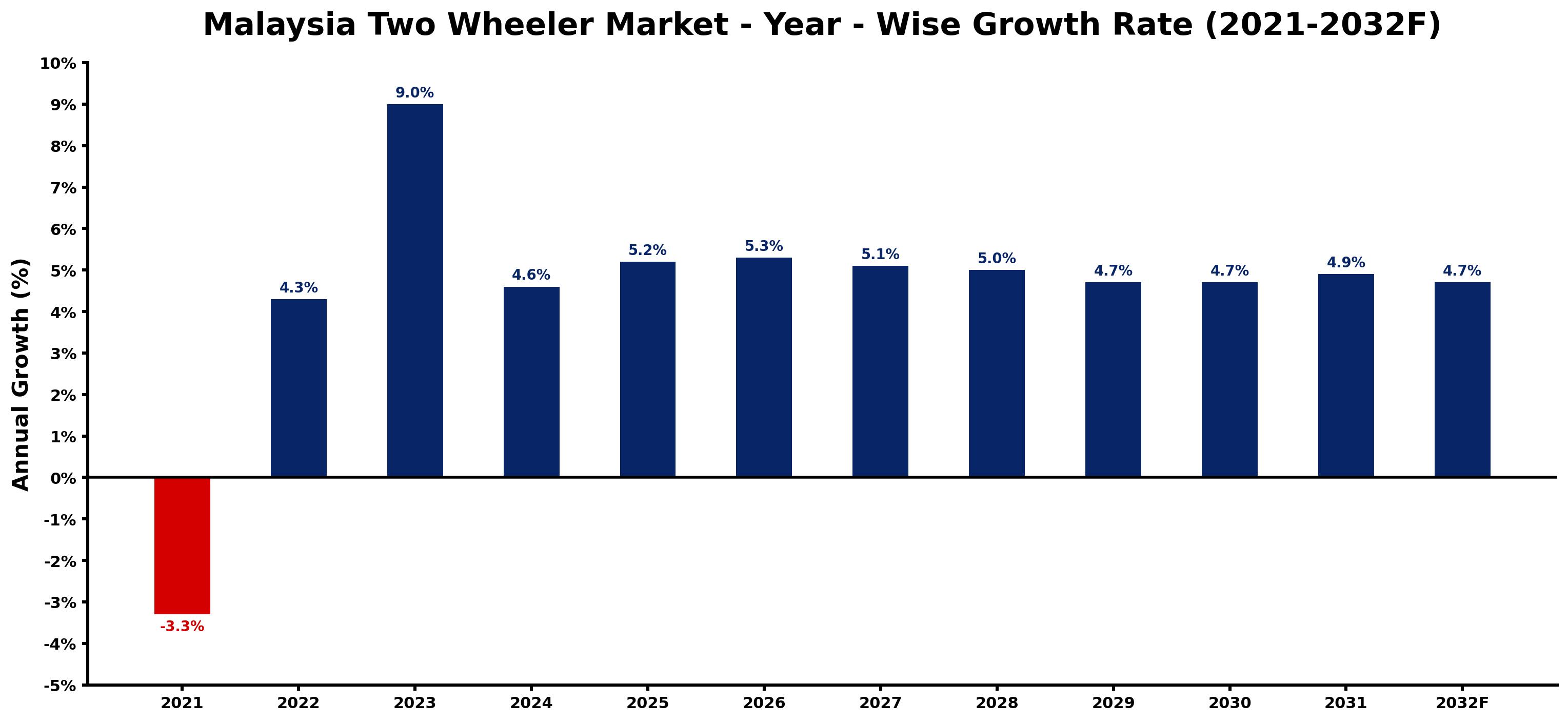
The table below presents the year wise growth rates along with the key drivers influencing the market
| Year | Growth Rate | Major Drivers |
| 2021 | -3.3% | Heightened travel restrictions during the pandemic significantly diminished twowheeler sales in Malaysia. |
| 2022 | 4.3% | Urban congestion issues pushed consumers toward two-wheelers as practical transport solutions. |
| 2023 | 9.0% | Rising fuel prices prompted budget-conscious Malaysians to consider fuel-efficient alternatives. |
| 2024 | 4.6% | Technological improvements in electric two-wheelers captured a niche customer segment. |
| 2025 | 5.2% | Increasing disposable incomes enabled more families to purchase additional vehicles. |
| 2026 | 5.3% | E-commerce expansion boosted demand for delivery motorcycles among local businesses. |
| 2027 | 5.1% | Emerging youth culture positioned two-wheelers as trendy lifestyle choices for millennials. |
| 2028 | 5.0% | Insurance companies began offering attractive packages tailored specifically for motorcycles. |
| 2029 | 4.7% | Local manufacturing initiatives reduced costs and improved availability of two-wheeler models. |
| 2030 | 4.7% | Public awareness campaigns highlighted environmental benefits of biking over driving. |
| 2031 | 4.9% | Integration of smart technology in bikes gained traction among tech-savvy consumers. |
| 2032 | 4.7% | Urban infrastructure developments increasingly accommodated two-wheelers for efficient commuting. |
Note - Market size estimations and growth projections presented in this report are based on 6Wresearch's advanced forecasting approach, validated with industry datasets as of June 2026.
Malaysia Two Wheeler Market Synopsis
The Malaysia Two Wheeler Market is projected to reach 5.3% and witness significant growth during the forecast period (2026-2032). This growth can be attributed to a combination of factors including increasing disposable incomes, rapid urbanization, and a shift towards environmentally friendly transportation options. The rising fuel prices are driving consumers towards electric mobility solutions, further invigorating the two wheeler segment, which encompasses scooters and motorcycles. As urban landscapes become more congested, the demand for agile, compact vehicles continues to rise, prompting adjustments in consumer preferences and habits.
Malaysia Two Wheeler Market Growth Drivers
The growth of the Malaysia two wheeler market is influenced by multiple factors that collectively enhance the industry's potential.
- Increased urbanization in Malaysia has led to a higher concentration of the population in cities, where two wheelers serve as an efficient mode of transportation amid traffic congestion.
- The rising disposable income allows more individuals to invest in personal transportation, significantly boosting the two wheeler market.
- Government policies aimed at promoting sustainable transport solutions have heightened awareness and acceptance of electric two wheelers, thus fostering market expansion.
- As fuel prices continue to escalate, consumers are shifting to cost-effective alternatives, with two wheelers providing a more economically viable solution.
- Technological advancements in electric mobility are enhancing the appeal of two wheelers, offering longer ranges, better efficiency, and lower maintenance costs, thereby attracting a wider consumer base.
Malaysia Two Wheeler Market Trends and Opportunities
Several emerging trends present unique opportunities within the Malaysia two wheeler market.
- The increasing popularity of ride-sharing apps and services is creating a new market segment for two wheeler rentals, catering to both tourists and locals.
- The integration of smart technology, such as navigation systems and smartphone connectivity in two wheeler designs, is attracting tech-savvy consumers.
- Environmental awareness is leading to a demand for electric scooters and motorcycles, reflecting a global shift towards sustainable practices; thus, manufacturers are investing in cleaner technologies.
- Regional disparities in demand are revealing opportunities for localized marketing strategies, focusing on urban versus rural preferences for two wheelers.
- Partnerships between manufacturers and technology firms are likely to foster innovation, resulting in enhanced product offerings that cater to evolving customer expectations.
Malaysia Two Wheeler Market Challenges and Restraints
Despite the promising landscape, the Malaysia two wheeler market faces challenges that must be navigated effectively.
- Intense competition among domestic and international manufacturers can lead to price wars, potentially affecting profit margins and market stability.
- Cultural perceptions regarding safety and the embrace of alternative transport modes may hinder the widespread adoption of two wheelers in certain demographics.
- Infrastructure inadequacies, particularly in rural areas, pose significant barriers to market penetration, limiting consumer access to reliable service and maintenance.
- The fluctuating costs of raw materials for manufacturing two wheelers can impact production costs and, ultimately, retail pricing.
- Regulatory challenges, including compliance with stringent environmental standards, could necessitate increased investment in cleaner technologies, affecting overall market profitability.
Malaysia Two Wheeler Market Government Investment and Initiatives
The Malaysian government has initiated various policies and programs aimed at fostering the growth of the two wheeler market.
- Government incentives for electric vehicle (EV) adoption, including tax exemptions and subsidies, are designed to lower the entry cost for consumers, thus enhancing market uptake.
- Public spending on developing infrastructure, such as dedicated motorcycle lanes and charging stations, supports ease of access and encourages two wheeler usage.
- Initiatives promoting public awareness about the environmental benefits of using two wheelers over conventional vehicles are being undertaken to shift public perception.
- Collaborations with private sector stakeholders are being encouraged to develop smart transportation solutions, aiming to modernize urban mobility.
- Regulatory frameworks that support safety standards for two wheelers contribute to enhancing consumer confidence, further stimulating market demand.
Malaysia Two Wheeler Market Latest Developments (May 2025 - June 2026)
Recent developments in the Malaysia two wheeler market indicate a strong focus on innovation and sustainability.
- Several manufacturers have launched electric models in response to the increasing demand for environmentally friendly transportation, positioning themselves strategically in the market.
- Collaboration among technology firms and two wheeler manufacturers to develop smart mobility solutions has gained momentum, enhancing user experience and product functionality.
- The government has intensified efforts to improve the regulatory framework surrounding electric vehicles, driving initiatives that facilitate growth and investment in this sector.
- Consumer interest in ride-sharing services that utilize two wheelers has surged, creating new business opportunities for providers and changing the transportation landscape.
- Awareness campaigns surrounding the benefits of two wheeler transport are proving effective, as evidenced by rising sales figures in urban centers across Malaysia.
Malaysia Two Wheeler Market - Key Attractiveness of the Report
- 10 Years of Market Numbers
- Historical Data Starting from 2022 to 2025
- Base Year: 2025
- Forecast Data until 2032
- Key Performance Indicators Impacting the Market
- Major Upcoming Developments and Projects
Key Highlights of the Report:
- Malaysia Two Wheeler Market Outlook
- Market Size of Malaysia Two Wheeler Market, 2025
- Forecast of Malaysia Two Wheeler Market, 2032F
- Historical Data and Forecast of Malaysia Two Wheeler Revenues & Volume for the Period 2022-2032F
- Malaysia Two Wheeler Market Trend Evolution
- Malaysia Two Wheeler Market Drivers and Challenges
- Malaysia Two Wheeler Price Trends
- Malaysia Two Wheeler Porter's Five Forces
- Malaysia Two Wheeler Industry Life Cycle
- Historical Data and Forecast of Malaysia Two Wheeler Market Revenues & Volume By Vehicle Type for the Period 2022-2032F
- Historical Data and Forecast of Malaysia Two Wheeler Market Revenues & Volume By Motorcycle for the Period 2022-2032F
- Historical Data and Forecast of Malaysia Two Wheeler Market Revenues & Volume By Scooter/Moped for the Period 2022-2032F
- Historical Data and Forecast of Malaysia Two Wheeler Market Revenues & Volume By Engine Capacity for the Period 2022-2032F
- Historical Data and Forecast of Malaysia Two Wheeler Market Revenues & Volume By Up to 125cc for the Period 2022-2032F
- Historical Data and Forecast of Malaysia Two Wheeler Market Revenues & Volume By 126-250cc for the Period 2022-2032F
- Historical Data and Forecast of Malaysia Two Wheeler Market Revenues & Volume By 251-500cc for the Period 2022-2032F
- Historical Data and Forecast of Malaysia Two Wheeler Market Revenues & Volume By Above 500cc for the Period 2022-2032F
- Malaysia Two Wheeler Import Export Trade Statistics
- Market Opportunity Assessment By Vehicle Type
- Market Opportunity Assessment By Engine Capacity
- Malaysia Two Wheeler Top Companies Market Share
- Malaysia Two Wheeler Competitive Benchmarking By Technical and Operational Parameters
- Malaysia Two Wheeler Company Profiles
- Malaysia Two Wheeler Key Strategic Recommendations






































