Malaysia Video Conferencing Market Size & Growth Rate (2026-2032)
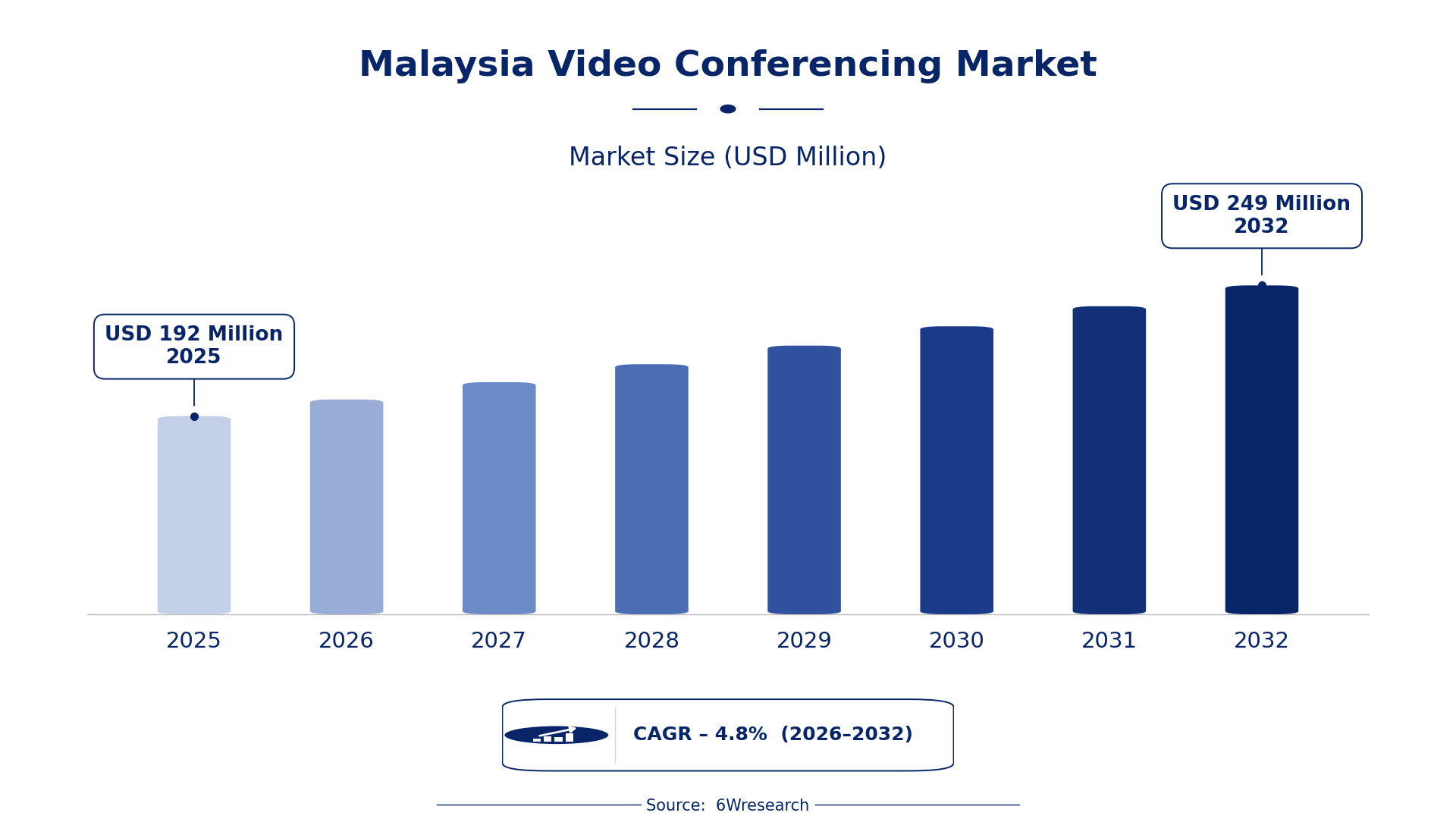
The Malaysia Video Conferencing Market was estimated at USD 192 Million in 2025 and is projected to reach USD 249 Million by 2032, growing at a CAGR of 4.8% from 2026 to 2032.
Malaysia Video Conferencing Market Synopsis
The Malaysia video conferencing market has surged in recent years, spurred by the urgent need for effective remote communication solutions. As companies adapt to flexible working arrangements, the demand for these technologies continues to rise, reshaping how organizations interact.
Looking ahead, this market is set to maintain its growth trajectory. Factors such as increased internet penetration and the ongoing digitization of various sectors will likely bolster the adoption of video conferencing tools across Malaysia.
Malaysia Video Conferencing Market Year-wise Growth Rate and Key Drivers
This graph illustrates the annual growth rates of the Malaysia Video Conferencing Market from 2021 to 2032, highlighting a steady upward trajectory and projected expansion over the forecast period.
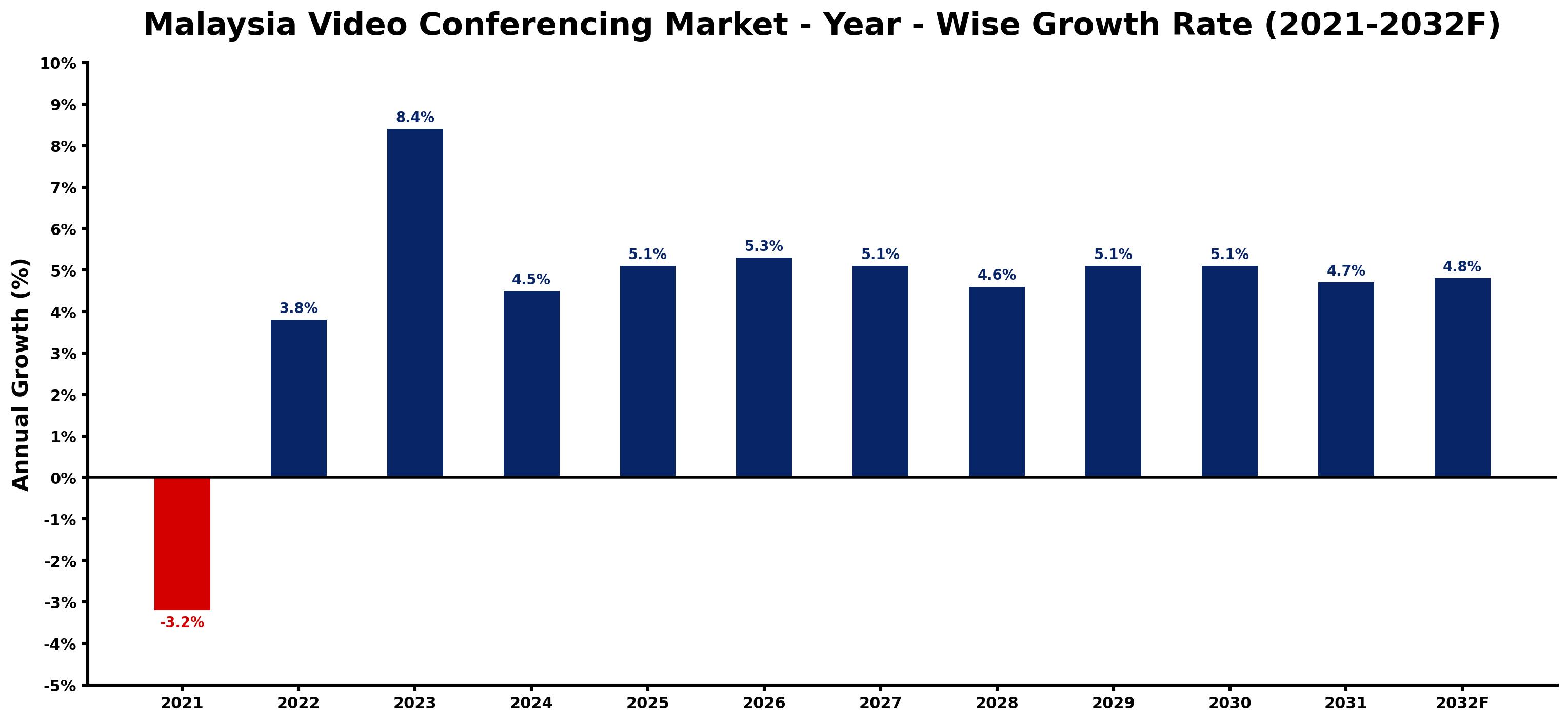
The table below presents the year‑wise growth rates along with the key drivers influencing the market
| Year | Growth Rate | Major Drivers |
| 2021 | -3.2% | MCO restrictions limited corporate investment in technology upgrades. |
| 2022 | 3.8% | Widespread remote work policies driving video adoption. |
| 2023 | 8.4% | Government digitalization initiatives increasing telecommunication capabilities. |
| 2024 | 4.5% | New e-learning programs enhancing educational video conferencing use. |
| 2025 | 5.1% | Corporate restructuring favoring virtual team collaboration tools. |
| 2026 | 5.3% | Increased healthcare teleconsultation services requiring video solutions. |
| 2027 | 5.1% | Surge in multinational firms needing cross-border communication tools. |
| 2028 | 4.6% | Local tech startups innovating video solutions for SMEs. |
| 2029 | 5.1% | Regulatory support for digital communication technologies boosting growth. |
| 2030 | 5.1% | Rising number of online events increasing video platform usage. |
| 2031 | 4.7% | Enhanced cybersecurity measures promoting secure video conferencing solutions. |
| 2032 | 4.8% | Growing interest in virtual events driving demand for conferencing. |
Note: Market size estimations and growth projections presented in this report are based on 6Wresearch's proprietary forecasting methodology, utilizing the latest available industry data, government publications, and primary research inputs.
Malaysia Video Conferencing Market Key Takeaways
Below are some of the specific key takeaways from the market, including:
- The market is experiencing a steady growth rate driven by the ongoing trend toward remote work.
- Investment in high-speed internet infrastructure is crucial for overcoming connectivity issues.
- Security concerns surrounding data protection are prompting users to seek more secure platforms.
- Increased collaboration features are becoming a vital component of video conferencing solutions.
- Educational institutions are significantly driving demand as they adopt these technologies for remote learning.
Evaluation of Restraints in Malaysia Video Conferencing Market
Despite its rapid growth, the Malaysia video conferencing market faces notable challenges. Limited network infrastructure, especially in rural areas, restricts access to high-quality video services. Additionally, security issues pose a significant hurdle. Organizations are increasingly concerned about data breaches and cyber threats, necessitating greater investments in security measures. Addressing these challenges is crucial for sustained market growth.
Malaysia Video Conferencing Market Trends
Several key trends are shaping the Malaysia video conferencing market. The integration of artificial intelligence in video conferencing tools is enhancing user experience through features like automated transcription and real-time translation. on top of that, the rise of hybrid work environments is driving demand for flexible and scalable solutions that can accommodate both in-office and remote participants. As organizations prioritize employee engagement, the emphasis on interactive features will also grow.
Malaysia Video Conferencing Market Opportunities
Opportunities abound for growth in the Malaysia video conferencing market, particularly in sectors like education and healthcare. The education sector's shift towards online learning creates a demand for versatile and user-friendly platforms. Similarly, the healthcare industry's increasing reliance on telemedicine solutions presents significant investment avenues. on top of that, partnerships between technology providers and local businesses can facilitate tailored solutions that meet specific market needs.
Government Initiatives in the Malaysia Video Conferencing Market
Government policy is playing a crucial role in shaping the Malaysia video conferencing market. With a focus on enhancing digital infrastructure, the government is prioritizing initiatives that support remote collaboration technologies. Public sector efforts to improve internet accessibility and security regulations are vital for the market's future development.
- A national digital infrastructure upgrade programme aimed at enhancing broadband connectivity, recently launched in early 2025.
- Ongoing initiatives to promote digital literacy among the workforce, which includes training on video conferencing tools and best practices.
- A regulatory framework introduced in 2025 mandating data protection standards specifically for video conferencing services.
- Upcoming public-private partnerships planned for 2027 that will focus on expanding access to video conferencing technology in rural areas.
Future Insights of the Malaysia Video Conferencing Market
From 2026 to 2032, the Malaysia video conferencing market is expected to continue evolving. With advancements in technology and increasing user expectations, companies will need to innovate constantly. Enhanced security features, integration with other collaborative tools, and improved user interfaces will be essential to capture a larger market share. Organizations that adapt to these changes will likely emerge as leaders in this growing sector.
Malaysia Video Conferencing Market Latest Developments
Recent activity in the Malaysia video conferencing market indicates a strong push towards technological enhancements and user-centric solutions. In the last year, several key developments have taken place, reflecting the industry's response to evolving demands.
- A leading technology vendor launched an upgraded video conferencing platform in Q2 2025, featuring enhanced security protocols and user experience improvements.
- An ongoing collaboration between educational institutions and tech companies aims to provide specialized video conferencing tools for remote learning, initiated in early 2025.
- A major regional operator is currently testing a new high-bandwidth video conferencing solution expected to improve service in underserved areas, with trials set to conclude by late 2025.
- A public initiative to integrate video conferencing tools into government services is planned for mid-2026, enhancing accessibility for citizens.
Malaysia Video Conferencing Market - Key Attractiveness of the Report
- 10 Years of Market Numbers
- Historical Data Starting from 2022 to 2025
- Base Year: 2025
- Forecast Data until 2032
- Key Performance Indicators Impacting the Market
- Major Upcoming Developments and Projects
Key Highlights of the Report:
- Malaysia Video Conferencing Market Outlook
- Market Size of Malaysia Video Conferencing Market, 2025
- Forecast of Malaysia Video Conferencing Market, 2032
- Historical Data and Forecast of Malaysia Video Conferencing Revenues & Volume for the Period 2022-2032F
- Malaysia Video Conferencing Market Trend Evolution
- Malaysia Video Conferencing Market Drivers and Challenges
- Malaysia Video Conferencing Price Trends
- Malaysia Video Conferencing Porter's Five Forces
- Malaysia Video Conferencing Industry Life Cycle
- Historical Data and Forecast of Malaysia Video Conferencing Market Revenues & Volume By Component for the Period 2022-2032F
- Historical Data and Forecast of Malaysia Video Conferencing Market Revenues & Volume By Hardware for the Period 2022-2032F
- Historical Data and Forecast of Malaysia Video Conferencing Market Revenues & Volume By Solutions for the Period 2022-2032F
- Historical Data and Forecast of Malaysia Video Conferencing Market Revenues & Volume By Services for the Period 2022-2032F
- Historical Data and Forecast of Malaysia Video Conferencing Market Revenues & Volume By Application for the Period 2022-2032F
- Historical Data and Forecast of Malaysia Video Conferencing Market Revenues & Volume By Corporate Communications for the Period 2022-2032F
- Historical Data and Forecast of Malaysia Video Conferencing Market Revenues & Volume By Training for the Period 2022-2032F
- Historical Data and Forecast of Malaysia Video Conferencing Market Revenues & Volume By Development for the Period 2022-2032F
- Historical Data and Forecast of Malaysia Video Conferencing Market Revenues & Volume By Marketing & Client Engagement for the Period 2022-2032F
- Historical Data and Forecast of Malaysia Video Conferencing Market Revenues & Volume By Deployment Mode for the Period 2022-2032F
- Historical Data and Forecast of Malaysia Video Conferencing Market Revenues & Volume By On-premises for the Period 2022-2032F
- Historical Data and Forecast of Malaysia Video Conferencing Market Revenues & Volume By Cloud for the Period 2022-2032F
- Historical Data and Forecast of Malaysia Video Conferencing Market Revenues & Volume By Vertical for the Period 2022-2032F
- Historical Data and Forecast of Malaysia Video Conferencing Market Revenues & Volume By BFSI for the Period 2022-2032F
- Historical Data and Forecast of Malaysia Video Conferencing Market Revenues & Volume By IT and Telecom for the Period 2022-2032F
- Historical Data and Forecast of Malaysia Video Conferencing Market Revenues & Volume By Healthcare & Lifescience for the Period 2022-2032F
- Historical Data and Forecast of Malaysia Video Conferencing Market Revenues & Volume By Education for the Period 2022-2032F
- Historical Data and Forecast of Malaysia Video Conferencing Market Revenues & Volume By Media and Entertainment for the Period 2022-2032F
- Historical Data and Forecast of Malaysia Video Conferencing Market Revenues & Volume By Other Verticals for the Period 2022-2032F
- Malaysia Video Conferencing Import Export Trade Statistics
- Market Opportunity Assessment By Component
- Market Opportunity Assessment By Application
- Market Opportunity Assessment By Deployment Mode
- Market Opportunity Assessment By Vertical
- Malaysia Video Conferencing Top Companies Market Share
- Malaysia Video Conferencing Competitive Benchmarking By Technical and Operational Parameters
- Malaysia Video Conferencing Company Profiles
- Malaysia Video Conferencing Key Strategic Recommendations






































