Malaysia Viscose Filament Yarns Market Size, Share & Growth Rate
The Malaysia Viscose Filament Yarns Market was estimated at USD 159 Million in 2025 and is projected to reach USD 205 Million by 2032, growing at a CAGR of 3.7% from 2026 to 2032. This projected growth is primarily fueled by the rebound in consumer spending as the economy stabilizes post-pandemic, alongside an increasing appetite for sustainable and eco-friendly textiles within the fashion and apparel industries. The rising investments in textile manufacturing technology further bolster this growth trajectory, ensuring that Malaysia remains a competitive player in the regional market.
Malaysia Viscose Filament Yarns Market Year-wise Growth Rate and Key Drivers
This graph highlights how the Malaysia Viscose Filament Yarns Market has steadily grown over the years, supported by major growth factors.
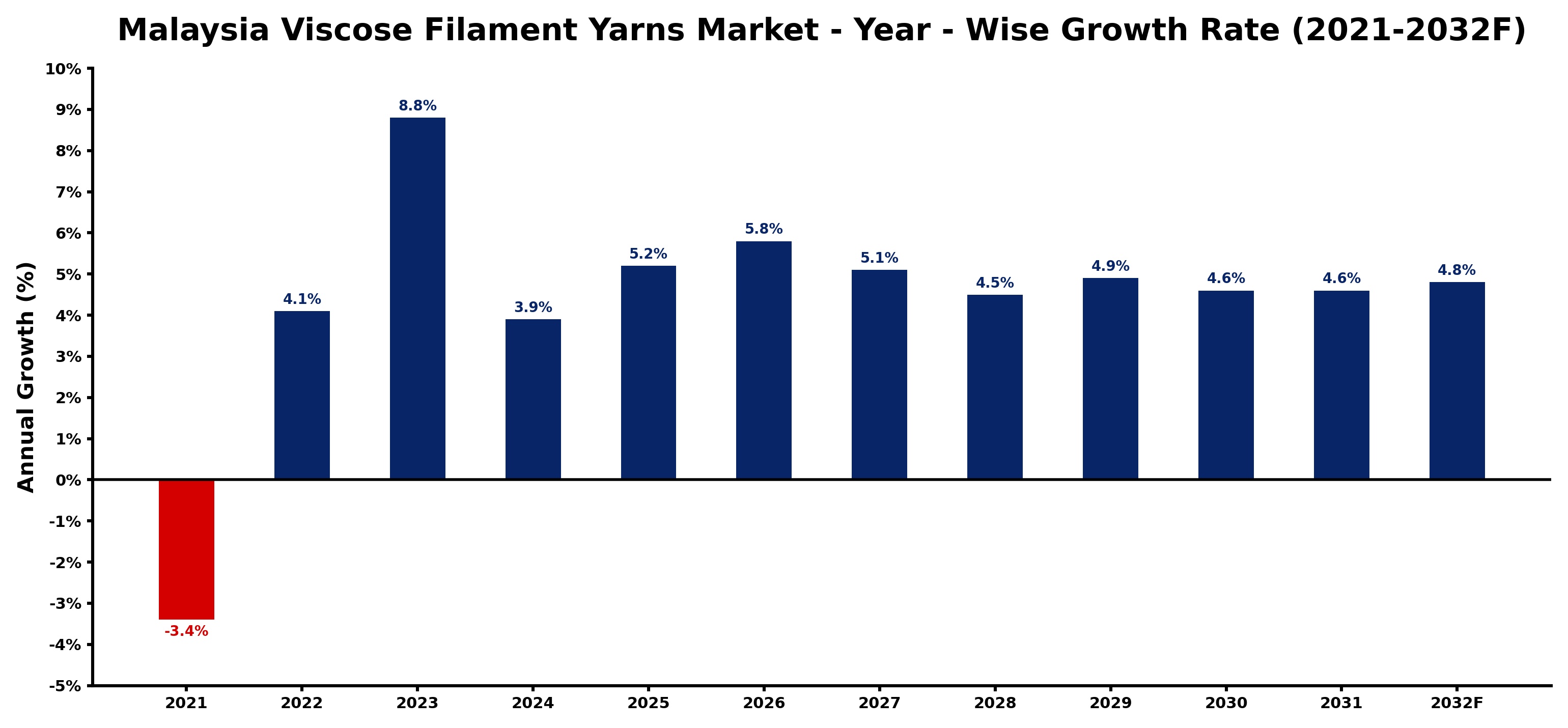
The table below presents the year‑wise growth rates along with the key drivers influencing the market
| Year | Growth Rate | Major Drivers |
| 2021 | -3.4% | Reduced export orders caused decreased production of filament yarns |
| 2022 | 4.1% | Increased foreign investment drives expansion of textile manufacturing capacity |
| 2023 | 8.8% | Domestic textile manufacturers optimized production lines for export readiness |
| 2024 | 3.9% | Smart manufacturing adoption boosted yarn production efficiency and exports |
| 2025 | 5.2% | Manufacturing investments in automation boost yarn production efficiency |
| 2026 | 5.8% | Regional textile manufacturers ramped up filament yarn production volumes |
| 2027 | 5.1% | Technological upgrades in spinning mills boost yarn production efficiency |
| 2028 | 4.5% | Textile sector investments boosted Malaysian viscose filament yarn output |
| 2029 | 4.9% | Foreign investments boosted high tech textile manufacturing capacity in Malaysia |
| 2030 | 4.6% | Improved yarn production efficiency boosted export market competitiveness |
| 2031 | 4.6% | Precision engineering advancements boost efficiency in filament yarn production |
| 2032 | 4.8% | Revived automotive sector spurred demand for high quality filament yarns |
Note - Market size estimations and growth projections presented in this report are based on 6Wresearch’s advanced forecasting approach, validated with industry datasets as of June 2026.
Malaysia Viscose Filament Yarns Market Synopsis
A notable trend in the Malaysia viscose filament yarn market is the shift towards sustainable practices. As consumers become more environmentally conscious, manufacturers are adapting their processes to meet this growing demand for eco-friendly products. This evolution is creating new opportunities for viscose filament yarns, as they are derived from natural cellulose fibers, appealing to the sustainability-focused market segment.
Moreover, the versatility of viscose filament yarns is expanding their applications beyond traditional apparel, penetrating sectors such as home furnishings and industrial textiles. As Malaysia's textile industry recovers and evolves, the adoption of these yarns is expected to gain momentum, further solidifying their importance in the manufacturing process.
Malaysia Viscose Filament Yarns Market Key Takeaways
- The market is witnessing growth due to the rising demand for sustainable textiles.
- Investment in technology and manufacturing processes is key to maintaining competitive advantages.
- Post-pandemic economic recovery is leading to an increase in consumer spending.
- Applications are broadening beyond clothing to include home furnishings and industrial uses.
- Environmental concerns surrounding production methods necessitate advancements in sustainability.
Evaluation of Restraints in Malaysia Viscose Filament Yarns Market
The Malaysia viscose filament yarn market does face significant constraints, particularly related to sustainability and environmental concerns. The production of viscose filament yarns involves chemical processes that can be harmful if not managed properly. This has led to increased scrutiny from consumers and regulatory bodies alike, demanding greater transparency and accountability. As such, companies are under pressure to innovate their production methods to mitigate environmental impacts while simultaneously addressing consumer concerns about sustainability and ethical sourcing.
Malaysia Viscose Filament Yarns Market Trends
Current trends indicate a robust shift toward the adoption of circular economy principles within the viscose filament yarn sector. The increasing prevalence of recycled materials is reshaping how manufacturers source their inputs, fostering a growing interest in sustainable supply chains. Concurrently, technological advancements in textile manufacturing, such as automation and digitalization, are becoming pivotal. These innovations not only streamline production but also enhance the quality of the yarns produced, further driving market growth.
Malaysia Viscose Filament Yarns Market Opportunities
As the demand for eco-friendly textiles rises, the Malaysia viscose filament yarn market presents compelling investment opportunities. Companies that focus on developing innovative and sustainable yarn production processes are likely to capture significant market share. Furthermore, expanding into emerging markets within Southeast Asia could provide additional avenues for growth, given the rising consumer demand for quality textiles. Capitalizing on these trends can position businesses favorably for long-term success.
Government Initiatives in the Malaysia Viscose Filament Yarns Market
The Malaysian government has been actively promoting policies that encourage sustainable practices within the textile sector. Initiatives aimed at improving resource efficiency and reducing environmental impact are becoming more prevalent, which aligns with global sustainability goals. By fostering public-private partnerships and supporting research and development, the government is paving the way for innovations that could benefit the viscose filament yarn market. These efforts signal a commitment to nurturing a sustainable textile industry while enhancing Malaysia's competitive edge.
Future Insights of the Malaysia Viscose Filament Yarns Market
Looking forward, the Malaysia viscose filament yarn market is poised for a transformative period through 2026-2032. As consumer preferences lean towards sustainable and ethically produced products, market players will need to adapt quickly to remain relevant. The anticipated growth in manufacturing capabilities will likely result in enhanced product offerings, meeting both aesthetic and environmental demands. This dual focus on quality and sustainability is essential for capturing emerging market segments, reinforcing Malaysia's position as a key player in the regional textile landscape.
Malaysia Viscose Filament Yarns Market Latest Developments (May 2025 - June 2026)
Recent developments in the Malaysia viscose filament yarn market indicate a strong push towards adopting innovative production technologies that emphasize sustainability. Companies are increasingly exploring partnerships to enhance their sustainability credentials, seeking to reduce waste and improve energy efficiency in production processes. Additionally, the growing interest in eco-friendly textiles has prompted various stakeholders to engage in initiatives aimed at promoting awareness and education around the benefits of viscose filament yarns.
Malaysia Viscose Filament Yarns Market - Key Attractiveness of the Report
- 10 Years of Market Numbers
- Historical Data Starting from 2022 to 2025
- Base Year: 2025
- Forecast Data until 2032
- Key Performance Indicators Impacting the Market
- Major Upcoming Developments and Projects
Key Highlights of the Report:
- Malaysia Viscose Filament Yarns Market Outlook
- Market Size of Malaysia Viscose Filament Yarns Market, 2025
- Forecast of Malaysia Viscose Filament Yarns Market, 2032
- Historical Data and Forecast of Malaysia Viscose Filament Yarns Revenues & Volume for the Period 2022-2032F
- Malaysia Viscose Filament Yarns Market Trend Evolution
- Malaysia Viscose Filament Yarns Market Drivers and Challenges
- Malaysia Viscose Filament Yarns Price Trends
- Malaysia Viscose Filament Yarns Porter's Five Forces
- Malaysia Viscose Filament Yarns Industry Life Cycle
- Historical Data and Forecast of Malaysia Viscose Filament Yarns Market Revenues & Volume By Type for the Period 2022-2032F
- Historical Data and Forecast of Malaysia Viscose Filament Yarns Market Revenues & Volume By Continuous for the Period 2022-2032F
- Historical Data and Forecast of Malaysia Viscose Filament Yarns Market Revenues & Volume By Semi-contunuous for the Period 2022-2032F
- Historical Data and Forecast of Malaysia Viscose Filament Yarns Market Revenues & Volume By Application for the Period 2022-2032F
- Historical Data and Forecast of Malaysia Viscose Filament Yarns Market Revenues & Volume By Garment industry for the Period 2022-2032F
- Historical Data and Forecast of Malaysia Viscose Filament Yarns Market Revenues & Volume By Auto industry for the Period 2022-2032F
- Historical Data and Forecast of Malaysia Viscose Filament Yarns Market Revenues & Volume By other for the Period 2022-2032F
- Malaysia Viscose Filament Yarns Import Export Trade Statistics
- Market Opportunity Assessment By Type
- Market Opportunity Assessment By Application
- Malaysia Viscose Filament Yarns Top Companies Market Share
- Malaysia Viscose Filament Yarns Competitive Benchmarking By Technical and Operational Parameters
- Malaysia Viscose Filament Yarns Company Profiles
- Malaysia Viscose Filament Yarns Key Strategic Recommendations






































