Malaysia Water & Wastewater Treatment Market Summary
The malaysia water & wastewater treatment market was estimated at USD 239 Million in 2025 and is projected to reach USD 311 Million by 2032, growing at a CAGR of 5.6% from 2026 to 2032.
Malaysia Water & Wastewater Treatment Market Year-wise Growth Rate and Key Drivers
This graph highlights how the Malaysia Water & Wastewater Treatment Market has steadily grown over the past five years, supported by major growth factors.
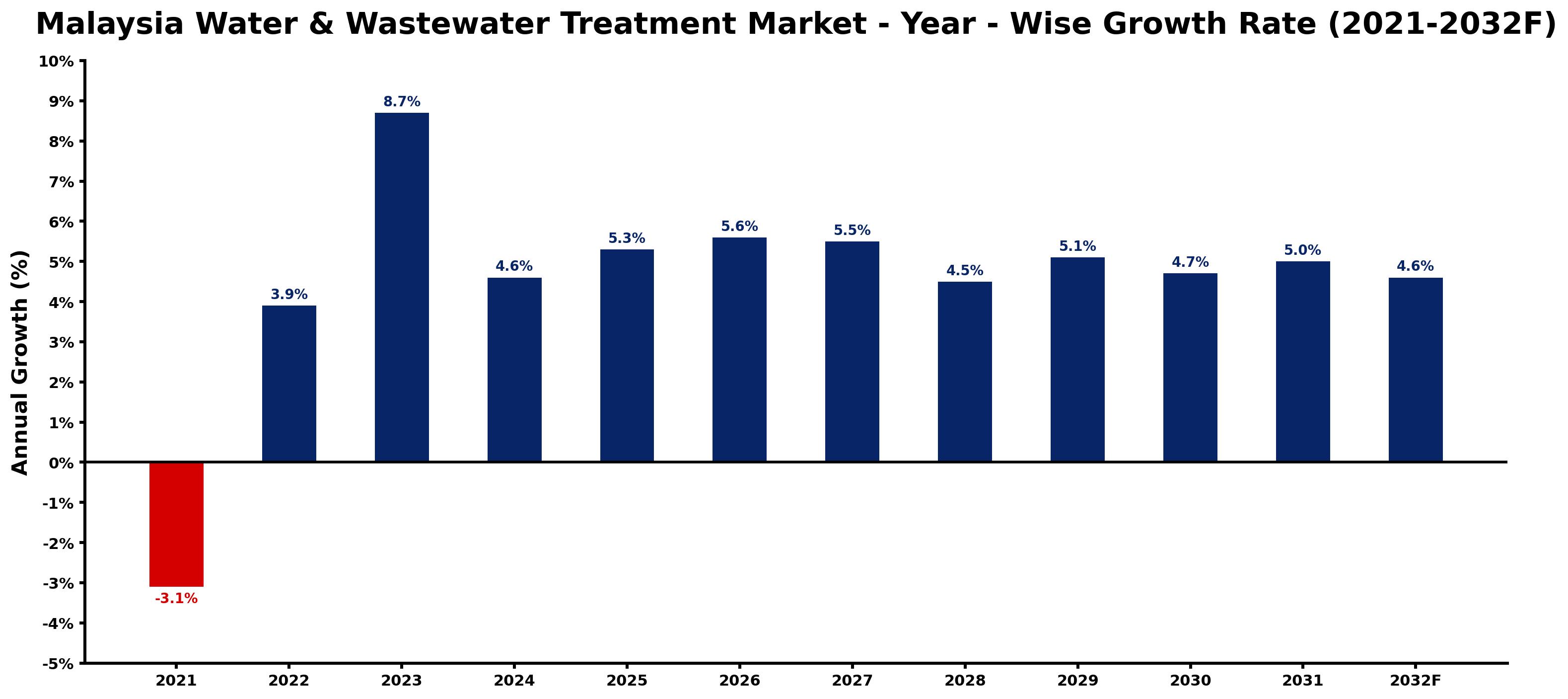
The table below presents the year wise growth rates along with the key drivers influencing the market
| Year | Growth Rate | Major Drivers |
| 2021 | -3.1% | Pandemicrelated restrictions hampered infrastructure projects, leading to decreased investment in water treatment facilities. |
| 2022 | 3.9% | Increased urbanization led to higher demand for comprehensive water management solutions. |
| 2023 | 8.7% | Public awareness of water scarcity initiated community-driven conservation efforts across Malaysia. |
| 2024 | 4.6% | Technological innovations in filtration introduced cost-effective alternatives for wastewater processing. |
| 2025 | 5.3% | Collaboration with international firms enhanced local expertise in sustainable water practices. |
| 2026 | 5.6% | The hospitality sector's expansion necessitated robust water treatment systems for compliance. |
| 2027 | 5.5% | Climate change impacts prompted businesses to reassess their water usage and treatment strategies. |
| 2028 | 4.5% | Emerging industries demanded reliable wastewater services to maintain operational efficiency. |
| 2029 | 5.1% | Legacy infrastructure challenges underscored the urgency for new treatment facility investments. |
| 2030 | 4.7% | Increased agriculture efficiency tied directly to advanced irrigation and wastewater recycling techniques. |
| 2031 | 5.0% | Consumer preferences shifted toward eco-friendly products, influencing water treatment practices. |
| 2032 | 4.6% | Long-term planning for urban growth emphasized integrated water management as a priority. |
Note - Market size estimations and growth projections presented in this report are based on 6Wresearch's advanced forecasting approach, validated with industry datasets as of June 2026.
Malaysia Water & Wastewater Treatment Market Synopsis
The Malaysia Water Wastewater Treatment Market is projected to reach 5.6% and witness significant growth during the forecast period (2026-2032). This growth is largely driven by the increasing population and rapid industrialization in the region, which have resulted in heightened domestic and industrial wastewater discharges. An inadequate sewage infrastructure, combined with improper disposal methods, has intensified the need for effective treatment solutions across the country.
Malaysia Water & Wastewater Treatment Market Growth Drivers
Several key factors are propelling growth in the Malaysia water & wastewater treatment market, including:
- The escalating population in urban areas is leading to higher wastewater generation, necessitating improved treatment capabilities to safeguard public health and the environment.
- Increased industrial activities across sectors such as manufacturing, oil & gas, and pharmaceuticals are generating significant volumes of wastewater, which must be treated to comply with environmental regulations.
- Stringent government regulations regarding environmental protection are encouraging both public and private sectors to invest in advanced water treatment technologies.
- Urbanization is prompting construction initiatives, including the upgrade of existing municipal sewerage systems and the development of new sewer networks, further stimulating market progress.
- Growing public-private partnerships are fostering collaborations that drive innovation and the adoption of state-of-the-art waste management technologies.
Malaysia Water & Wastewater Treatment Market Trends and Opportunities
The Malaysia water & wastewater treatment market is positioned to benefit from various emerging trends, including:
- A shift towards the adoption of smart metering devices is enhancing operational efficiency and enabling better monitoring of water supply and consumption.
- Investment in research and development of cutting-edge treatment technologies is expected to create a competitive advantage for companies focused on sustainability.
- The integration of advanced monitoring systems allows for real-time analysis and quicker response to water quality issues, promoting both compliance and safety.
- Renewable energy incorporation in wastewater treatment processes is gaining traction, contributing to the overall sustainability of the treatment infrastructure.
- Increased awareness among consumers regarding environmental protection is catalyzing demand for eco-friendly treatment solutions.
Malaysia Water & Wastewater Treatment Market Challenges and Restraints
Despite the growth potential, the Malaysia water & wastewater treatment market faces several challenges, including:
- Limited access to funding and investment in advanced infrastructure could hinder the adoption of new technologies.
- Technical challenges associated with integrating new waste treatment solutions into existing systems may impede progress.
- Regulatory compliance can be complex, posing a challenge for industries looking to meet stringent environmental standards.
- Public resistance to changes in waste management practices might slow the implementation of new systems.
- Maintaining a skilled labor force familiar with advanced treatment technologies is essential yet challenging in the current market landscape.
Malaysia Water & Wastewater Treatment Market Government Investment and Initiatives
The Malaysian government's focus on environmental sustainability has resulted in significant investment and initiatives aimed at improving water & wastewater treatment infrastructure. Policies promoting environmental protection have led to increased public spending on upgrading existing treatment facilities and constructing new sewerage systems. Various programs are designed to facilitate public-private partnerships, encouraging collaborative efforts between government agencies and industry stakeholders to enhance wastewater management practices.
Additionally, the government has introduced incentives for organizations committing to sustainable practices, thereby fostering a conducive environment for innovative water treatment solutions. Comprehensive development plans outlining long-term infrastructure improvements are also in place, aimed at addressing the demands of urban growth and protecting natural water resources.
Malaysia Water & Wastewater Treatment Market Latest Developments (May 2025 - June 2026)
Recent developments in the Malaysia water & wastewater treatment market highlight ongoing trends emphasizing sustainability and technological advancement. Innovations in low-energy wastewater treatment technologies have gained traction, with several projects focusing on energy-efficient processes. Moreover, partnerships between public and private sectors have increasingly emphasized the need for capacity building and knowledge transfer to enhance system efficiency.
Industry stakeholders are also exploring digital solutions, such as Internet of Things (IoT) applications, aimed at optimizing water management and treatment operations. This period has seen a renewed commitment to tackling environmental challenges through comprehensive water treatment approaches, which align with national goals of sustainability and resource conservation.
Malaysia Water & Wastewater Treatment Market - Key Attractiveness of the Report
- 10 Years of Market Numbers
- Historical Data Starting from 2022 to 2025
- Base Year: 2025
- Forecast Data until 2032
- Key Performance Indicators Impacting the Market
- Major Upcoming Developments and Projects
Key Highlights of the Report:
- Malaysia Water & Wastewater Treatment Market Outlook
- Market Size of Malaysia Water & Wastewater Treatment Market, 2025
- Forecast of Malaysia Water & Wastewater Treatment Market, 2032
- Historical Data and Forecast of Malaysia Water & Wastewater Treatment Revenues & Volume for the Period 2022-2032F
- Malaysia Water & Wastewater Treatment Market Trend Evolution
- Malaysia Water & Wastewater Treatment Market Drivers and Challenges
- Malaysia Water & Wastewater Treatment Price Trends
- Malaysia Water & Wastewater Treatment Porter's Five Forces
- Malaysia Water & Wastewater Treatment Industry Life Cycle
- Historical Data and Forecast of Malaysia Water & Wastewater Treatment Market Revenues & Volume By Product Category????????????? for the Period 2022-2032F
- Historical Data and Forecast of Malaysia Water & Wastewater Treatment Market Revenues & Volume By Treatment Technologies for the Period 2022-2032F
- Historical Data and Forecast of Malaysia Water & Wastewater Treatment Market Revenues & Volume By Delivery Equipment for the Period 2022-2032F
- Historical Data and Forecast of Malaysia Water & Wastewater Treatment Market Revenues & Volume By Treatment Chemicals for the Period 2022-2032F
- Historical Data and Forecast of Malaysia Water & Wastewater Treatment Market Revenues & Volume By Instrumentation for the Period 2022-2032F
- Historical Data and Forecast of Malaysia Water & Wastewater Treatment Market Revenues & Volume By Applications for the Period 2022-2032F
- Historical Data and Forecast of Malaysia Water & Wastewater Treatment Market Revenues & Volume By Municipal for the Period 2022-2032F
- Historical Data and Forecast of Malaysia Water & Wastewater Treatment Market Revenues & Volume By Industrial for the Period 2022-2032F
- Malaysia Water & Wastewater Treatment Import Export Trade Statistics
- Market Opportunity Assessment By Product Category?????????????
- Market Opportunity Assessment By Applications
- Malaysia Water & Wastewater Treatment Top Companies Market Share
- Malaysia Water & Wastewater Treatment Competitive Benchmarking By Technical and Operational Parameters
- Malaysia Water & Wastewater Treatment Company Profiles
- Malaysia Water & Wastewater Treatment Key Strategic Recommendations






































